

In this article
- 1. What Is the NAR1 Form in Hong Kong?
- 2. Why Does the Companies Registry Require the NAR1 Form?
- 3. What Is the Legal Basis for the NAR1 Form?
- 4. Who Needs to File an NAR1 Form?
- 5. What Information Must Be Included in an NAR1 Form?
- 6. When Is the NAR1 Form Due?
- 7. How Can a Company Submit an NAR1 Form?
- 8. What Happens If You Miss the NAR1 Filing Deadline?
- 9. Can a Company File an NAR1 Form If Nothing Has Changed?
- 10. Do Dormant Companies Need to File an NAR1 Form?
- 11. NAR1 Form FAQs
Many Hong Kong companies spend a lot of time thinking about taxes, audits, payroll, and bank compliance. Yet one of the most commonly missed corporate obligations has nothing to do with tax at all. It’s the NAR1 Form.
Every year, company secretaries receive urgent calls from directors who suddenly discover that their annual return is overdue. Sometimes the company has been operating normally for years. Taxes have been filed. Audit reports have been completed. The bank account is active.
Then a routine due diligence exercise, bank review, funding application, or corporate restructuring reveals that the company’s NAR1 filing has been neglected. At that point, late filing fees can become surprisingly expensive.
The NAR1 Form sits at the centre of Hong Kong’s annual corporate compliance framework. It is not a tax document and does not report company profits. Instead, it serves as an official confirmation of key company information maintained by the Companies Registry Hong Kong.
What Is the NAR1 Form in Hong Kong?
The NAR1 Form is the statutory Annual Return filed by Hong Kong incorporated companies with the Companies Registry. “NAR1” is simply the form number assigned to the annual return document.
The purpose of the filing is straightforward. It provides an annual snapshot of a company’s corporate information and confirms that the public records held by the Companies Registry remain accurate.
The filing contains details such as:
- Company name
- Registered office address
- Directors
- Company secretary
- Shareholders
- Share capital structure
- Company registration information
Think of the NAR1 Form as a yearly confirmation of who the company is, who manages it, and how it is structured. It is one of the core obligations under Hong Kong corporate law and forms part of the ongoing compliance requirements for incorporated companies.
Read also: Filing Profit Tax Returns in Hong Kong
Why Does the Companies Registry Require the NAR1 Form?
Hong Kong maintains one of the world’s most transparent corporate registration systems. The Companies Registry keeps public records so that investors, banks, regulators, suppliers, customers, and business partners can verify basic company information.
Without annual confirmation, the register would quickly become outdated. Imagine a company that changed directors three years ago, moved offices twice, and appointed a new company secretary. If those details were never maintained, anyone relying on the registry could be working with inaccurate information.
The NAR1 filing helps prevent that. It creates accountability and ensures that corporate records remain reliable for commercial and regulatory purposes.
When banks perform due diligence reviews, one of the first places they often check is the Companies Registry database. The same applies to investors, auditors, compliance teams, and potential business partners.
Read also: Companies Ordinance Impact on Hiring & Payroll (2026)
What Is the Legal Basis for the NAR1 Form?
The requirement comes from the Companies Ordinance (Cap. 622). Under the Companies Ordinance, Hong Kong companies must maintain accurate corporate records and file annual returns within prescribed deadlines.
Failure to comply is not treated as a minor administrative oversight. The law places responsibility on both the company and its officers to ensure filing obligations are met. That is why annual return penalties Hong Kong authorities impose can escalate quickly once filing deadlines are missed.
Read also: IR56 Forms for Employers in Hong Kong : A Brief Study
Who Needs to File an NAR1 Form?
Most Hong Kong private limited companies must file an NAR1 Form every year. This includes:
- Startups
- SMEs
- Family-owned businesses
- Holding companies
- Foreign-owned subsidiaries
- Investment companies
- Trading businesses
- Professional service firms
Many overseas entrepreneurs assume that because their Hong Kong company is inactive or generating little revenue, annual return obligations do not apply. That assumption often leads to compliance problems. As long as the company remains incorporated and has not been formally deregistered, annual return filing obligations generally continue.
Read also: IR56B: Hong Kong’s Essential Remuneration Reporting
What Information Must Be Included in an NAR1 Form?
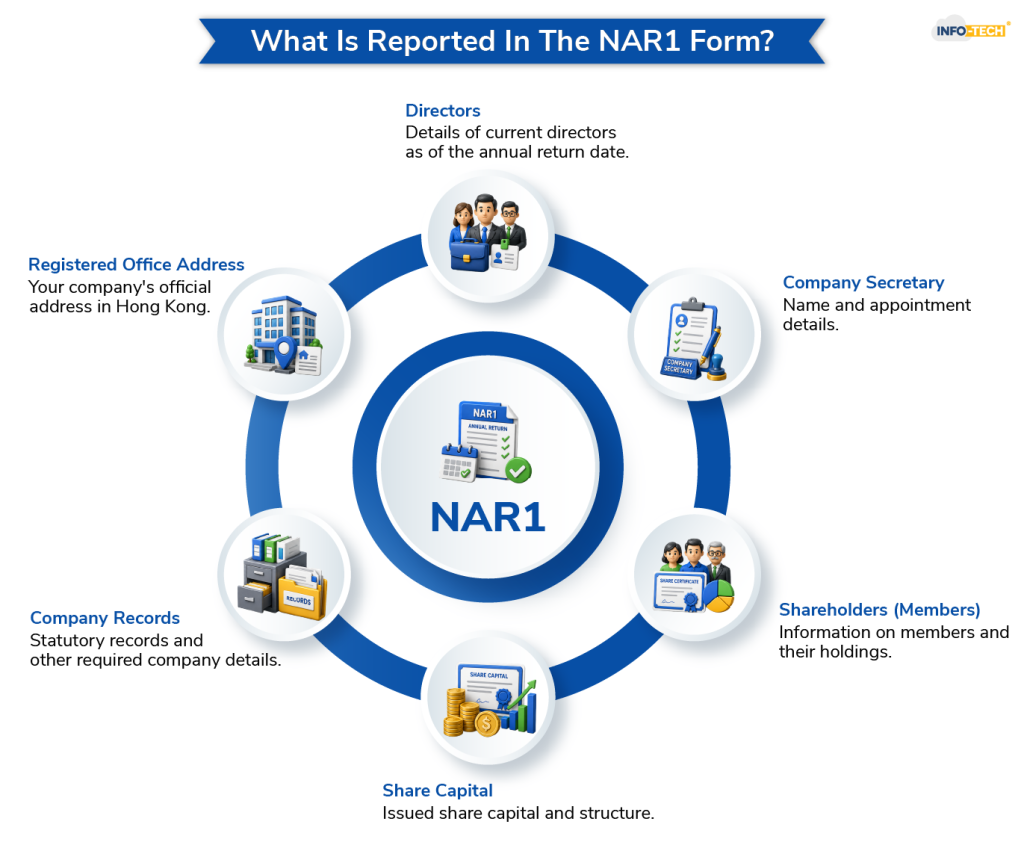
The NAR1 Form is designed to provide a current picture of the company’s corporate structure.
Registered Office Address
Every Hong Kong company must maintain a registered office address in Hong Kong. The address recorded in the annual return must match official company records. If the company has relocated during the year, the updated address should already have been reported through the appropriate filing procedures.
Directors
The annual return records the company’s directors. This includes details relating to individuals responsible for managing the company and making strategic decisions. Accurate director records are particularly important because banks, investors, and regulators frequently review them during compliance checks.
Company Secretary
Every Hong Kong company must appoint a company secretary. The NAR1 confirms the secretary’s details and ensures the public register remains up to date.
Shareholders and Members
The form records ownership information and identifies the company’s members. This helps maintain transparency regarding company ownership and control.
Share Capital Structure
Information regarding issued shares and share capital must also be reflected accurately. Any changes in share allotments or restructuring activities should already have been properly filed before the annual return is submitted.
Corporate Records
The filing acts as a confirmation that the company’s statutory records remain accurate and properly maintained.
Read also: What is IR56F Form and How to Fill It
When Is the NAR1 Form Due?
For private limited companies, timing revolves around one important date: the company’s anniversary of incorporation. The annual return must be filed within 42 days after the incorporation anniversary each year.
Many directors mistakenly assume that filing deadlines align with financial year-end dates or tax return deadlines. They do not. The deadline is linked to the incorporation anniversary.
Example
| Event | Date |
|---|---|
| Company incorporated | 15 July 2025 |
| Anniversary date | 15 July 2026 |
| Filing deadline | 26 August 2026 |
The 42-day filing window begins immediately after the anniversary date.
Missing that window triggers higher filing fees.
How Can a Company Submit an NAR1 Form?
Companies can submit their Hong Kong Annual Return through:
- Electronic filing
- Paper filing
Electronic filing has become increasingly popular because it is faster and generally easier to track.
As digital compliance systems continue to evolve, more companies are moving toward electronic filing and digital record management.
For businesses managing multiple compliance obligations, electronic submissions also reduce the risk of administrative errors.
Read also: IR56G Filing Guide for Departing Employees in Hong Kong
What Happens If You Miss the NAR1 Filing Deadline?
This is where many businesses get an unpleasant surprise. The government filing fee increases significantly once the filing becomes late. The longer the delay, the more expensive it becomes.
Late Filing Fee Structure for Private Companies
| Filing Time | Government Fee |
|---|---|
| Within 42 days | HK$105 |
| More than 42 days but within 3 months | HK$870 |
| More than 3 months but within 6 months | HK$1,740 |
| More than 6 months but within 9 months | HK$2,610 |
| More than 9 months | HK$3,480 |
A company that misses several years of annual returns can quickly accumulate substantial compliance costs.
The financial penalties are only part of the problem. Persistent non-compliance may expose directors to enforcement action and can create difficulties when dealing with banks, investors, regulators, or future business transactions.
Read also: IR56M, The Non-Employee Tax Rule Businesses Often Overlook
Can a Company File an NAR1 Form If Nothing Has Changed?
Yes. In fact, that is often exactly what happens. The annual return is not only for reporting changes. It is also a confirmation that existing information remains correct.
Even if:
- Directors remain the same
- Shareholders remain the same
- Office address remains the same
- Company secretary remains the same
The filing is still required. A common misconception is that companies only file when updates occur. The law does not work that way.
Do Dormant Companies Need to File an NAR1 Form?
This area causes confusion every year. Some business owners assume that a company with no trading activity automatically becomes dormant. That is not necessarily true.
Dormancy under Hong Kong law involves specific legal procedures and conditions. Companies that have formally obtained dormant status may be subject to different treatment, but many businesses incorrectly assume that they qualify as dormant when they do not.
As a result, annual return obligations are sometimes overlooked until penalties begin to accumulate. When in doubt, professional advice should be obtained rather than relying on assumptions.
Read also: What is the IR6036B Form in Hong Kong?
How Can Businesses Stay Compliant?
Strong compliance is rarely about working harder. It is usually about building systems. Successful companies tend to:
- Maintain updated statutory records
- Track anniversary dates well in advance
- Review director and shareholder information regularly
- Keep company secretary records current
- Centralise important corporate documents
- Use digital compliance tracking tools
- Conduct periodic governance reviews
For Hong Kong companies, annual return filing is one of the simplest ways to demonstrate good corporate governance and maintain a clean compliance record. This is where modern HRMS software and compliance management platforms can make a meaningful difference. Having a centralised system for employee information, document management, compliance tracking, approval workflows, and operational records reduces the risk of missed deadlines and incomplete filings.
NAR1 Form FAQs
What is an NAR1 form?
The NAR1 Form is the Annual Return that Hong Kong companies file with the Companies Registry to confirm important corporate information such as directors, shareholders, company secretary details, and registered office address.
When to submit NAR1?
For a private limited company in Hong Kong, the NAR1 Form must be filed within 42 days after the company’s incorporation anniversary each year.
How to fill in NAR1?
To complete the NAR1 Form, you need to provide up-to-date company information, including details of the registered office, directors, company secretary, shareholders, and share capital. Once the information has been verified, the form can be submitted online through the Companies Registry’s e-Registry or filed in paper form together with the required filing fee.
How to submit NAR1 online?
You can submit the NAR1 Form online through the Hong Kong Companies Registry’s e-Services portal by logging into your account, completing the electronic NAR1 form with your company’s current details, and paying the filing fee online. Once submitted successfully, you will receive an electronic acknowledgement and filing record for your company’s compliance records.
