

In this article
- 1. What Is IR6036B Form In Hong Kong?
- 2. Do You Need to File IR6036B?
- 3. How Does IR6036B Form Differ From Other Tax Forms?
- 4. What Is Required For Filling IR6036B Form?
- 5. What Mistakes People Make While Filing IR6036B?
- 6. How To Fill IR6036B Form?
- 7. How To Make Filing IR6036 Easier?
- 8. What Do Businesses Struggle With?
- 9. Does Using Software Or Services Help?
- 10. Why IR6036B Form Is Important?
- 11. IR6036B Form FAQs
If you run a business in Hong Kong, you already know tax filing isn’t something you can take lightly. There are forms for everything, deadlines that don’t wait, and rules that keep changing. Somewhere in the middle of all this, the IR6036B form tends to catch people off guard.
Most business owners come across it while handling IR56M and pause for a second thinking “What is this for? Do I actually need it?”
The short answer: yes, if you’re working with freelancers or external service providers. Let’s get to know about it in a way that actually makes sense.
What Is IR6036B Form In Hong Kong?
IR6036B is not a form where you report income. It’s more like a cover page that goes along with IR56M form. Whenever your business pays people who are not employees, this form comes into the picture. That includes:
- Freelancers
- Consultants
- Agents or brokers
- Sub-contractors
- Creatives like writers, artists, or performers
Instead of listing payments itself, IR6036B basically confirms:
“All the payments we made to non-employees have been properly reported in IR56M.”
Think of it as the final summary sheet that ties everything together.
Do You Need to File IR6036B?
Not every business needs to. But if you regularly work with external people, you probably do. Here’s the deciding factor — how much you’re paying them.
You need to file IR6036B (along with IR56M) if:
- You paid consultants, freelancers, or agents more than HKD 25,000 in a year, or
- You paid sub-contractors more than HKD 200,000 in a year
If you’re below these amounts, you’re usually in the clear. But once you cross them, filing becomes compulsory.
How Does IR6036B Form Differ From Other Tax Forms?
This is where things get confusing for most people. The names are similar, but each form has a completely different role.
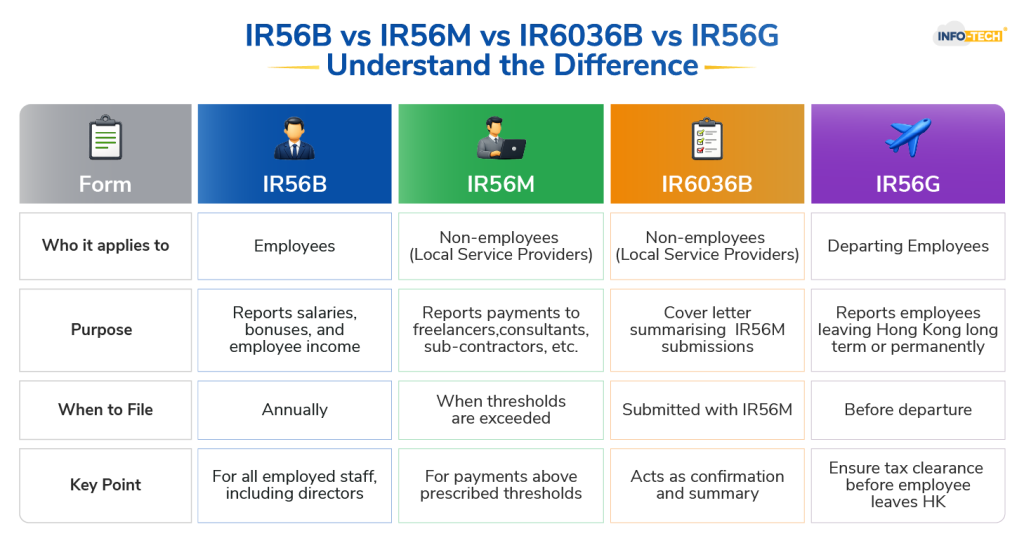
Here’s a quick way to look at it:
| Form | Used for | Applies to | Timing |
| IR56B | Reporting salaries and bonuses | Employees | Once a year |
| IR56M | Reporting payments | Non-employees | When thresholds are crossed |
| IR6036B | Summary/cover letter | Non-employees | Submitted with IR56M |
| IR56G | Reporting employee departure | Employees leaving HK | Before departure |
Remember one thing: 👉 IR56M does the reporting, IR6036B supports it.
What Is Required For Filling IR6036B Form?
Before filling anything, it helps to gather everything in one place. Otherwise, you’ll keep going back and forth. You’ll need:
- Your business name and employer file number
- Details of the reporting period
- Reference to IR6036A (if applicable)
- Total number of IR56M forms you’re submitting
- Information about who you paid and what for
It’s not complicated, but missing something here can slow things down later.
What Mistakes People Make While Filing IR6036B?
Even though the form looks simple, a lot of small mistakes happen.
Some of the common ones are:
- Leaving out important details like file numbers
- Reporting wrong amounts or not checking thresholds properly
- Submitting IR6036B without attaching IR56M
- Mixing up employees and non-employees
- Filing late and ending up with penalties
Most of these are easy to avoid by just reviewing everything once before submitting.
How To Fill IR6036B Form?
If you take it step by step, it’s pretty straightforward. Start by pulling together all the payments you made to non-employees during the year. Once you have that:
- Check if those payments cross the required thresholds
- Prepare an IR56M form for each person
- Fill in IR6036B with your business details
- Mention how many IR56M forms you’re attaching
- Add the required declarations
Once that’s done, attach everything neatly (organising them alphabetically usually helps).
For submission, you have a few options:
- File online through the IRD eTAX system
- Send it by post
- Submit via approved digital storage (if allowed)
When Should You Submit It?
There’s no separate deadline just for IR6036B.
It goes hand in hand with IR56M, so both are submitted together; usually during the annual tax filing period. Missing deadlines isn’t something you want to risk. It can lead to:
- Penalties
- Compliance issues
- Extra follow-ups from the IRD
A simple reminder system can help you stay on track.
How To Make Filing IR6036 Easier?
If you want this process to be smooth every year, a little preparation goes a long way.
- Keep track of payments as you go instead of waiting till year-end
- Use accounting or payroll software to avoid manual errors
- Double-check figures before submitting
- Stay updated with any IRD rule changes
These small habits can save you a lot of last-minute stress.
What Do Businesses Struggle With?
Even experienced teams run into issues.
- Late submissions — usually because payments weren’t tracked properly
- Data errors — simple mistakes in numbers or names
- Confusion between forms — especially IR56B vs IR56M
- Lack of expertise — common in smaller businesses
The fix is usually simple: better tracking, a review process, and sometimes getting outside help.
Does Using Software Or Services Help?
In most cases, yes; especially if you’re handling multiple payments. Good payroll or HR software can:
- Keep everything organised in one place
- Track thresholds automatically
- Generate forms quickly
- Reduce manual errors
Info-Tech also supports:
- Payroll processing
- MPF calculations
- Tax filing
- Compliance guidance
If you want fewer headaches during tax season, this is worth considering. Contact us today!
Why IR6036B Form Is Important?
It might feel like just another document, but it plays an important role. Getting it right helps you:
- Avoid penalties
- Keep your records clean
- Stay compliant with IRD rules
- Run your business without unnecessary issues
Final Thoughts
Once you understand what IR6036B is doing, it’s not as complicated as it first seems. It’s simply there to support your IR56M submission and confirm everything has been reported properly.
If your records are organised and you follow a clear process, this becomes just another routine task. And if you ever feel unsure, getting a bit of help, whether through software or a professional can make things a lot easier.
IR6036B Form FAQs
What is the difference between IR56B and IR56M?
The key difference between IR56B and IR56M comes down to who you’re paying. IR56B is used to report income paid to employees, including salaries, bonuses, and allowances, and is filed annually for all staff, including directors. IR56M, on the other hand, is used to report payments made to non-employees such as freelancers, consultants, and subcontractors, and is only required when those payments exceed specific thresholds (HKD 25,000 or HKD 200,000 depending on the category).
What is IR56B in Hong Kong?
IR56B is a tax form used in Hong Kong by employers to report the income of their employees to the Inland Revenue Department (IRD).
How to inform HK IRD that you are leaving HK?
To inform the Hong Kong Inland Revenue Department (IRD) that you are leaving Hong Kong, your employer is required to submit Form IR56G at least one month before your expected departure. This form reports your final income and employment details to the IRD, and your employer may withhold your final payments, such as salary or bonuses, until your tax obligations are fully settled, ensuring you leave Hong Kong without any outstanding tax issues.
Do employers need to provide the copy of IR56B to the employee?
Yes, employers in Hong Kong are required to provide a copy of Form IR56B to the employee. When the employer submits IR56B to the Inland Revenue Department (IRD), they must also give a copy to each employee for their own records and for completing their individual tax return.
