

In this article
- 1. Why Do So Many Directors Confuse the Annual Return With Tax Filing?
- 2. What Is an Annual Return Actually Used For?
- 3. Do I Still Need to File an Annual Return If My Company Didn’t Trade?
- 4. When Is the Annual Return Filing Deadline in Hong Kong?
- 5.How Can a HK$105 Annual Return End Up Costing Thousands?
- 6. What Happens If You Miss the Annual Return Filing Deadline?
- 7. Is Filing a Company Change the Same as Filing an Annual Return?
- 8. What Should Directors Check Before Filing an Annual Return?
- 9. Final Thoughts
- 10. Annual Return FAQs
Ask a company secretary what compliance task gets forgotten most often, and the annual return will usually be somewhere near the top of the list.
Not because it is particularly difficult.
Not because it takes weeks to prepare.
And certainly not because companies do not know it exists.
The problem is that annual return filing tends to sit quietly in the background. Unlike tax deadlines, payroll obligations, or audit requirements, it rarely demands attention until the filing date is approaching. By then, many directors are busy running the business, dealing with customers, managing staff, or focusing on growth plans. A filing that takes only a short time to complete can easily slip through the cracks.
The irony is that the annual return is one of the simplest compliance obligations a Hong Kong company has. Yet every year, businesses end up paying unnecessary penalties simply because they misunderstood what the filing was for or assumed somebody else was handling it.
Understanding how the annual return works is not just about avoiding fines. It is about keeping your company’s records accurate and ensuring that your business remains in good standing with the Companies Registry.
Why Do So Many Directors Confuse the Annual Return With Tax Filing?
The name is partly to blame.
When people hear the words “annual return”, they naturally think about tax. It sounds similar to a tax return, and many first-time business owners assume the two are connected.
They are not.
An annual return is filed with the Companies Registry. A Profits Tax Return is filed with the Inland Revenue Department. They serve completely different purposes and are governed by different requirements.
The annual return is not concerned with revenue, profits, expenses, or financial performance. It does not ask how much money the company made during the year. It does not require management accounts or audited financial statements.
Instead, it focuses on something much more straightforward: whether the information recorded about your company is still accurate.
That distinction matters because it is entirely possible for a company to be fully up to date with its tax obligations while simultaneously being late with its annual return.
What Is an Annual Return Actually Used For?
One of the easiest ways to understand the annual return is to think of it as a yearly confirmation of your company’s public record.
Every Hong Kong company has information stored with the Companies Registry. Over time, things change. Directors resign and new ones are appointed. Shareholdings are transferred. Companies move offices. Secretaries are replaced.
The Registry needs a way to ensure that the information it holds remains current.
That is where the annual return comes in.
For a private company, the filing is generally made using Form NAR1. The form confirms information such as:
- Company name and registration number
- Registered office address
- Directors’ particulars
- Company secretary details
- Shareholder information
- Share capital structure
In practical terms, the annual return allows the Companies Registry to maintain an accurate picture of who is responsible for the company and how the company is structured.
What it does not do is provide a picture of the company’s financial health. That is a separate matter dealt with through accounting and tax filings.
Do I Still Need to File an Annual Return If My Company Didn’t Trade?
This is one of the most common misconceptions among business owners.
A company may have generated no revenue, issued no invoices, and carried out no business activity for an entire year. From the owner’s perspective, the business feels inactive.
Legally, however, the company still exists.
As long as the company remains registered, the filing obligation remains in place.
This catches many directors by surprise. They assume that because nothing happened during the year, there is nothing to report. Months later, they discover that annual returns were still required and that late filing fees have been accumulating in the background.
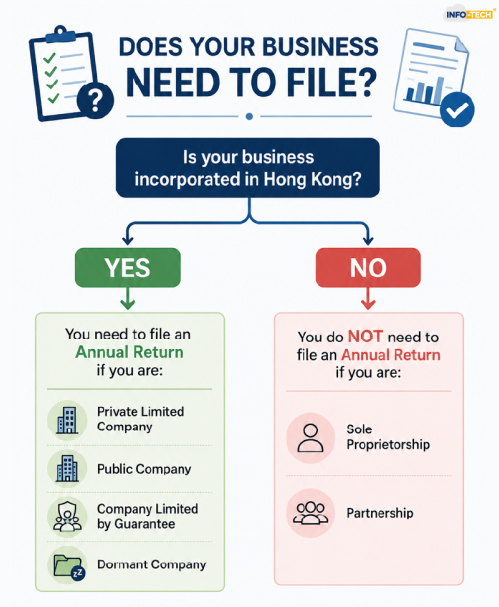
Dormant companies are therefore not exempt from annual return filing requirements.
The same applies whether the company is a startup that has not yet launched, a business that has temporarily paused operations, or a company being retained for future projects.
If it remains on the Companies Register, the annual return still needs to be filed.
When Is the Annual Return Filing Deadline in Hong Kong?
Unlike some compliance obligations that move around from year to year, the annual return follows a predictable schedule.
For private companies limited by shares, the filing deadline is tied directly to the company’s incorporation date. The return must be submitted within 42 days after the anniversary of incorporation.
That sounds generous until you realise how quickly those six weeks pass.
Many directors remember the incorporation date itself but forget that the filing window begins immediately afterward. Before long, the deadline has come and gone.
Because the date remains the same every year, it is worth treating it as a permanent fixture on the company’s compliance calendar rather than something that needs to be rediscovered annually.
Most company secretaries already do this as part of their normal responsibilities, which is one reason businesses often rely on them to manage annual filings.
How Can a HK$105 Annual Return End Up Costing Thousands?
When filed on time, the annual return is inexpensive.
For a private company, the standard filing fee is only HK$105.
That figure creates a false sense of comfort because many directors assume that a late filing cannot be much more expensive.
The reality is quite different.
Once the statutory deadline has passed, the filing fee increases significantly. The longer the delay continues, the higher the penalty becomes.
A company that misses the deadline by several months may find itself paying thousands of dollars for a filing that would otherwise have cost little more than a business lunch.
What frustrates many business owners is that these penalties are largely avoidable. The filing itself is not particularly complex. The additional cost usually arises simply because nobody was actively monitoring the deadline.
What Happens If You Miss the Annual Return Filing Deadline?
The story is often remarkably similar.
A company is incorporated. The directors are focused on launching the business. The first year passes quickly. Customers, staffing issues, marketing activities, and operational challenges naturally take priority.
The annual return is not forgotten deliberately. It simply never reaches the top of the to-do list.
Then a reminder arrives.
At that point, the filing itself is still manageable, but there may already be additional fees involved. If the delay continues, those fees continue to increase.
The longer the issue remains unresolved, the more complicated it becomes.
This is why experienced company secretaries place so much emphasis on compliance calendars. The annual return is rarely a difficult task. The challenge is ensuring that it is dealt with before it becomes an expensive one.
Is Filing a Company Change the Same as Filing an Annual Return?
Another area that causes confusion is the relationship between company changes and annual returns.
Some directors assume they can wait until the annual return to report everything at once.
Unfortunately, that is not how the system works.
Changes such as director appointments, resignations, registered office updates, or company secretary changes generally have their own filing requirements and deadlines. Those changes should be reported when they occur.
The annual return is not intended to replace those filings.
Instead, it serves as confirmation that the information currently held by the Companies Registry is accurate.
Waiting until the annual return to disclose changes can create discrepancies that may lead to further compliance complications.
What Should Directors Check Before Filing an Annual Return?
Before submitting an annual return, it is worth taking a few minutes to review the company’s records carefully.
Questions worth asking include:
- Is the registered office address still correct?
- Are all director details up to date?
- Has the company secretary information changed?
- Have any share transfers taken place during the year?
- Have all relevant corporate changes already been filed with the Companies Registry?
These checks are simple, but they help ensure that the information being submitted accurately reflects the company’s current position.
Accuracy matters because the annual return ultimately becomes part of the company’s public record.
Final Thoughts
The annual return is not the most demanding compliance requirement facing Hong Kong companies, but it is one of the easiest to underestimate.
Perhaps that is because the filing appears routine. Perhaps it is because the fee is relatively small when submitted on time. Or perhaps it is because the name leads people to assume it belongs in the same category as tax filings.
Whatever the reason, the result is often the same: a deadline that receives less attention than it deserves.
While the annual return itself is submitted through the Companies Registry, maintaining accurate company records throughout the year makes the process considerably easier. Many businesses reduce administrative burden by using integrated business solutions such as HRMS Software, Payroll Software, Leave Management Systems, and Employee Self-Service (ESS) platforms to keep workforce records organised, accessible, and up to date whenever compliance reviews or statutory filings are required.
For most companies, annual return filing should be viewed as a simple yearly housekeeping exercise. Keep company records current, monitor the filing date, and deal with the return promptly when the time comes.
Done properly, it remains little more than a routine administrative task. Left unattended, it can become an unnecessarily expensive compliance problem.
Annual Return FAQs
What is an annual return in Hong Kong?
An annual return is a statutory filing submitted to the Companies Registry that confirms a company’s key corporate information, including its registered office address, directors, company secretary, shareholders, and share capital structure. It is not a tax filing and does not contain financial information.
Is an annual return the same as a Profits Tax Return?
No. An annual return and a Profits Tax Return are separate compliance obligations. The annual return is filed with the Companies Registry to update company information, while the Profits Tax Return is filed with the Inland Revenue Department (IRD) to report taxable income and profits.
Who is required to file an annual return in Hong Kong?
Most companies incorporated in Hong Kong must file an annual return, including private companies limited by shares, public companies, and companies limited by guarantee. Dormant companies are also required to file annual returns as long as they remain registered.
What is Form NAR1?
Form NAR1 is the annual return form used by private companies limited by shares in Hong Kong. It provides the Companies Registry with updated information about the company’s structure, officers, and shareholders as of the anniversary date of incorporation.
