

In this article
- 1. What Does Salary in Lieu of Notice Mean?
- 2. Why Employers Sometimes Prefer Immediate Termination?
- 3. Serving Notice vs Payment in Lieu
- 4. How Salary in Lieu Is Calculated?
- 5. Can Employers Dismiss Someone Without Notice?
- 6. Why Final Salary Payment Matters?
- 7. Common Misunderstandings Around Notice Periods
- 8. Final Thoughts
- 9. Salary In Lieu Of Notice FAQs
Most people do not think much about notice periods until someone suddenly resigns or gets terminated.
That is usually when the confusion starts.
Can the employee leave immediately? Does the company still need to pay them? What happens to unused leave? Does commission count? And perhaps the most common question HR teams hear:
“What exactly is salary in lieu of notice?”
In Hong Kong workplaces, this issue comes up more often than many businesses expect. Sometimes the separation is friendly. Sometimes it is tense. Either way, the way a company handles notice periods says a lot about its HR practices.
And when things are handled poorly, disputes tend to follow very quickly.
Under the Employment Ordinance Hong Kong, employers and employees both have responsibilities when ending an employment relationship. Salary in lieu of notice is part of that process, but many people misunderstand how it actually works.
What Does Salary in Lieu of Notice Mean?
Put simply, salary in lieu of notice means paying someone instead of asking them to work through their notice period.
Let’s say an employee’s contract requires one month’s notice. If the employer wants the person to leave immediately, the company can pay one month’s wages instead of asking the employee to continue working.
The same idea can apply the other way around too.
An employee who resigns but does not want to stay for the full notice period may also need to compensate the employer.
This is why payment in lieu of notice is not only an employer issue. Employees sometimes forget that notice obligations work both ways.
In reality, though, many companies negotiate practical solutions rather than strictly enforcing every clause. A clean handover is often more important than arguing over a few weeks of notice.
Why Employers Sometimes Prefer Immediate Termination?
Not every company wants an employee to remain in the office after resignation or termination.
That sounds harsh, but it is often practical rather than personal.
A finance employee handling confidential reports, for example, may be asked to leave immediately after resignation. A sales manager with access to client accounts may also be released early. In some workplaces, keeping a departing employee around for another month simply creates unnecessary tension.
There are also situations where relationships have already broken down long before termination happens.
Managers may prefer to close the matter quickly instead of dragging out the notice period.
That is where salary in lieu of notice usually comes into play.
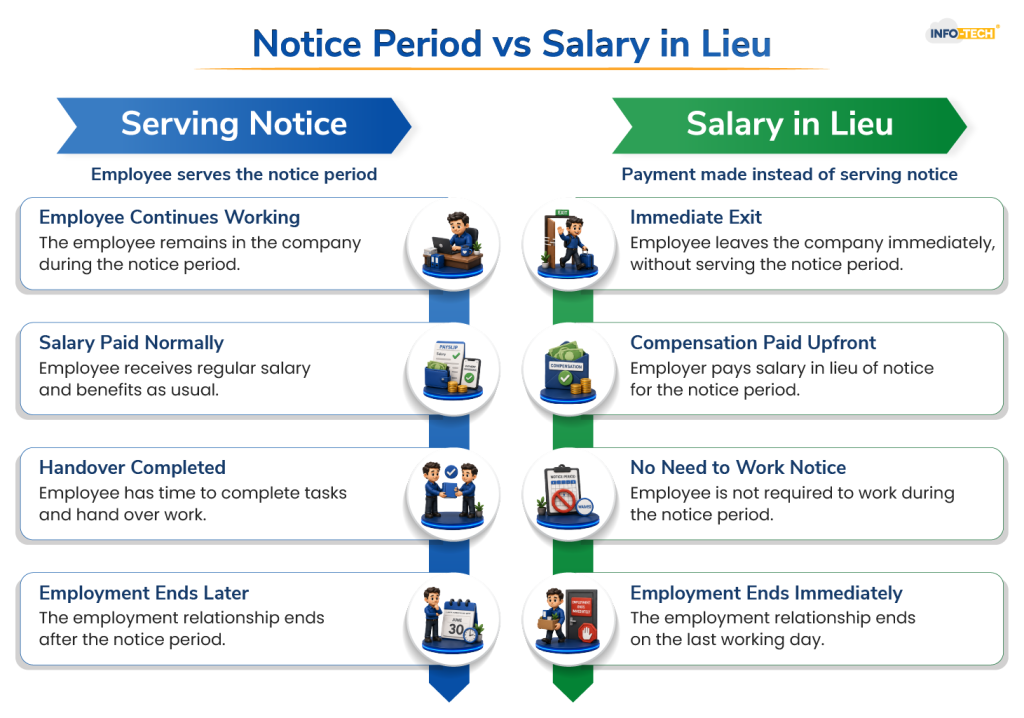
How is Serving Notice Different From Payment in Lieu?
People often use these phrases interchangeably, but legally and operationally they are quite different.
When someone serves notice, they remain employed during the notice period. They continue receiving salary as usual, continue working, and technically remain part of the company until the final day arrives.
Payment in lieu changes that entirely.
Employment ends immediately.
The employee stops working right away, and compensation is paid instead of serving the remaining notice period.
That immediate ending affects several things behind the scenes:
- Payroll processing
- Mpf arrangements
- Annual leave calculations
- System access
- Company property returns
- Final salary timelines
For HR teams, these details matter more than people realize.
How Salary in Lieu Is Calculated?
This is usually where problems begin.
Many employers assume the calculation only involves base salary. But under Hong Kong labour law, wages can include more than just monthly basic pay.
For example, if an employee consistently receives guaranteed allowances or fixed monthly commissions, those payments may also need to be considered.
Imagine this situation.
An employee earns:
- HK$28,000 basic salary
- HK$4,000 monthly transport allowance
If the employer calculates payment in lieu using only the basic salary figure, the employee may argue the calculation is incomplete.
And honestly, this is where many payroll disputes start — not because anyone intended to underpay someone, but because the calculation was rushed or misunderstood.
That is why experienced HR teams usually review both the employment contract and payroll records carefully before processing termination payments.
Can Employers Dismiss Someone Without Notice?
Yes, but only in limited situations.
Under the Employment Ordinance, summary dismissal without notice is generally reserved for serious misconduct cases. Theft, fraud, violence, or serious dishonesty may justify immediate dismissal without compensation.
Poor performance alone usually does not.
This is an area where companies sometimes get themselves into trouble.
A manager becomes frustrated after months of performance issues and assumes immediate dismissal is legally acceptable. Later, the employee files a Labour Tribunal claim arguing there was no valid reason for dismissal without notice or payment in lieu.
These situations are not rare in Hong Kong.
And very often, the issue is not the termination itself. It is the way the termination was handled.
Why Final Salary Payment Matters?
Another mistake employers make is delaying final salary payment.
Under Hong Kong law, final payments are generally supposed to be settled within seven days after termination. That includes unpaid salary, accrued leave, and payment in lieu where applicable.
When payments are delayed, employees naturally become anxious and frustrated.
From a business perspective, delayed final salary also affects company reputation internally. Staff notice how departing employees are treated. Word spreads quickly inside offices.
Sometimes faster than management expects.
What are the Common Misunderstandings Around Notice Periods?
One misconception is that employers can terminate employment anytime without consequences.
That is not entirely true.
Notice obligations or payment in lieu usually still apply unless summary dismissal is legally justified.
Another misunderstanding is that employees can resign immediately whenever they want. Technically, contractual notice obligations still exist unless both sides agree otherwise.
There is also confusion about what counts as wages during payment calculations. Many employees assume bonuses should always be included, while some employers assume only base salary matters.
In reality, it depends heavily on the contract structure and payment patterns.
Which is exactly why termination disputes can become messy surprisingly fast.
Final Thoughts
Salary in lieu of notice sounds like a simple payroll term on paper. In reality, it sits right in the middle of employment rights, payroll obligations, and workplace relationships.
For employers, handling notice periods properly helps reduce disputes, protects compliance, and avoids unnecessary legal risk.
For employees, understanding notice rights helps prevent confusion during resignations and terminations.
And in Hong Kong’s increasingly compliance-focused business environment, companies that manage employee exits professionally are usually the ones with stronger HR foundations overall.
Our HRMS solutions, payroll software, and employment law compliance support help Hong Kong businesses manage notice periods, final salary payments, and employee terminations more confidently and accurately.
For employers and HR teams looking to strengthen labour law understanding further, our payroll and HR compliance training programs provide practical guidance tailored to Hong Kong workplace requirements.
Salary In Lieu Of Notice FAQs
What is salary in lieu of notice?
It is compensation paid instead of requiring someone to work through their notice period.
Can an employee resign without serving notice in Hong Kong?
Yes, but payment in lieu of notice may apply unless the employer agrees to an early release.
Does salary in lieu include allowances?
In some cases, yes, especially if allowances form part of regular contractual wages.
Can poor performance justify immediate dismissal?
Usually not. Poor performance alone generally does not justify summary dismissal without notice.
