

In this article
- 1. What Is IR56G in Hong Kong?
- 2. Why IR56G Filing is Important?
- 3. When Does an Employer Need to File IR56G?
- 4. What Is the Difference Between IR56F and IR56G?
- 5. What Happens During the Hong Kong Tax Clearance Process?
- 6. What Information Needs to Be Reported in IR56G?
- 7. What Happens If an Employer Releases Salary Too Early?
- 8. What Are the Most Common IR56G Filing Mistakes?
- 9. What Should Employees Prepare Before Leaving Hong Kong?
- 10. IR56G Form FAQs
Employee resignations are usually straightforward until someone says, “I’m leaving Hong Kong next month.” That is when many HR and payroll teams suddenly remember the IR56G process.
In Hong Kong, handling a departing employee is not only about final salary calculations, notice periods, or handing over company property. Once an employee plans to leave Hong Kong for more than a short trip, the employer enters a completely different compliance territory: tax clearance. And this is where the IR56G form becomes important.
A surprising number of businesses still misunderstand how serious the IR56G obligation is. Some assume it works like a normal termination filing. Others submit it too late, release salary too early, or forget to report stock-based compensation. By the time the Inland Revenue Department (IRD) follows up, the situation becomes stressful for both employer and employee.
If your company employs expatriates, relocated staff, regional directors, or even local employees who are emigrating, understanding IR56G properly is no longer optional.
What Is IR56G in Hong Kong?
IR56G is officially called:
“Notification by an Employer of an Employee Who is About to Depart from Hong Kong.”
It is a tax clearance form filed with the Inland Revenue Department (IRD) when an employee is leaving Hong Kong, whether permanently or for more than a month’s time.
Many employers mistakenly think the form only applies to expatriates. That is not true. The IR56G filing obligation applies whenever:
- an employee terminates employment; and
- plans to leave Hong Kong for more than one month
This is part of Hong Kong’s employee departure tax clearance process. The purpose is simple. Before someone leaves Hong Kong, the IRD wants to ensure all salaries tax matters are settled properly.
Why IR56G Filing is Important?
From the IRD’s perspective, once someone leaves Hong Kong, collecting unpaid taxes becomes much harder. So, the government places a legal responsibility on employers to assist in the tax clearance process. That responsibility is not symbolic either.
Once the IR56G is filed, the employer must temporarily withhold payments owed to the employee until the IRD issues what is known as a “Letter of Release.”
This includes:
- salary
- bonuses
- commissions
- allowances
- rental reimbursements
- end-of-service payments
- expense reimbursements in some cases
A lot of employers become uncomfortable at this stage because employees naturally ask: “Why is my final salary being held?”
The answer is simple: Hong Kong tax law requires it.
When Does an Employer Need to File IR56G?
The IR56G form must generally be filed at least one month before the employee departs Hong Kong. Not one month after resignation. Not one month after the last working day.
The timing is linked specifically to the employee’s departure from Hong Kong.
For example:
| Scenario | IR56G Needed? |
| Employee resigns but stays in Hong Kong | No |
| Employee resigns and relocates to Singapore | Yes |
| Expat assignment ends and employee returns home | Yes |
| Employee leaves Hong Kong for several months | Usually yes |
In practice, HR teams should start discussing tax clearance as soon as resignation or relocation conversations begin. Waiting until the final week creates unnecessary pressure.
Read also: IR56B: Hong Kong’s Essential Remuneration Reporting
What Is the Difference Between IR56F and IR56G?
This confuses many employers, especially smaller businesses handling payroll internally. Here is the simplest way to think about it:
| Form | Purpose |
| IR56F | Employee termination only |
| IR56G | Employee termination + departure from Hong Kong |
Both forms report employment income details, but IR56G triggers the formal tax clearance process. Another important difference is: Once IR56G is filed, the employer must withhold payment until IRD approval is received. This withholding obligation does not apply under IR56F.
Read also: What is IR56F Form and How to Fill It
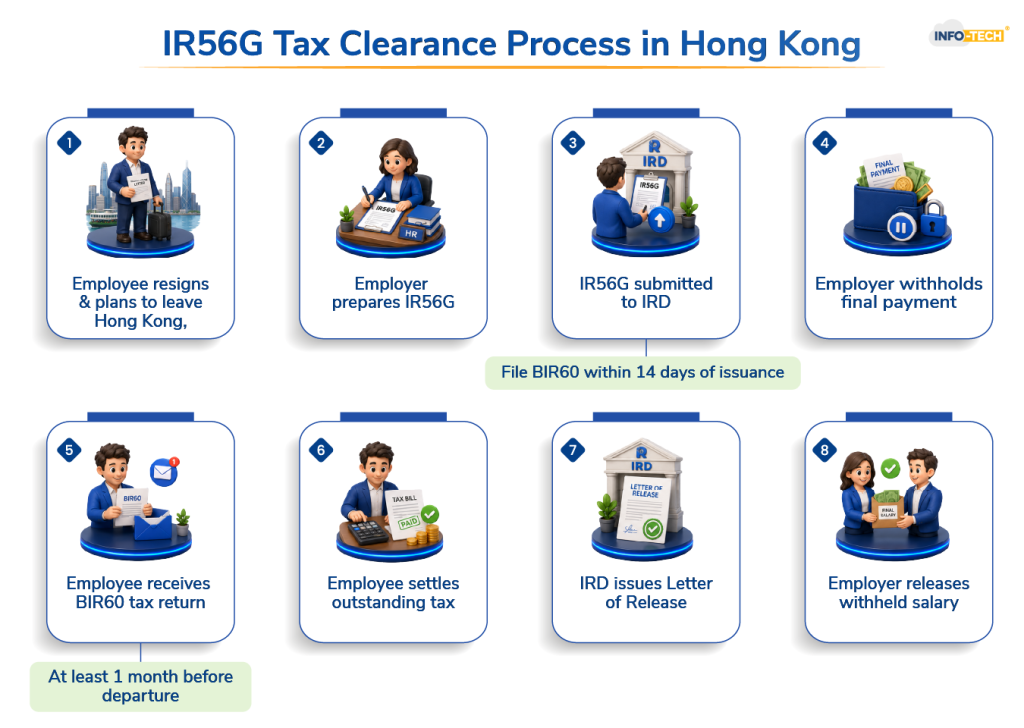
What Happens During the Hong Kong Tax Clearance Process?
The actual process is not complicated, but it involves coordination between the employee, employer, payroll team, and IRD.
Here is how it usually takes place in real business situations.
Step 1: Employee Announces Departure
The employee informs the employer they are leaving Hong Kong. At this point, HR should immediately identify:
- intended departure date
- final employment date
- outstanding payments
- bonuses not yet paid
- share options or equity benefits
- housing or rental reimbursements
This early review prevents reporting mistakes later.
Step 2: Employer Files IR56G
The employer prepares and submits the IR56G form to the IRD. Two copies are normally prepared:
- one for IRD
- one for the employee
The filing includes detailed compensation information from the beginning of the tax year up to the employee’s departure.
Step 3: Employer Withholds Payment
This is the stage many employees dislike. From the date IR56G is submitted until the IRD issues the “Letter of Release,” the employer must withhold amounts payable to the employee.
This is a legal requirement under Hong Kong tax regulations.
Step 4: Employee Completes Tax Clearance
The employee communicates directly with the IRD and settles any outstanding tax obligations.The IRD may issue additional assessments if necessary.
Once payment is settled, the IRD releases clearance approval.
Step 5: IRD Issues Letter of Release
The IRD sends the Letter of Release to either:
- the employer
- the employee
Once received, withheld payments can finally be released. This officially completes the employee departure tax clearance process.
Read also: What is the IR6036B Form in Hong Kong?
What Information Needs to Be Reported in IR56G?
This is where payroll accuracy becomes extremely important. The IR56G form requires more than just base salary figures.
The employer must report:
- salary and wages
- bonuses
- commissions
- housing benefits
- rental reimbursements
- gratuities
- payment in lieu of notice
- deferred compensation
- certain retirement scheme payments
- share option gains
- stock awards
This is also where many payroll teams accidentally underreport income.
For instance, companies sometimes forget about:
- pending commissions
- retention bonuses
- unvested shares
- deferred incentive plans
- relocation allowances
The IRD pays close attention to these items during tax clearance reviews.
What Happens If an Employer Releases Salary Too Early?
This is not just an administrative mistake. It can become a financial risk.
If the employer releases withheld money before receiving the IRD Letter of Release, and the employee leaves Hong Kong without settling taxes, the IRD may recover the unpaid tax from the employer.
This is why experienced HR professionals take the withholding requirement seriously even when employees become frustrated about delayed payments.
What Are the Most Common IR56G Filing Mistakes?
After handling enough employee departures, you start seeing the same patterns repeatedly.
Filing Too Late
Many employers only realize IR56G is required after the employee has already left Hong Kong. At that point, the situation becomes messy quickly.
Forgetting Variable Compensation
Bonuses, commissions, and deferred payments are commonly missed.
Confusing IR56F and IR56G
This still happens surprisingly often, especially in growing startups without dedicated payroll specialists.
Releasing Funds Before Clearance
This exposes the company to unnecessary tax risk.
Poor Internal Coordination
Sometimes HR knows about the departure, but payroll does not. Or finance processes final salary before compliance checks happen. The issue is rarely the form itself. It is usually communication breakdown between departments.
What Should Employees Prepare Before Leaving Hong Kong?
Employees also play an important role in making tax clearance smoother.
A departing employee should usually prepare:
- Hong Kong ID details
- departure date
- passport/travel records
- latest salary details
- bonus information
- housing arrangements
- updated overseas address
Employees should also avoid leaving Hong Kong abruptly before tax clearance is completed.
That creates unnecessary complications for everyone involved.
Read also: IR56M, The Non-Employee Tax Rule Businesses Often Overlook
How Can HRMS and Payroll Systems Reduce IR56G Filing Errors?
Modern HR and payroll systems are becoming increasingly important for Hong Kong compliance work, especially for businesses handling expatriate employees or regional mobility.
A good HRMS platform helps centralize:
- employee movement records
- payroll history
- bonuses and allowances
- tax reporting data
- IR56 form generation
- final payment calculations
- compliance reminders
This reduces the chances of missing compensation items or filing incorrect information during employee departure processing.
For growing Hong Kong businesses, especially those hiring international talent, having organized payroll and employee records makes tax clearance significantly faster and easier.
Final Thoughts on IR56G Filing in Hong Kong
The IR56G process is one of those areas where payroll, HR, finance, and compliance all intersect. While the form itself may not look intimidating, the implications behind it certainly matter.
A missed filing deadline, incomplete compensation reporting, or early salary release can create unnecessary exposure for employers. At the same time, employees who are relocating overseas often expect a smooth departure experience, which means internal coordination becomes incredibly important.
This is one reason many Hong Kong businesses are moving toward integrated HRMS and payroll software. Having employee records, payroll history, tax filing data, IR56 reporting, and departure workflows connected in one place makes compliance much easier to manage — especially for companies with expatriate staff or regional teams.
Instead of chasing spreadsheets and email approvals during an employee’s final month, HR and payroll teams can focus on getting the process right from the beginning.
Read also: IR56 Forms for Employers in Hong Kong : A Brief Study
IR56G Form FAQs
What is the IR56G form?
IR56G is a tax clearance form filed by employers when an employee is leaving Hong Kong for more than one month.
What is the difference between IR56F and IR56G?
IR56F is used for employment termination, while IR56G applies when the employee is both terminating employment and leaving Hong Kong.
When should IR56G be filed?
The employer should generally submit IR56G at least one month before the employee departs Hong Kong.
Are bonuses and share options reportable in IR56G?
Yes. Employers may need to report bonuses, commissions, deferred compensation, and certain share-related benefits.
