

In this article
- 1. What is Petty Cash?
- 2. Why Do Companies Keep Petty Cash?
- 3. What Are Common Petty Cash Examples?
- 4. Is Petty Cash An Asset?
- 5. Is Petty Cash the Same As Cash On Hand?
- 6. Who Should Be Responsible for Petty Cash?
- 7. How Much Petty Cash Should A Business Keep?
- 8. How Do You Record Petty Cash Properly?
- 9. How Can Petty Cash Be Managed Better?
- 10. Petty Cash FAQs
What is Petty Cash?
Petty cash is the small amount of cash kept aside by business to meet their minor expenses. Not every payment for a business or organization needs a bank transfer, card payment, invoice, or long approval process. Sometimes the office just needs something small, and immediately for urgent use.
It could be used for a pack of envelopes, a taxi fare for a quick work errand, a small courier charge, or snacks for a client meeting. The amount may be small, but it is still the company’s money.
Why Do Companies Keep Petty Cash?
Petty cash is mainly kept for convenience of use, whenever required. In a normal working day, small expenses come up without much planning, like the printer runs out of paper or someone needs to send documents or a staff member pays for parking while visiting a client.
For a Hong Kong SMEs, these little payments are common. If the team has to wait for formal approval of fund or expenditure every time, work slows down. Petty cash helps the business settle small things quickly without turning every minor purchase into a finance task that is time consuming.
What Are Common Petty Cash Examples?
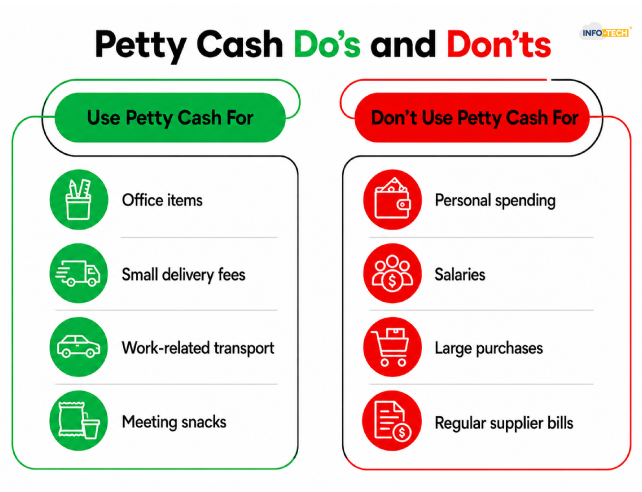
Petty cash is usually used for small office or business costs. Some common examples are stationery purchase, postage or courier fees, local transport, parking fee, meeting refreshments, small cleaning items, or minor staff reimbursements.
It should not be used for anything personal. It should also not be used for any huge expenses such as salaries, large purchases, regular supplier bills, or expenses that need proper approval. A good test is simple: would you be comfortable explaining this expense to your accounts team later, as a sudden need? If not, petty cash is probably not the right way to pay for it.
Is Petty Cash An Asset?
Yes, petty cash is an asset because the business owns it and can use it. It is usually treated as part of cash or cash equivalents in the accounts.
When the company takes money from the bank and keeps it as petty cash, it does not mean that the money has disappeared. It only means that the money has moved from one place to another. Once it is spent, the expense should be recorded properly.
For example, money used for printer paper should be recorded specifically as office supplies, not just “cash spent.”
Is Petty Cash the Same As Cash On Hand?
Not exactly. Petty cash is a small fund set aside for minor expenses. It normally has a fixed amount and one person looking after it.
Cash on hand is a broader term. It can include things such as petty cash, cash from sales, cash in the register, and any other physical cash the business has at that moment.
So petty cash is part of cash on hand, but cash on hand is not always petty cash.
Who Should Be Responsible for Petty Cash?
Petty cash should not be some funding everyone can open and use whenever and however they like. That may feel easy at first, but it becomes messy very quickly.
Only one person should be responsible for maintaining it. This could be someone from admin, finance, accounts, or operations. Their role is not complicated. They keep the cash safe, give it out only for business reasons, collect receipts, and update the record regularly.
How Much Petty Cash Should A Business Keep?
There is no standard petty cash amount for every business. A small office may only need HK$500 or HK$1,000. A retail shop, clinic, café, or company with frequent errands may need a little more.
The amount should match real usage. Keeping too little means the fund runs out all the time. Keeping too much cash in the office creates unnecessary risk.
The simplest way is to look at the small expenses from the past few weeks or months. That usually gives a clear idea of how much petty cash is actually needed.
How Do You Record Petty Cash Properly?
Every petty cash expense should be recorded on the same day, or at least as soon as possible. Waiting until the end of the month is where mistakes usually happen for accounts closing.
The record should show the date, amount, reason for the expense, name of the person who took the cash, and the receipt for the same. It can be written in a petty cash book, a spreadsheet, or a system. The format matters less than the habit itself.
For example, “HK$68 for office stationery, bought by Mei, receipt attached” is already much better than a vague note saying “office item.” Clear records save time later.
How Can Petty Cash Be Managed Better?
Petty cash does not need a complicated system, but it does need basic rules. Decide what it can be used for. Set a limit for each expense. Keep receipts. Count the cash regularly. Do not mix it with sales cash or personal money.
The person in charge should check whether the remaining cash plus the receipts equals the original fund amount. If the fund started with HK$1,000, and HK$300 is left, the receipts should explain the other HK$700. If they do not, the difference should be checked early.
As the business grows, petty cash can become harder to manage with paper slips and memory. Receipts go missing. Staff forget what they bought. Managers approve things late. This is where a proper HRMS or claims management software can help. Employees can submit small claims with receipts, managers can approve them clearly, and the finance team gets cleaner records.
Petty cash is a small part of the business, but it still shows how carefully money is handled. Keep it simple, keep it recorded, and it will do its job without creating problems later.
Petty Cash FAQs
What is petty cash?
Petty cash is a small amount of money a business keeps aside for minor daily expenses, such as stationery, courier fees, or meeting refreshments.
What is the purpose of petty cash?
The purpose of petty cash is to help a business pay for small, everyday expenses quickly without using formal payment methods each time. It is mainly used for minor costs like office supplies, courier charges, local transport, or meeting refreshments.
Why is it called petty cash?
It is called petty cash because “petty” means small or minor. So, petty cash simply means a small amount of cash kept for minor business expenses like stationery, postage, courier fees, or small office purchases.
What is another name for petty cash?
Another name for petty cash is imprest cash or cash float. In simple terms, it can also be called a small expense fund.
