

In this article
- 1. What Does IR56E Mean?
- 2. Why Is IR56E Important For Hong Kong Employers?
- 3. Who Needs To Submit IR56E?
- 4. When Should IR56E Be Filed?
- 5. Which Employees Should Be Reported Through IR56E?
- 6. What Information Is Required In the IR56E Form?
- 7. How Can Employers Submit IR56E?
- 8. Can IR56E Be Submitted Online?
- 9. What Common Mistakes Do Employers Make When Filing IR56E?
- 10. How Is IR56E Different From IR56B, IR56F, And IR56G?
- 11. IR56E Form FAQs
Hiring someone in Hong Kong is not only about signing an offer letter and setting up payroll. The moment a new employee joins, the employer may also have a tax reporting duty with the Inland Revenue Department. That is where IR56E comes in.
IR56E is one of those forms that looks simple on the surface, but it can cause trouble if HR, payroll, and finance teams do not treat it seriously. For growing companies, especially SMEs and startups, it is easy to miss because everyone is busy onboarding the employee, arranging MPF, preparing access cards, and sorting out salary details. But the IRD still expects the employer’s notification to be handled properly.
What Does IR56E Mean?
IR56E stands for notification by an employer of an employee who commences to be employed.
In plain English, it is the form used by an employer to tell the IRD that a new employee has started work and may be chargeable to salaries tax.
It is not the employee’s own tax return. It is an employer filing. The employee may later receive a salaries tax return from the IRD, but IR56E is the employer’s way of reporting the start of the employment relationship.
Read also: What is IR56F Form and How to Fill It
Why Is IR56E Important For Hong Kong Employers?
IR56E helps the IRD keep track of new employment income. Without it, the tax record for the employee may not match what is actually happening in the company.
For employers, the form matters because it connects directly with Hong Kong payroll compliance. It also shows whether the business keeps proper employment records.
A missed IR56E may not always create a problem on day one. The issue often appears later, when:
- the company prepares annual employer’s returns
- employee resigns
- employee leaves Hong Kong
- payroll records are checked
- the IRD asks questions about employment income
That is why experienced HR teams do not leave IR56E until the end of the year. They build it into the onboarding process.
Who Needs To Submit IR56E?
The employer is responsible for submitting IR56E.
In practice, the work may be handled by the HR manager, payroll team, finance team, company secretary, outsourced payroll provider, or tax representative. Still, the responsibility sits with the employer.
For example, if a Hong Kong company hires a sales executive on 1 July, the business should check whether IR56E filing is required and prepare the form within 1 October. It should not be treated as something the employee will handle alone.
Read also: IR56G Filing Guide for Departing Employees in Hong Kong
When Should IR56E Be Filed?
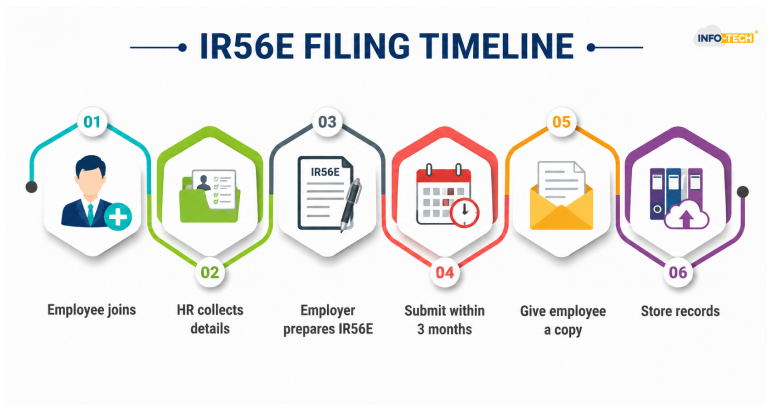
IR56E should generally be filed within 3 months from the employee’s commencement date, where the employee is likely to be chargeable to salaries tax.
The start date matters. If the employee joins on 10 May, the deadline is counted from 10 May, not from the first payroll run or the end of the tax year.
A small delay in recording the correct joining date can easily affect filing. This is why HR records, employment contracts, and payroll setup should all show the same commencement date.
Which Employees Should Be Reported Through IR56E?
IR56E is normally relevant for new employees who may be chargeable to Hong Kong salaries tax. This can include full-time employees, part-time employees, local hires, transferred staff, and employees paid partly by an overseas company if their work arrangement creates a Hong Kong tax reporting obligation.
Employers should not guess based only on job title or nationality. A director, regional employee, or secondee may still need proper review.
When in doubt, employers should check the employment terms, work location, payment arrangement, and tax position before deciding how to report.
Read also: NAR1 Form: Hong Kong Annual Return Filing Explained
What Information Is Required In the IR56E Form?
IR56E asks for both employer and employee information. Some details are straightforward. Others need careful checking.
Common information includes:
- employer file number or business registration details
- employer name and address
- employee name, address, gender, and marital status
- HKID or passport details
- employment start date
- job title or capacity
- salary, allowances, bonuses, and benefits
- housing or place of residence details, if applicable
- whether the employee is paid by a non-Hong Kong company
The form should not be completed from memory. It should be based on verified employee records, payroll data, employment documents, and benefit arrangements.
How Can Employers Submit IR56E?
Employers can submit IR56E in paper form or use electronic services where available. Some businesses prepare IR56 forms through the IRD’s tools or approved payroll software, then submit the required data through the proper channel.
For a very small employer, paper filing may still feel manageable. But once the business starts hiring regularly, manual preparation becomes risky. One wrong figure, missing address, or outdated employee detail can create unnecessary back-and-forth.
Read also: IR56M, The Non-Employee Tax Rule Businesses Often Overlook
Can IR56E Be Submitted Online?
Yes, electronic filing options are available through the IRD’s employer e-services and related filing tools, depending on the employer’s setup and filing method.
That said, online filing does not mean the form can be prepared casually. The same accuracy rules apply. The employer still needs to review employee details, income figures, housing benefits, and any overseas payment arrangement before submission.
After IR56E is submitted, the employer should keep proper records of the filing. A copy should also be provided to the employee.
This is useful for both sides. The employee may need the information when handling salaries tax matters. The employer may need it later when preparing annual IR56B reporting, handling resignation, or responding to IRD queries.
A good practice is to store the filed IR56E together with the employee’s onboarding records, payroll profile, and tax documents.
What Common Mistakes Do Employers Make When Filing IR56E?
Most IR56E mistakes are not due to lack of knowledge. They come from rushed admin work.
Common issues include:
- missing the 3-month filing deadline
- entering the wrong commencement date
- using an outdated employee address
- forgetting housing benefits or allowances
- not checking whether overseas payments exist
- assuming payroll software has been reviewed by a human
- failing to give the employee a copy
- mixing up IR56E with IR56B, IR56F, or IR56G
The biggest problem is scattered information. HR has one version. Payroll has another. Finance has the salary breakdown. Nobody sees the full picture until filing time.
How Is IR56E Different From IR56B, IR56F, And IR56G?
These forms are related, but each one is used at a different point in the employment cycle.
- IR56E is for the start of employment.
- IR56B is for annual reporting of remuneration and pensions.
- IR56F is used when an employee is about to cease employment.
- IR56G is used when an employee is leaving Hong Kong permanently or for a substantial period.
A simple way to remember it: IR56E starts the record, IR56B reports the year, IR56F closes employment, and IR56G deals with departure from Hong Kong.
Read also: IR56 Forms for Employers in Hong Kong : A Brief Study
How Should HR And Payroll Teams Prepare For IR56E Filing?
The best time to prepare for IR56E is during onboarding, not after the employee has already settled into the job.
A practical workflow looks like this:
- collect complete employee information before the start date
- confirm salary, allowances, benefits, and housing details
- check whether the employee receives income from outside Hong Kong
- record the exact commencement date
- set an internal deadline before the 3-month limit
- review the form before submission
- save the employer copy and employee copy
For busy HR teams, a simple checklist can prevent a lot of stress.
Why Should Growing Hong Kong Businesses Take IR56E Seriously?
When a company is small, tax forms may be handled by one person who “knows where everything is.” That works until the team grows, hiring becomes faster, and employee information starts spreading across emails, spreadsheets, payroll files, and chat messages.
IR56E is more than a form. It is a test of how well the business manages employee records.
This is also where organized systems make a real difference. Info-Tech’s HRMS software helps businesses keep employee-related records, payroll follow-ups, document tracking, compliance reminders, and internal notes easier to manage in one place. It does not replace tax advice, but it gives teams cleaner visibility and fewer missed details.
For Hong Kong employers, good filing starts with good records. When employee data is clear, IR56E becomes a manageable task instead of a last-minute compliance headache.
IR56E Form FAQs
What is IR56E in Hong Kong?
IR56E is a Hong Kong employer tax form used to notify the Inland Revenue Department when a new employee starts work.
Is IR56E filed by the employee or employer?
IR56E is filed by the employer. The employee should receive a copy after submission.
Is IR56E the same as IR56B?
No. IR56E is for new employment notification, while IR56B is used for annual reporting of remuneration and pensions.
What happens if IR56E is filed late?
Late or incorrect filing can create compliance risk and may expose the employer to penalties or IRD follow-up.
