

In this article
- 1.What Exactly Is Form ND2A?
- 2. Why Does This Form Matter?
- 3. When Does a Company Need to File Form ND2A?
- 4. Who Usually Handles the Filing?
- 5. What Information Is Usually Required?
- 6.How Is The Filing Process For Form ND2A Done?
- 7. What Are The Common Mistakes Businesses Make?
- 8.Conclusion
- 9. Form ND2A Frequently Asked Questions
Most people do not start a business thinking about statutory forms.
They think about clients, growth, hiring staff, opening bank accounts, maybe even expanding overseas one day. Corporate filings usually sit somewhere in the background — important, but easy to postpone when daily operations become hectic.
That is exactly why forms like ND2A quietly catch companies off guard.
A director leaves the business. A new partner joins. Someone takes over as company secretary. Internally, the company moves on quickly. But legally, the Companies Registry still needs to be informed. And if that update never happens, the gap eventually shows up somewhere else.
Sometimes during a bank review.
Others during an audit.
And, sometimes when investors begin checking company records.
And by then, what could have been a quick filing suddenly becomes a much bigger administrative problem.
What Is Form ND2A?
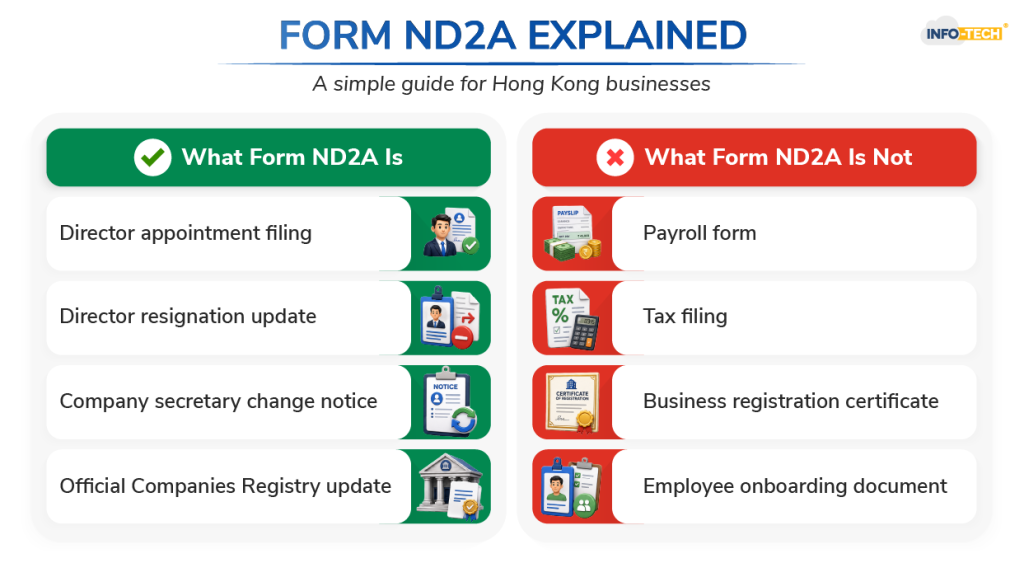
Form ND2A is an official document filed with the Hong Kong Companies Registry whenever there is a change involving:
- A company director
- A company secretary
Its full name is:
Notice of Change of Company Secretary and Director (Appointment/Cessation)
In simpler language, the form tells the government when someone joins or leaves one of these statutory positions.
That may sound straightforward — and honestly, it is. The problem is not usually the form itself. The problem is that businesses are busy, and compliance updates tend to get delayed while everyone focuses on operational work instead.
Why Does This Form Matter?
A few years ago, many smaller businesses treated these filings as routine paperwork that only mattered during annual compliance periods.
Things have changed.
Today, company records are reviewed constantly by banks, auditors, regulators, payment providers, and investors. If the information held by the Companies Registry no longer matches the actual structure of the business, questions start appearing very quickly.
Imagine this situation.
A company appoints a new operations director during a rapid expansion phase. The individual begins approving payments, managing teams, and representing the company externally almost immediately. Internally, everyone already sees them as part of leadership.
But the ND2A filing never gets submitted.
Three months later, the bank conducts a routine compliance review and notices that the person actively managing transactions does not officially appear in the company records.
Now the company has to explain the discrepancy.
Nothing fraudulent happened. Nobody intentionally hid information. But incomplete records create uncertainty, and financial institutions are increasingly cautious about uncertainty.
That is why filings like Form ND2A matter more today than they did years ago.
When Does a Company Need to File Form ND2A?
A company generally needs to file the form whenever there is an official appointment or cessation involving directors or the company secretary.
Some common examples include:
| Situation | Filing Required |
| Appointment of a new director | Yes |
| Director resignation | Yes |
| Removal of a director | Yes |
| Appointment of company secretary | Yes |
| Company secretary resignation | Yes |
The filing deadline is usually:
Within 15 days from the effective date of the change
This is where companies often make mistakes.
The deadline does not begin when someone finally prepares the paperwork. It starts from the actual date the appointment or resignation takes effect.
That small difference is responsible for many late filings.
Who Usually Handles the Filing?
Legally, the responsibility belongs to the company itself.
Operationally, the filing is often managed by:
- Company secretaries
- Corporate service providers
- Compliance teams
- Directors
- External accounting firms
But one very common issue — especially in SMEs — is assumption.
The founder assumes the corporate secretary already filed it.
The corporate secretary is waiting for signed documents.
The director thinks somebody else handled everything.
And suddenly, weeks have passed.
This happens more often than most people realize, particularly during restructuring periods when businesses are already juggling staffing changes, operational decisions, and financial pressure simultaneously.
What Information Is Usually Required?
The details depend on the type of change being reported, but companies commonly need information such as:
For Director Appointments
- Full legal name
- Residential address
- HKID or passport details
- Nationality
- Occupation
- Appointment date
For Resignations or Removal
- Name of outgoing officer
- Effective cessation date
- Nature of cessation
Accuracy matters here more than people expect.
Even minor inconsistencies between registry records, bank records, and internal systems can trigger additional verification checks later. Something as simple as a slightly different passport spelling may end up creating unnecessary delays during compliance reviews.
How Is The Filing Process Done?
On paper, filing Form ND2A is not particularly complicated.
Most companies follow a process like this:
- Confirm the appointment or resignation internally
- Gather supporting information
- Prepare the form carefully
- Submit it to the Companies Registry
- Update internal records afterward
The last step is the one businesses forget most often.
The statutory filing gets completed, but payroll access, banking approvals, HR systems, and internal governance records remain outdated. Over time, these inconsistencies create operational confusion.
This becomes even more noticeable in growing companies where responsibilities shift frequently.
What Are The Common Mistakes Businesses Make?
Interestingly, most compliance problems around ND2A are not caused by complicated regulations.
They usually come from ordinary operational disorganization.
One common issue is delayed filing during busy periods. Leadership changes happen quickly, but documentation gets pushed aside while everyone focuses on business continuity.
Another problem is inconsistent recordkeeping. A director renews a passport, changes residential address, or uses slightly different name formats across systems.
Some companies also fail to connect HR changes with statutory obligations properly. A senior employee may gradually take on director-level authority operationally while the legal filings are forgotten completely.
These are small gaps individually. But together, they create unnecessary compliance risk.
Conclusion
Form ND2A may look like a small administrative filing, but it reflects something much bigger behind the scenes — whether a company is keeping its governance records properly aligned with reality.
And increasingly, that matters.
Banks, regulators, auditors, and investors now expect businesses to maintain updated corporate information consistently, not just during annual filing periods. Small administrative gaps that once went unnoticed are now flagged much faster during compliance reviews.
As companies grow, manually managing director appointments, payroll approvals, employee records, and statutory deadlines becomes harder to control accurately across departments. This is why many Hong Kong businesses are gradually adopting integrated HRMS and payroll systems that help centralize information, improve visibility, and reduce compliance-related administrative risk before small issues become operational problems.
Form ND2A Frequently Asked Questions
What is Form ND2A used for?
Form ND2A is used to notify the Hong Kong Companies Registry about appointments, resignations, or removals involving company directors and company secretaries.
When must Form ND2A be filed?
The form is generally required within 15 days after the appointment or resignation takes effect.
Can Form ND2A be filed online?
Yes. Many companies submit Form ND2A electronically through Hong Kong’s e-Registry platform.
What happens if Form ND2A is filed late?
Late filing may lead to penalties, compliance issues, and delays during banking or audit reviews.
