

In this article
- 1. What is the Hong Kong Companies Registry?
- 2. Why Do Businesses Register a Company in Hong Kong?
- 3. What Are the Requirements to Register a Hong Kong Company?
- 4. How Do You Register a Company Through the Companies Registry?
- 5. How Much Does Hong Kong Company Registration Cost In 2026?
- 6. What Tax Obligations Does a New Hong Kong Company Have?
- 7. What Problems Should Founders Avoid When Dealing with the Companies Registry?
- 8. Conclusion
- 9. Hong Kong Company Registry FAQs
Hong Kong remains a popular place to start and operate a business because of its straightforward tax system, international connections and established legal framework. At the centre of the company setup process is the Hong Kong Companies Registry, the government department that incorporates companies, records statutory documents and oversees compliance under the Companies Ordinance.
For both local and overseas founders, understanding how the Registry works can prevent rejected applications, missed deadlines and unnecessary penalties. This guide explains the main services, registration requirements, government fees, tax duties and ongoing filings in simple terms.
What is the Hong Kong Companies Registry?
The Hong Kong Companies Registry, commonly called the Companies Registry or HKCR, is the government department responsible for incorporating and regulating companies in Hong Kong.
It operates under the policy oversight of the Financial Services and the Treasury Bureau. Its main role is to maintain an accurate and transparent corporate registration system.
The Registry:
- Incorporates local companies
- Registers non-Hong Kong companies operating in Hong Kong
- Records annual returns and other statutory documents
- Maintains public company information
- Checks whether companies and their officers meet filing requirements
- Regulates trust or company service providers
- Provides online company search and filing services
The Registry does not collect profits tax. Tax administration and Business Registration Certificates are handled by the Inland Revenue Department, even though both departments work together through the one-stop company registration process.
What Services Does the Hong Kong Companies Registry Provide?
The Companies Registry supports businesses from incorporation through to ongoing compliance.
Company incorporation
It processes applications for:
- Private and public companies limited by shares
- Companies limited by guarantee
- Registered non-Hong Kong companies
- Re-domiciled companies
- Other entities covered by the relevant ordinances
Once the authorities approve an application, they issue the company a Certificate of Incorporation. They may also issue a Business Registration Certificate through the one-stop registration process.
Company records and public searches
The Registry maintains information such as:
- Company name
- Business Registration Number
- Incorporation date
- Registered office
- Directors and company secretary
- Share capital
- Annual returns
- Registered charges
Members of the public can search selected company information through the Registry’s e-Services Portal. This is useful for banks, investors, suppliers and businesses carrying out due diligence.
Electronic filing
Companies can use the e-Services Portal to:
- Submit incorporation applications
- File annual returns
- Report company changes
- Search company records
- Order company documents
- Set annual return reminders
Compliance and licensing
The Registry monitors statutory filings and administers the licensing system for trust or company service providers. A person providing company formation or company secretarial services as a business may need a valid TCSP licence.
Why Do Businesses Register a Company in Hong Kong?
Hong Kong offers several practical advantages for local and international businesses.
Access to Asian and global markets
Hong Kong is well connected to Mainland China and major markets across Asia. It also has established banking, transport, legal and professional service networks.
Simple tax structure
Hong Kong applies a territorial tax system. In general, profits arising in or derived from Hong Kong are taxable, while profits genuinely sourced outside Hong Kong may fall outside the local tax charge. The source of profits depends on the facts and activities of the business.
No general VAT or GST
Hong Kong does not impose a general value-added tax or goods and services tax. Capital gains are generally not taxed, although gains may still be taxable when they are revenue or trading profits in nature.
Foreign ownership is permitted
A non-Hong Kong resident may incorporate and own a local limited company. Directors do not need to be Hong Kong residents, but the company must still appoint a local company secretary and maintain a registered office in Hong Kong.
Fast online incorporation
The authorities can normally approve a correctly completed electronic application for a private company limited by shares within one hour. Hard-copy applications normally take around four working days.
What Are the Requirements to Register a Hong Kong Company?
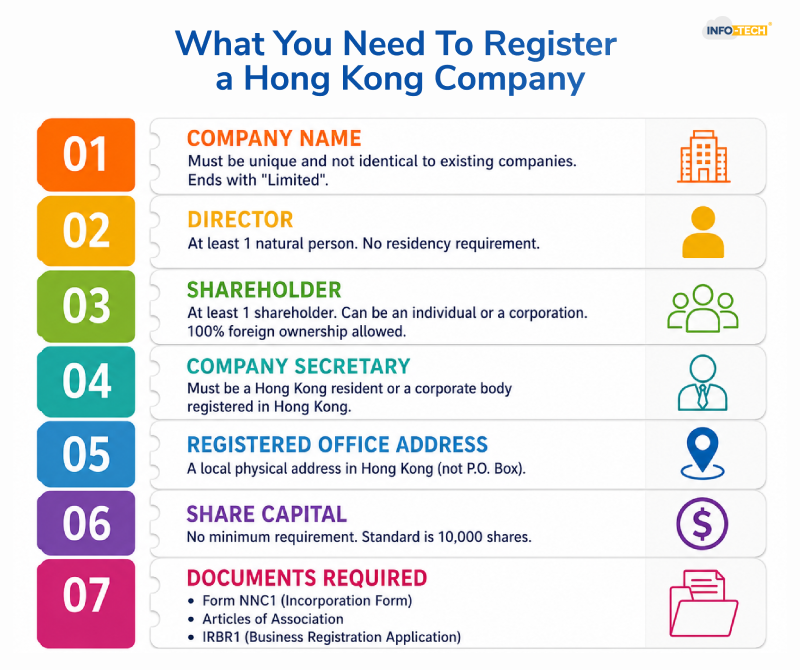
Most businesses register as private companies limited by shares. The main requirements are shown below.
| Requirement | What you need |
| Company name | A name that is available and acceptable under the Companies Ordinance |
| Founder member | At least one founder member or shareholder |
| Director | At least one director who is an individual |
| Company secretary | An eligible individual or corporate body with a Hong Kong presence |
| Registered office | An address located in Hong Kong |
| Share capital | No statutory minimum paid-up capital |
| Articles of association | The company’s internal governance document |
| Incorporation form | Form NNC1 for a company limited by shares |
| Business registration notice | Form IRBR1 |
Company name
The proposed name must not be identical to an existing company name. Restricted, misleading or potentially infringing names might also get rejected.
You can complete a company name search through the e-Services Portal, but the Registry confirms final approval only after it processes the incorporation application.
Directors
A private company must have at least one director who is a natural person. A non-Hong Kong resident may act as a director.
Company secretary
The company must appoint a company secretary.
- An individual secretary must ordinarily reside in Hong Kong.
- A corporate secretary must have its registered office or place of business in Hong Kong.
- A sole director cannot also act as the company secretary of the same company.
Registered office
The registered office must be located in Hong Kong. Its details must be included in the incorporation form. It is used for legal notices, government correspondence and statutory records.
Share capital
There is no legal minimum paid-up capital. A company limited by shares must have at least one founder member, but the Companies Ordinance does not prescribe a minimum number of shares or minimum capital amount.
How Do You Register a Company Through the Companies Registry?
You can complete the company registration process online or submit paper documents.
Step 1: Choose the company type and name
Most commercial businesses choose a private company limited by shares. Check that the proposed name is available and prepare alternatives in case it is rejected.
Step 2: Decide the company structure
Confirm:
- Shareholders
- Directors
- Company secretary
- Registered office
- Share capital
- Initial shareholdings
Step 3: Prepare the documents
A private company limited by shares normally submits:
- Form NNC1
- Articles of association
- Form IRBR1
- The required incorporation and business registration fees
Step 4: Submit the application
Applications may be filed through different ways:
- Electronically through the e-Services Portal
- In hard copy at the Companies Registry
Step 5: Receive the certificates
Once the application gets approved, the Registry will issue:
- Certificate of Incorporation
- Business Registration Certificate
Electronic and paper certificates have the same legal effect.
Step 6: Complete post-incorporation tasks
After incorporation, the company may need to:
- Open a corporate bank account
- Apply for industry-specific licences
- Prepare statutory registers
- Identify significant controllers
- Appoint a designated representative
- Set up accounting, payroll and tax records
A company must keep a Significant Controllers Register even when it has no significant controller. It must also appoint at least one eligible designated representative to assist law enforcement officers when required.
How Much Does Hong Kong Company Registration Cost In 2026?
For an electronic application to incorporate a local company with share capital, the Companies Registry fee is HK$1,545.
The Business Registration Certificate charge depends on the commencement date of the certificate. From 1 April 2026 to 31 March 2027, the charges are:
| Item | 2026 fee |
| Electronic incorporation fee | HK$1,545 |
| Hard-copy incorporation fee | HK$1,720 |
| One-year Business Registration Certificate | HK$2,350 |
| Three-year Business Registration Certificate | HK$6,170 |
| On-time private company annual return | HK$105 |
For a standard electronic incorporation with a one-year Business Registration Certificate, the combined government charges are generally HK$3,895.
These figures do not include professional fees for company secretarial services, registered office services, accounting, audit, banking assistance or licence applications.
What Annual Filings and Compliance Duties Must a Hong Kong Company Complete?
Company registration is only the first step. The company must continue meeting its legal and filing duties each year.
File the annual return
A local private company must normally file Form NAR1 within 42 days after its incorporation anniversary.
The return records information including:
- Registered office
- Directors
- Company secretary
- Members
- Share capital
- Company structure
The company must still file the return even if none of the details have changed. Certain companies with formal dormant status may be exempt from the annual return requirement.
| When Form NAR1 is delivered | Registration fee |
| Within 42 days | HK$105 |
| More than 42 days but within 3 months | HK$870 |
| More than 3 months but within 6 months | HK$1,740 |
| More than 6 months but within 9 months | HK$2,610 |
| More than 9 months late | HK$3,480 |
Late filing can also expose the company and its responsible officers to prosecution and further fines.
Renew the Business Registration Certificate
The certificate must get renewed each year or every three years, which depends on the selected term. The amount payable is based on the certificate’s commencement date.
Maintain statutory records
Companies should keep accurate and updated records, including:
- Register of members
- Register of directors
- Register of company secretaries
- Significant Controllers Register
- Share allotment and transfer records
- Board and shareholder resolutions
- Accounting records and financial statements
Report company changes
Changes should be reported using the relevant forms. For example:
- Director or secretary appointment or resignation: Form ND2A
- Change in director or secretary details: Form ND2B
- Registered office change: Form NR1
Director and company secretary changes generally need to be reported within 15 days.
What Tax Obligations Does a New Hong Kong Company Have?
The Companies Registry handles corporate filings, while the Inland Revenue Department manages taxation.
Profits tax
Hong Kong applies two-tiered profits tax rates for corporations:
| Assessable profits | Tax rate |
| First HK$2 million | 8.25% |
| Amount above HK$2 million | 16.5% |
The two-tiered rate is subject to eligibility rules, particularly where connected entities are involved.
First Profits Tax Return
The first Profits Tax Return is commonly issued around 18 months after incorporation. The filing deadline stated on the return must be followed, and audited financial statements and a tax computation may be required.
After the first return, companies generally file profits tax returns annually.
Territorial source rules
A company is taxed on profits arising in or derived from Hong Kong. Claims that profits are offshore require evidence showing where the profit-generating activities took place.
Foreign-sourced income exemption rules may also apply to certain passive income received by multinational enterprise entities. Offshore treatment should therefore not be assumed automatically.
Employer reporting
A company hiring employees in Hong Kong must meet employer reporting duties, which may include:
- Notifying the IRD after becoming an employer
- Filing the annual Employer’s Return, including Form BIR56A
- Preparing employee remuneration forms
- Maintaining payroll and employment records
What Problems Should Founders Avoid When Dealing with the Companies Registry?
Many registration and compliance problems are caused by small administrative mistakes rather than complex legal issues.
Common problems include:
- Choosing a company name that is unavailable or restricted
- Entering inconsistent director, shareholder or address details
- Using an incomplete or outdated form
- Appointing an ineligible company secretary
- Missing the 42-day NAR1 deadline
- Failing to report company changes within the required period
- Keeping incomplete statutory or accounting records
- Assuming an inactive company is automatically dormant
- Making an offshore profits claim without supporting evidence
- Underestimating bank account KYC requirements
Overseas founders may also find it difficult to maintain a local registered office, appoint an eligible company secretary and follow changes in company, tax and anti-money laundering rules.
A professional company secretarial, accounting or compliance provider can assist with incorporation documents, annual filings, statutory records and deadline tracking. However, directors remain responsible for ensuring that the company meets its legal obligations.
Conclusion
The Hong Kong Companies Registry provides a fast and largely digital route to company incorporation, but staying compliant requires more than obtaining a Certificate of Incorporation. Companies must maintain a Hong Kong registered office, appoint the correct officers, renew their business registration, file annual returns and keep accurate corporate and tax records.
The process is manageable when deadlines and responsibilities are tracked from the beginning. Filing documents correctly and on time is also far less expensive than dealing with late fees, rejected forms or enforcement action later.
Hong Kong Company Registry FAQs
What is the company registry in Hong Kong?
The Hong Kong Companies Registry is the government department that registers companies, maintains corporate records and oversees statutory compliance.
How can I check if a company is registered in Hong Kong?
Visit the Hong Kong Companies Registry’s e-Services Portal, open the company search service, and search using the company name or registration details to view its current registered information.
How can I search if a company is registered?
Search the Hong Kong Companies Registry’s e-Services Portal using the company name or Business Registration Number to confirm its registration status and view available company details.
How much is the filing fee for Hong Kong Companies Registry?
The filing fee depends on the document: a private company’s annual return costs HK$105 when filed on time, while company incorporation costs HK$1,545 online or HK$1,720 in hard copy.
