
In this article
- 1. What Procurement Means?
- 2. Why Is Procurement Important?
- 3. What Are the Main Types of Procurement?
- 4. How Does the Procurement Process Work?
- 5. What Is the Difference Between Procurement and Purchasing?
- 6. How Is Procurement Different From Sourcing?
- 7. What Are Some Examples of Procurement?
- 8. How Can Software Make Business Operations Easier?
- 9. Procurement FAQs
Every business needs to buy things from outside the company. A restaurant buys ingredients, an office pays for software and assets, and a manufacturer depends on raw materials and machine parts. Procurement is the process used to find and obtain all of these goods and services.
It is often confused with purchasing, but procurement starts much earlier than placing an order. It can begin when someone identifies a need and continue through supplier selection, negotiation, delivery, payment and recordkeeping.
What Procurement Means?
Procurement is the full process a business follows to get what it needs from a supplier.
Take something as ordinary as buying laptops for a team. Someone first has to work out how many are needed, what specifications they should have and how much the company can spend. Suppliers are then compared, prices may be negotiated, the order is approved and the delivered laptops are checked.
The aim is not simply to choose the cheapest quotation. A low price does not help much if the supplier delivers late, sends poor-quality products or offers no support when something goes wrong. Procurement looks at the complete value of a purchase, including quality, cost, delivery and reliability.
Why Is Procurement Important?
Procurement affects everyday work more than people sometimes realise. If supplies arrive late, work may slow down or even be paused till the supply is delivered. If the wrong materials are ordered, production can be heavily affected. When purchases are made without proper approval, the business may spend far more than the expected expenditure.
A clear procurementing gives the company better control over these issues. It helps teams buy what they actually need, avoid unnecessary cost spending and choose suppliers they can really rely upon. It also creates a proper record of quotations, orders, contracts and payments that are in process or already processed. This makes it easier to see where money is going and whether suppliers are keeping their side of the agreement.
What Are the Main Types of Procurement?
It is usually divided into four types, although some purchases can fall into more than one category.
Direct: covers anything used to make the products a company sells. For a manufacturer, this may include raw materials, packaging and component parts. For a retailer, it can include goods bought from a wholesaler and later sold to customers.
Indirect: covers the things a business needs to keep running but which do not become part of its final product. Office supplies, utilities, marketing services, staff training and accounting support are common examples.
Goods: refers to physical items. These can range from factory machinery and raw materials to desks, printers and stationery.
Services: involves hiring an outside person or company to carry out work. Legal advice, security, equipment repairs, consultancy and outsourced accounting support – all fall into this group.
How Does the Procurement Process Work?
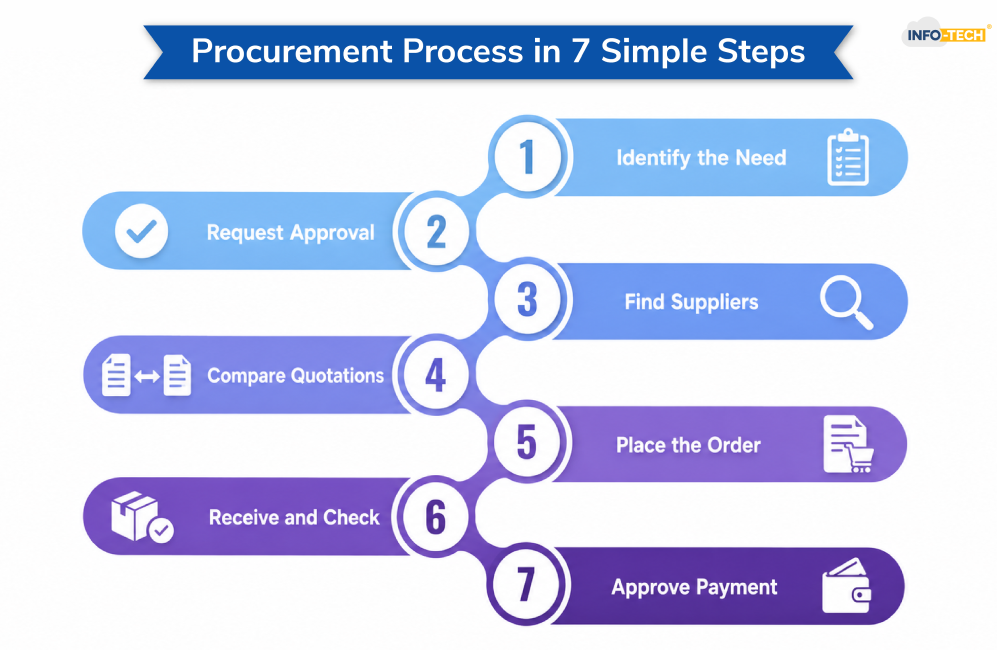
The process usually begins when a department identifies something it needs. The request should explain what is required, how much is needed, when it is needed and what budget is available with the company.
Once the request is approved, the company looks for suitable suppliers. For a routine purchase, this may mean collecting a few quotations. For a larger contract, the business may ask suppliers to submit detailed cost proposals.
The options are then compared. Price matters, but it is usually not the only deciding point. The company may also decide based on the quality, delivery time, experience, payment terms and the supplier’s past performance (if any).
After a supplier is selected, both sides agree on the price and conditions. A purchase order is sent, the goods or services are delivered, and the company checks that everything delivered matches with what was requested.
The invoice is normally compared with the purchase order and delivery record before payment is approved. Records are then kept so the business can refer to them later when reordering, reviewing costs or dealing with a supplier issue.
Read also: What Is Enterprise Asset Management (EAM)?
What Is the Difference Between Procurement and Purchasing?
Purchasing is part of procurement, but the two terms do not mean the same thing.
| Procurement | Purchasing |
| Covers the complete process of obtaining goods or services | Deals mainly with completing an order |
| Starts with identifying a business need | Usually starts after the requirement is approved |
| Considers quality, risk, value and supplier reliability | Focuses more on price, quantity and delivery |
| Can involve long-term supplier planning | Often deals with an immediate purchase |
| Includes supplier selection and contract management | Includes ordering, receiving and payment |
Finding suppliers, comparing proposals and negotiating a yearly contract are procurement activities. Sending a purchase order under that contract is a purchasing activity.
How Is Procurement Different From Sourcing?
Sourcing is one stage within procurement. It mainly deals with finding and selecting suppliers. This can include researching the market, asking for quotations, checking supplier backgrounds and negotiating prices or contract terms. Once a supplier has been chosen, it continues through ordering, delivery, payment and supplier review.
Supply chain management is broader than both. It covers procurement, but it also deals with transportation, inventory, warehousing, production and the movement of finished products to customers.
Put simply, sourcing finds the supplier, purchasing completes the order and procurement manages the whole process around that purchase.
What Are Some Examples of Procurement?
Procurement looks different in every industry. A hotel may procure food, toiletries, furniture, laundry services and booking software. A construction company may need cement, machinery, safety equipment and subcontractors. An office may buy laptops, internet services, stationery and training for employees.
Small businesses also use procurement, even when they do not call it that. The business owner or office manager may compare suppliers, approve purchases, place orders and check invoices without having a separate procurement team.
What matters is that purchases are considered properly instead of being made without checking the need, price or supplier.
How Can Software Make Business Operations Easier?
Procurement helps a company manage what it buys from suppliers. This process can be simplified and automated by using a Project Cost Management Software. Contact us today to organize and compute your project costing.
Payroll and HRMS software supports another important side of the business: employee management. Attendance, leave, claims, salary details and staff records can all be handled through one system, making payroll less time-consuming and reducing repeated checks.
Together, these tools give businesses a clearer view of both project costs and employee expenses. This makes day-to-day operations easier to control and helps teams work with more accurate information.
Procurement FAQs
What is procurement in simple terms?
Procurement is the process a business follows to find, buy, and manage the goods or services it requires.
What are the 4 types of procurement?
The 4 types of procurement are direct procurement, indirect procurement, goods procurement, and services procurement.
Does procurement mean purchasing?
Not exactly. Though purchasing is a part of procurement, they do not mean the same. Procurement also includes identifying needs, finding suppliers, comparing options, negotiating terms, and checking deliveries.
What is an example of procurement?
Here’s a simple example: A restaurant needs vegetables for the week. The manager checks stock, compares prices from three suppliers, chooses one based on quality and delivery time, places the order, checks the goods when they arrive, and approves the invoice for payment.
