

In this article
- 1. What is a Fiscal Year?
- 2. What is the Fiscal Year in Hong Kong?
- 3. What is the Difference Between a Fiscal Year and a Calendar Year?
- 4. Can a Hong Kong Company Choose Its Own Year-End?
- 5. Why is the Financial Year-End Important?
- 6. How Does the Fiscal Year Affect Profits Tax?
- 7. Can a Company Change Its Financial Year-End?
- 8. Fiscal Year FAQs
A fiscal year is the period a business uses to organise its accounts for the year. It gives the business a clear starting and ending point for looking at income, expenses and overall results of the year.
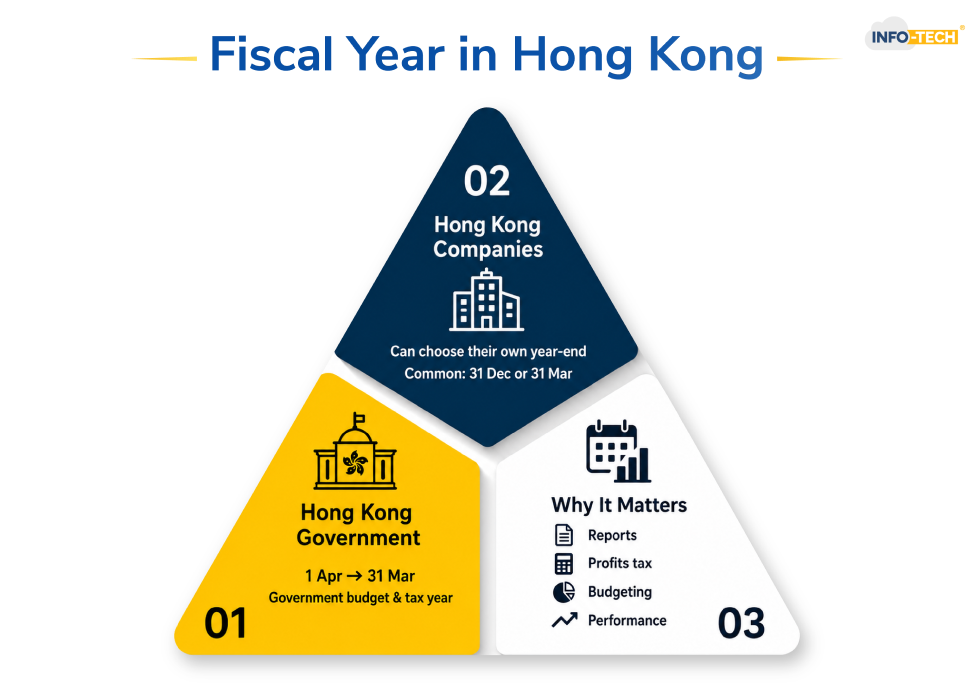
In Hong Kong, the government works on a financial year from 1 April to 31 March. Companies do not necessarily have to follow those same dates for their own accounts, though.
What is a Fiscal Year?
A fiscal year, or a financial year, is usually 12 months long. It can follow the calendar year, but it does not necessarily have to.
For example, a business could use the financial year:
- 1 January to 31 December
- 1 April to 31 March
- 1 July to 30 June
The date on which the period finishes is known as the financial year-end. So, if a company’s accounts run from January to December, its year-end is 31st December.
What is the Fiscal Year in Hong Kong?
The Hong Kong Government’s financial year runs from 1 April to 31 March every year. The 2026/27 year, for example, starts on 1st April 2026 and ends on 31st March 2027.
A Hong Kong company can still keep its own accounts using a different year-end according to its needs. Many businesses simply choose dates that can easily make sense for the way they operate.
What is the Difference Between a Fiscal Year and a Calendar Year?
The terms are easy to mix up, but the main difference is the dates they cover.
| Term | Meaning |
| Fiscal or financial year | The period a business uses for its yearly accounts |
| Calendar year | 1 January to 31 December |
| Accounting period | The period covered by a set of accounts |
| Year of assessment | The period used for Hong Kong tax purposes |
A company using 31st December as its year-end is following the calendar year and a company ending its accounts on 31st March usually works on an April-to-March cycle.
Can a Hong Kong Company Choose Its Own Year-End?
Yes. Hong Kong companies can choose a financial year-end that works for the business. 31 December and 31 March are common, although another date may also suit some companies better.
The decision can come down to fairly practical things. A business may want to finish its financial year after its busiest season, for example. A company that belongs to a larger group may use the same year-end as its parent company. Others simply choose a date that makes budgeting, accounting and audit work easier to manage for their organization.
How Is the First Financial Year Decided?
For a new company, the first financial year starts from its incorporation date.
The directors then decide on the first year-end within the rules that apply in Hong Kong. Because of this, the first financial year will not always be exactly 12 months. It may be a little shorter or longer, although it normally cannot go beyond 18 months from incorporation. After the first year, the company usually moves into a regular 12-month cycle.
Why is the Financial Year-End Important?
The year-end is basically the cut-off point for the company’s yearly accounts.
Once that date arrives, the business can look back at its sales, spending and profit for that period. Those figures are then used for things such as annual accounts, tax work and business planning. It also gives the company a consistent period to compare against previous years. That makes it easier to see whether the business is growing, slowing down or spending more than before.
How Does the Fiscal Year Affect Profits Tax?
Hong Kong’s official tax year runs from 1 April to 31 March, while a company’s own financial year may run on different dates.
For profits tax, the company’s accounts are used to work out the profit for the period that applies. This means a business needs to keep an eye on its own year-end as well as the tax filing dates it has to meet. They are related, but they are not always the same thing.
Can a Company Change Its Financial Year-End?
Yes, a company may change its year-end when its business needs change. It might want to match the reporting dates of a parent company, for example, or move its year-end away from a particularly busy time of year.
For SMEs, the change can affect accounting & bookkeeping, tax and audit work, so it is better to sort out the timing before moving to a new date.
How Can Accounting Software Help?
Year-end is much easier when the accounts have been kept properly during the year. If invoices, expenses and bank transactions are already recorded, there is less to sort out when the accounts need to be closed.
With Info-Tech’s Accounting Software, businesses can keep these records in one place and pull up reports for the period they need. It gives the finance team a clearer picture of the numbers without having to put everything together at the last minute.
Fiscal Year FAQs
What is the fiscal year?
A fiscal year is a 12-month period a business or government uses to track its finances, prepare accounts and measure financial performance of their company.
What is the financial year in Hong Kong?
In Hong Kong, the government’s financial year runs from 1 April to 31 March each year.
What is the HK tax year?
The Hong Kong tax year, known as the year of assessment, runs from 1 April to 31 March of the following year.
Is a calendar year the same as a fiscal year?
No, calendar year and fiscal year are two different periods. While a calendar year always runs from 1 January to 31 December, a fiscal year may follow any 12-month period chosen for accounting or reporting of a business or company.
