

In this article
- 1. Why Are More Businesses Reconsidering Their Approach to HR?
- 2. When Did HR Become So Complicated?
- 3. Why Is Compliance Driving Businesses Towards HR Outsourcing?
- 4. Can HR Outsourcing Actually Reduce Business Costs?
- 5. Why Are Companies Looking for Better HR Technology Solutions?
- 6. How Does HR Outsourcing Free Up Time for Business Leaders?
- 7. What Happens to HR Operations When a Business Starts Growing?
- 8. Why Is Regional Expansion Increasing Demand for HR Outsourcing?
- 9. Has the Perception of HR Outsourcing Changed Over the Years?
- 10. Why Are HR Software and Outsourcing Services Becoming a Powerful Combination?
- 11. HR Outsourcing Hong Kong FAQs
Why Are More Businesses Reconsidering Their Approach to HR?
A decade ago, HR outsourcing was often viewed as something only small businesses did when they couldn’t afford an in-house HR team.
Today, the conversation looks very different.
Walk into any growing company in Hong Kong and you’ll hear a familiar complaint. Managers are spending more time dealing with payroll questions, MPF administration, tax forms, leave calculations, employment contracts, and compliance updates than they are focusing on customers, sales, or growth. The bigger the company becomes, the more these responsibilities seem to multiply.
That reality is one reason hr outsourcing hong kong services have moved from being a cost-cutting option to becoming a strategic business decision.
The shift isn’t happening because companies suddenly want less control over their workforce. In many cases, it’s the opposite. Businesses want better control, fewer compliance risks, and more time to focus on work that actually moves the company forward.
When Did HR Become So Complicated?
Ask business owners what they expected when they hired their first employee.
Most will talk about growth, expansion, and new opportunities.
Very few will mention payroll reporting deadlines, statutory leave calculations, MPF submissions, employee record management, or tax filing obligations.
Yet these tasks quickly become part of everyday operations.
The challenge isn’t that any one requirement is particularly difficult. It’s that every requirement carries consequences when handled incorrectly. A missed contribution, an inaccurate payroll calculation, or an overlooked compliance update can create issues that take far longer to fix than to prevent.
For companies with lean teams, keeping up with changing employment requirements has become a full-time responsibility in itself.
That is where outsourcing starts to make sense.
Rather than asking managers or finance staff to wear multiple hats, businesses are increasingly turning to specialists whose sole focus is managing these functions accurately and efficiently.
Why Is Compliance Driving Businesses Towards HR Outsourcing?
Most business owners don’t lose sleep over HR administration.
What they do worry about is making mistakes.
Hong Kong’s employment framework requires employers to stay on top of a wide range of obligations, from employment contracts and statutory benefits to MPF contributions and tax reporting. As businesses grow, keeping track of these requirements becomes increasingly demanding.
The Continuous Contract requirement, commonly known as the 468 Rule, is a good example. Employers need accurate records of employee working hours to determine benefit eligibility. For businesses managing part-time, casual, or flexible work arrangements, monitoring this manually can become surprisingly complicated.
Many outsourcing providers invest heavily in systems designed specifically for this type of compliance management. Instead of relying on spreadsheets, paper records, or fragmented processes, companies gain access to structured systems that help reduce risk and improve accuracy.
For management teams, that confidence is often worth more than the cost savings alone.
Can HR Outsourcing Reduce Business Costs?
There is also a simple financial reality behind the growing popularity of outsourcing.
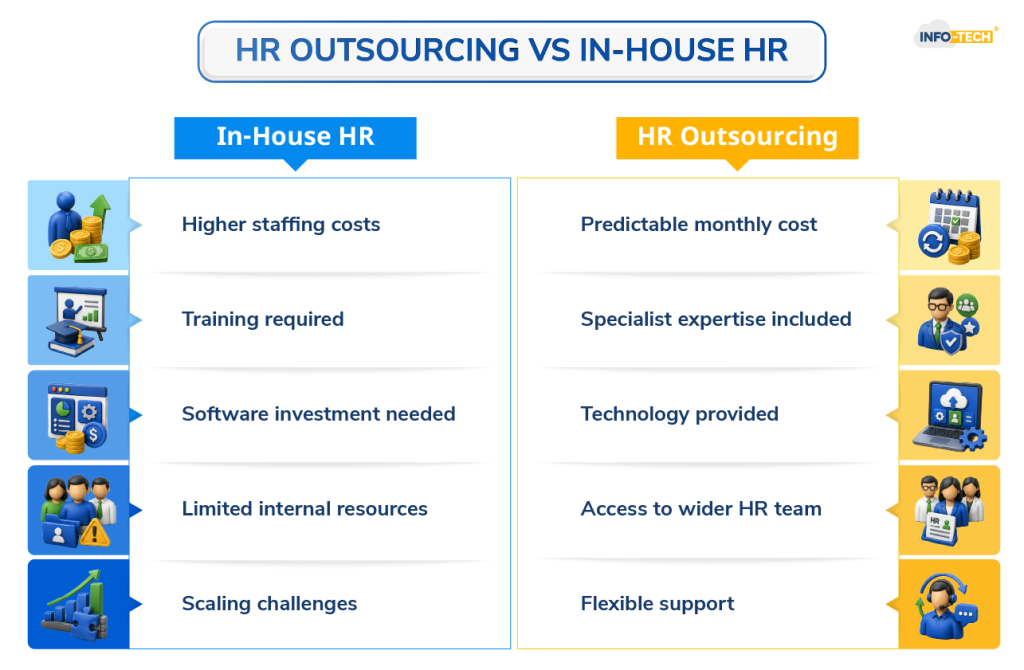
Building an internal HR department is expensive.
Beyond salaries, there are recruitment costs, training expenses, software subscriptions, system maintenance, and the ongoing challenge of keeping staff updated on changing regulations.
For large corporations, these costs may be manageable.
For SMEs, they can become difficult to justify.
Many business owners eventually ask themselves a straightforward question: does it make sense to build an entire department around administrative functions that can be handled externally by specialists?
Increasingly, the answer is no.
Outsourcing allows companies to access experienced payroll professionals, compliance specialists, and HR administrators without carrying the full cost of maintaining those resources internally.
The result is often a more predictable operating cost and greater flexibility as the business evolves.
Why Are Companies Looking for Better HR Technology Solutions?
The modern workforce expects a very different employee experience from what existed ten years ago.
Employees want digital access to leave applications, payslips, tax documents, attendance records, and company information. Managers expect real-time reporting. Business leaders want workforce data that helps them make informed decisions.
Delivering all of this requires technology.
The problem is that implementing HR technology isn’t always straightforward. Purchasing software is only one part of the equation. There are setup costs, training requirements, integrations, security considerations, and ongoing maintenance responsibilities.
Many companies discover that buying software is the easy part. Managing it effectively is where the real challenge begins.
This is another area where hr outsourcing hong kong providers have gained traction. Instead of building systems from scratch, businesses gain access to established platforms and processes that are already operational.
The technology becomes available without the burden of managing it internally.
How Does HR Outsourcing Free Up Time for Business Leaders?
There is an interesting trend emerging across many industries.
Companies are becoming more selective about where management spends its time.
A decade ago, business owners often accepted that HR administration was simply part of running a company. Today, many view it differently.
When senior staff spend hours reviewing payroll adjustments, answering administrative questions, or managing compliance paperwork, there is an opportunity cost attached to that time.
Those same hours could be spent developing new business, strengthening client relationships, improving operations, or exploring new markets.
Outsourcing isn’t just about reducing workload. It’s about allowing people to focus on work that creates greater value for the business.
That distinction is important because it changes how companies evaluate the return on investment.
What Happens to HR Operations When a Business Starts Growing?
Success often creates challenges of its own.
A company that grows from ten employees to fifty employees doesn’t experience five times more HR administration. In many cases, the complexity increases much faster than headcount.
More employees mean more payroll processing, more leave management, more onboarding, more documentation, and more compliance obligations.
Without the right systems in place, growth can expose weaknesses that weren’t visible when the business was smaller.
This is why many companies begin exploring outsourcing during periods of expansion.
Rather than continuously hiring additional HR personnel, businesses can access support that scales alongside their workforce.
Whether the company is hiring five people or fifty, the administrative infrastructure is already there.
Why Is Regional Expansion Increasing Demand for HR Outsourcing?
Hong Kong businesses are increasingly looking beyond local borders.
Some are expanding into Mainland China. Others are hiring remote employees across Asia-Pacific markets. Many are exploring opportunities within the Greater Bay Area.
The challenge is that hiring internationally often involves navigating unfamiliar employment laws, payroll requirements, tax systems, and compliance frameworks.
Establishing a legal entity in every market is not always practical.
As a result, Employer of Record (EOR) services have become increasingly popular. Through these arrangements, companies can hire talent in other jurisdictions without immediately setting up local entities.
For businesses pursuing regional growth, outsourcing has become more than an HR solution. It has become an expansion strategy.
Has the Perception of HR Outsourcing Changed Over the Years?
Perhaps the biggest change isn’t operational. It’s cultural.
There was a time when outsourcing was sometimes viewed as a compromise.
Today, many businesses see it as smart resource allocation.
Few companies build their own accounting software, while few manage their own data centres and few create their own payment infrastructure.
Instead, they rely on specialists.
The same thinking is increasingly being applied to HR.
Companies are recognising that there is a difference between managing people and managing administration. While culture, leadership, employee engagement, and talent development remain internal priorities, routine operational tasks can often be handled more efficiently by external experts.
That shift in mindset is reshaping how businesses approach workforce management.
Why Are HR Software and Outsourcing Services Becoming a Powerful Combination?
The demand for hr outsourcing hong kong services shows little sign of slowing.
Employment regulations continue to evolve. Technology expectations continue to rise. Competition for talent remains intense. At the same time, businesses are under constant pressure to improve efficiency and control costs.
Against that backdrop, outsourcing offers something many organisations are looking for: simplicity.
Not because HR is becoming less important.
Because it has become too important to leave to outdated processes, overstretched teams, or administrative guesswork. This is where modern HR software and outsourcing services often work hand in hand. Cloud-based HRMS platforms, payroll software, attendance management systems, and employee self-service portals can automate routine tasks, reduce errors, and provide management with real-time workforce insights. When combined with professional HR outsourcing support, businesses gain both the technology and expertise needed to manage their workforce more effectively.
HR Outsourcing Hong Kong FAQs
Why are companies choosing HR outsourcing in Hong Kong?
Many companies choose HR outsourcing to reduce administrative workload, improve compliance with employment regulations, manage payroll more efficiently, and gain access to professional HR expertise without building a large in-house team.
Is HR outsourcing suitable for small and medium-sized businesses?
Yes. HR outsourcing is particularly beneficial for SMEs because it provides access to experienced HR professionals, payroll support, and compliance services at a lower cost than maintaining a full internal HR department.
What HR functions can be outsourced?
Businesses commonly outsource payroll processing, MPF administration, tax filing support, employee onboarding, leave management, recruitment assistance, compliance monitoring, and employee record management.
How does HR outsourcing support business growth?
By handling routine HR administration and compliance responsibilities, outsourcing providers allow business owners and managers to focus more on strategic priorities such as expansion, customer acquisition, employee development, and overall business performance.
