
In this article
Walk through any factory, logistics hub, hospital, utility plant, or even a large office complex and you’ll find one thing in common: assets everywhere.
Some are obvious. Production machinery, company vehicles, generators, air-conditioning systems, servers, elevators.
Others quietly do their job in the background until something goes wrong.
The reality is that most businesses don’t lose money because they lack assets. They lose money because those assets are poorly maintained, underutilized, or unexpectedly fail at the worst possible moment.
A manufacturing line stops for six hours.
A delivery vehicle breaks down during peak operations.
Critical equipment requires emergency repairs that cost three times more than planned maintenance.
This is exactly the challenge that Enterprise Asset Management (EAM) is designed to solve.
At its simplest, EAM is a structured way for businesses to keep track of, maintain, and optimize the assets they rely on every day. Instead of treating maintenance as an afterthought, EAM helps companies understand the full story of an asset—from the day it is purchased until the day it is retired.
And for many businesses today, that visibility can make the difference between smooth operations and constant disruption.
Why Has EAM Become Such a Big Deal?
A few decades ago, asset management was often handled with filing cabinets, spreadsheets, and the collective memory of experienced employees.
If a machine needed servicing, someone remembered.
A warranty document was needed, somebody searched for it.
If equipment failed unexpectedly, the maintenance team dealt with it and moved on.
That approach becomes difficult when a company grows.
Managing ten assets is one thing.
Managing ten thousand is something entirely different.
As operations become larger and more complex, every asset creates information. Maintenance records. Inspection reports. Spare part requirements. Repair histories. Compliance documentation. Performance data.
Without a central system, that information becomes scattered across departments, emails, spreadsheets, and paper files.
This is where EAM creates value. It brings everything into one place, allowing businesses to see not just what assets they own, but how those assets are performing and what they are costing the company over time.
According to SAP, modern EAM systems help organizations manage physical assets throughout their entire lifecycle while supporting maintenance planning, operational efficiency, and long-term asset performance.
What Does EAM Manage?
One of the biggest misconceptions is that EAM is simply maintenance software.
It isn’t.
Maintenance is certainly a major part of it, but Enterprise Asset Management covers far more than fixing equipment when it breaks.
Think about a delivery truck.
Long before that truck ever makes its first delivery, decisions have already been made about purchasing it, budgeting for it, insuring it, and assigning it to operations.
Years later, somebody will decide whether it should be repaired, upgraded, sold, or replaced.
Every stage of that journey matters.
EAM helps businesses manage each of those stages rather than focusing solely on repairs.
A modern strategy typically covers:
- Asset planning and procurement
- Installation and commissioning
- Daily operations
- Preventive maintenance
- Compliance inspections
- Spare parts management
- Performance monitoring
- Asset replacement and disposal
In other words, EAM looks at the entire lifespan of an asset instead of just the moments when something goes wrong.
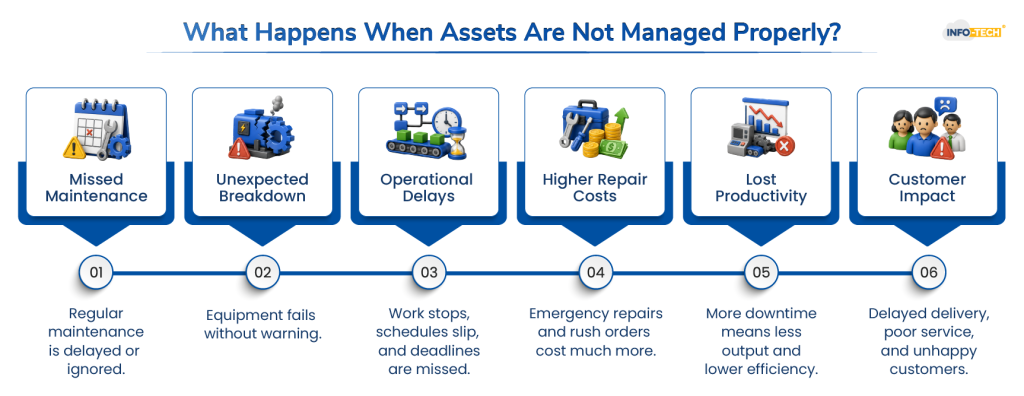
What is the Cost of Not Managing Assets Properly?
Many businesses only start paying attention to asset management after a major failure.
By then, the damage is already done.
A production line outage can delay customer orders.
A failed generator can disrupt critical operations.
A neglected HVAC system can lead to expensive emergency repairs.
The direct repair bill is often only part of the problem.
Lost productivity, missed deadlines, customer dissatisfaction, regulatory issues, and overtime labour costs can quickly push the true cost much higher.
This is why many companies are moving away from reactive maintenance models.
Rather than waiting for assets to fail, they use EAM systems to identify warning signs early and schedule maintenance before problems escalate.
The goal is not simply to repair equipment.
The goal is to prevent disruptions from happening in the first place.
EAM Frequently Asked Questions
What is EAM in simple terms?
EAM, or Enterprise Asset Management, is a process and software system used to track, maintain, and optimize physical assets throughout their lifecycle to improve performance and reduce costs.
What is the main purpose of EAM?
The primary purpose of EAM is to maximize asset reliability, extend asset lifespan, reduce downtime, and improve operational efficiency while controlling maintenance costs.
What is the difference between EAM and CMMS?
A CMMS focuses mainly on maintenance activities, while EAM manages the entire asset lifecycle, including planning, procurement, operation, maintenance, compliance, and retirement.
Which businesses need EAM software?
Organizations with significant physical assets, such as manufacturers, utilities, transportation companies, healthcare facilities, construction firms, and infrastructure operators, benefit most from EAM software.
