

In this article
If you really look at how businesses get paid today, something has clearly changed. Not loudly, not dramatically—but enough that you can feel the difference. And if you’re still following the old way of sending invoices and waiting… you’ve probably noticed it too.
Debtor days used to be one of those numbers finance teams worried about quietly in the background. It showed up in reports, got discussed in meetings, and that was about it. But in 2026, it doesn’t stay in finance anymore. It reflects how your entire business runs—how quickly you move, how connected your systems are, and honestly, how easy you are to do business with.
Why Payment Friction is a Problem?
Most people assume customers delay payments because they’re not prioritising it. But that’s rarely the full story.
More often, it’s just… inconvenient.
Think about how payments usually happen. Someone receives an invoice, maybe as a PDF. They open it, note the details, then think, “I’ll handle this later.” Later turns into next week, then the next cycle. Not because they don’t want to pay—but because it takes effort.
Now compare that to a much simpler experience:
- You open the invoice
- Click a payment link
- Choose Stripe or PayPal
- Done in under a minute
That’s it. No mental load, no switching between apps, no “I’ll get back to this.”
And that’s the real shift. It’s not about chasing people harder—it’s about removing the small bits of friction that quietly slow everything down.
How Faster Payments = Shorter DSO?
When payments come in faster, it’s easy to think, “Great, better cash flow.” But it goes deeper than that.
It changes how the business feels to run.
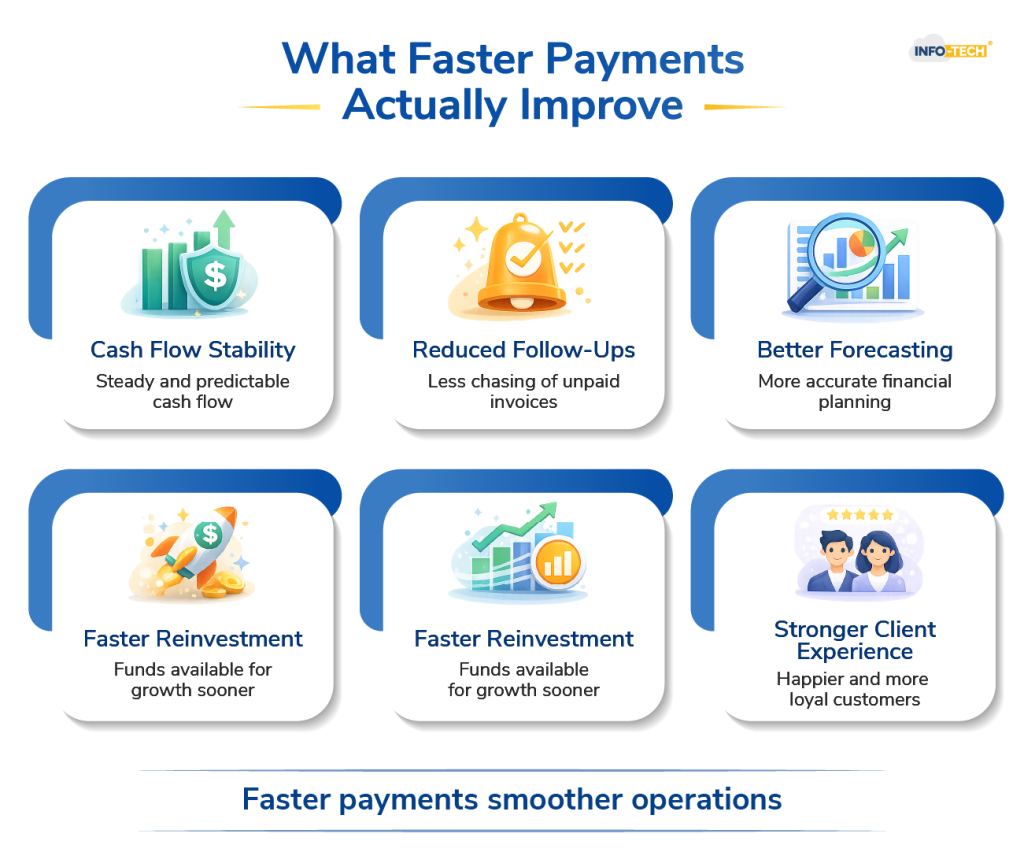
You’re no longer waiting around for money that’s technically already yours. You don’t have to delay decisions or hold back on spending because cash is stuck somewhere in the pipeline. Things just… move.
You start to notice:
- You can plan ahead without second-guessing
- You rely less on credit just to stay comfortable
- You make decisions quicker because the numbers are clearer
And maybe the biggest difference? Momentum.
When money comes in on time—or earlier—teams don’t feel stuck. Sales closes deals and sees results faster. Finance isn’t constantly following up. Leadership isn’t waiting to act.
Everything just flows better.
Where Most Businesses Still Get It Wrong?
Here’s the thing—most businesses already know late payments are a problem. But the way they try to fix it doesn’t really help.
They send more reminders.
They tighten payment terms.
They add penalties.
And sure, sometimes that works. But not in a lasting way.
Because all of that assumes the customer is the problem.
In reality, it’s usually the process.
Sales closes a deal, then somewhere along the line, things slow down. The invoice goes out later. Payment details aren’t clear. The customer has to figure things out on their own. Small gaps appear—and those gaps add days, sometimes weeks.
Instead of pushing harder, what actually works is making the entire process smoother from the start.
What is the Role of CRM Software in Payment Speed?
This is where things get interesting. Because CRM isn’t just about payments—it’s about how everything connects.
Modern CRM software isn’t just for tracking leads anymore. It sits right in the middle of your operations, connecting what happens before a deal closes with what happens after.
So instead of this:
- Deal closes
- Someone manually creates an invoice later
- Finance sends it separately
- Payment gets delayed
You get something much cleaner:
- Deal closes
- Invoice is generated instantly
- Payment link is already included
- Customer receives everything in one go
No gaps. No waiting.
And that’s the difference. Payments don’t get faster because you asked for them sooner—they get faster because the process itself starts sooner and runs without interruption through the use of CRM.
Why Built-In Payment Links is Useful?
At first, adding a payment link to an invoice doesn’t sound like a big deal. But once you see how people respond to it, you realise how much it actually changes things.
When you send an invoice and the payment option is right there:
- People are more likely to act immediately
- They don’t postpone it for later
- They don’t need to figure out how to pay
It just happens.
Especially when you give familiar options like Stripe or PayPal—there’s no learning curve. It feels natural.
And that’s the key. The easier it feels, the faster it happens.
Why 2026 Feels Different?
A few years ago, offering online payments felt like an upgrade. Now it’s just expected.
People are used to:
- Instant transactions
- Multiple payment options
- Doing everything from their phone
So when your payment process feels slow or outdated, it stands out—and not in a good way.
On the flip side, when everything is smooth and quick, it builds trust without you having to say anything. It tells people you’re organised, modern, and easy to work with.
And that alone can influence how quickly they pay you.
Why It’s About Closing the Loop?
Every business runs on a cycle—finding leads, closing deals, sending invoices, collecting payments, and then building long-term relationships.
But a lot of companies unknowingly slow things down right at the payment stage.
And when that happens, everything after it slows down too.
When payments are quick, though:
- Sales sees faster results
- Finance spends less time chasing
- Customers don’t feel any friction
The whole loop tightens. And when that loop is tight, the business feels… lighter. Faster. More in control.
Final Thought
Reducing debtor days isn’t really about being stricter or more aggressive.
It’s about making things easier.
Because when paying you is simple, people don’t delay it. They just do it.
And once that happens consistently, you stop worrying about when money will come in—and start operating like it already has.
Frequently Asked Questions
How do faster payments help reduce debtor days?
Faster payments reduce debtor days by removing delays in the payment process. When customers can pay instantly—through options like payment links or digital wallets—they’re less likely to postpone it. Instead of waiting days or weeks, payments happen almost immediately, which shortens the overall cash collection cycle and improves cash flow predictability.
Why do businesses still experience delayed payments in 2026?
Even in 2026, many businesses face delays because their payment processes are still manual or fragmented. Invoices are sent late, payment methods are limited, or customers need to take multiple steps to complete a transaction. These small inefficiencies add up, making payments slower—not due to unwillingness, but because the process isn’t convenient.
How does CRM software help speed up payment collection?
CRM software helps by connecting sales, invoicing, and payments into one smooth workflow. Once a deal is closed, invoices can be generated instantly with built-in payment options. This removes the usual lag between departments and ensures customers receive everything they need to pay right away, significantly reducing delays.
What is the impact of built-in payment links on cash flow?
Built-in payment links make it easier for customers to pay the moment they receive an invoice. This convenience increases the chances of immediate payment, reduces follow-ups, and shortens debtor days. Over time, this leads to more consistent cash flow, better financial planning, and less dependency on external funding or credit.
