
In this article
- 1. What Is a Tax Identification Number (TIN)?
- 2. Why You Keep Getting Asked For TIN?
- 3. How Hong Kong Does TIN Differently?
- 4. What is the format of a UEN?
- 5. TIN for Individuals: It’s Your HKID
- 6. TIN for Businesses: Your BRN
- 7. Comparison Between TIN and Other Tax-Related Numbers(TIN)?
- 8. How the System Actually Uses Your TIN?
- 9. Where to Find Your TIN?
- 10. Why Getting TIN Right Matters?
- 11. Closing Thoughts
- 12. Tax Identification Number FAQs
If you’ve ever filled out a tax form, opened a bank account, or dealt with anything remotely financial, you’ve probably been asked for a Tax Identification Number without much explanation.
And that’s where the confusion usually begins. What exactly is a TIN? Do you have one already? Is it different from other IDs? This guide breaks down what a TIN is, how it works (with focus on Hong Kong), and why it matters more than most people realise.
What Is a Tax Identification Number (TIN)?
Tax Identification Number (TIN) is simply a way for government to recognise you in their tax system. It’s a unique number that links everything from your income, filings, payments to you or your business.
Without it, there would be no reliable way to track who has paid taxes, who hasn’t, or what belongs to whom. That’s why it stays quiet behind almost every financial or tax-related process you do. It’s not just about administration either. TINs also help reduce tax evasion, make reporting more accurate, and allow countries to exchange financial information when needed.
Why You Keep Getting Asked For TIN?
You’ll notice that your TIN shows up in places you wouldn’t immediately connect to taxes.
That’s because it’s used as a general financial identifier. You’ll typically need it when:
- Filing your income tax return
- Opening a bank or investment account
- Starting a job or setting up payroll
- Registering a business
- Handling cross-border financial transactions
In other words, it’s not optional, it’s part of how the system recognises you.
How Hong Kong Does TIN Differently?
This is where things get interesting. In many countries, you’re issued a specific number just for tax purposes. Hong Kong doesn’t do that. There’s no separate “TIN card” or dedicated number given out.
Instead, the system uses numbers you already have.
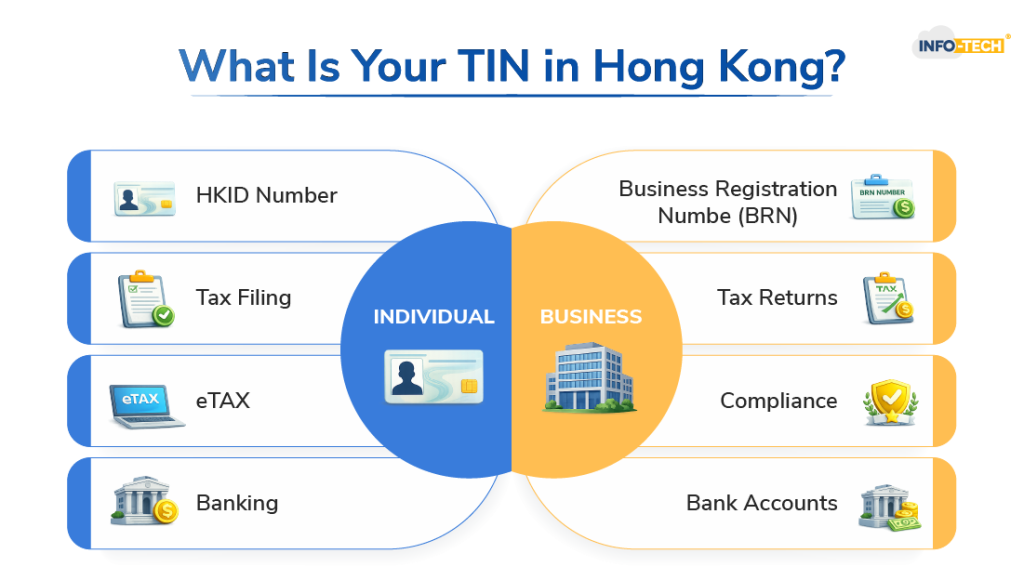
- If you’re an individual → your HKID number is your TIN
- If you run a business → your Business Registration Number (BRN) is your TIN
It’s a simpler setup, and once you understand it, it actually makes things much easier.
What’s TIN for Individuals? It’s Your HKID
If you live or work in Hong Kong, your Hong Kong Identity Card (HKID) number is what the tax department uses to identify you. There’s no extra registration needed. No separate application.
That same HKID number is what you’ll use when:
- Filing your taxes
- Logging into the eTAX system
- Dealing with the Inland Revenue Department (IRD)
One small detail people often miss; the check character (the last letter or number) is part of the TIN and needs to be included when you provide it.
Even non-residents aren’t left out. If you earn income in Hong Kong and file taxes, the system assigns you a tax file number so your finances can be tracked properly.
What’s TIN for Businesses? Your BRN
For companies, things work in a similar way. Your Business Registration Number (BRN) acts as your TIN.
You’ll find this number on your Business Registration Certificate, and it’s used everywhere from tax filings to banking and compliance checks.
Since December 2023, the BRN has taken on an even bigger role. It’s now treated as the Unique Business Identifier (UBI), meaning it’s the main number used across different government systems. So, if you’re running a business, this is the number you’ll keep coming back to.
Comparison Between TIN and Other Tax-Related Numbers
| Number | Who Uses It | What It’s For | What It Means in Hong Kong |
| TIN | Individuals & businesses | Tax identification | HKID or BRN |
| SSN (US) | Individuals | Personal tax & benefits | Similar to HKID |
| EIN (US) | Businesses | Business tax reporting | Similar to BRN |
| VAT ID | Businesses | Indirect tax reporting | Not used in Hong Kong |
| CRN | Companies | Company registry records | Not a tax number |
* In HK, the equivalent of CRN (Company Registration Number) is the Certificate of Incorporation number, and the BRN and CRN are often used together.
How the System Uses Your TIN?
Behind the scenes, your TIN connects everything together.
It’s used by:
- The Inland Revenue Department to track filings and payments
- Banks to verify your identity and meet reporting rules
- Financial institutions for international compliance (CRS, FATCA)
So even if you don’t think about it often, your TIN is constantly being referenced in the background.
Where to Find Your TIN?
Most people already have it but just don’t realise it.
- Individuals: Check your HKID, tax return, or assessment notice
- Businesses: Look at your Business Registration Certificate
There’s no separate “TIN document” you need to hunt down.
Why Getting TIN Right is Important?
This is one of those small details that can cause big issues if handled incorrectly.
Using the wrong number or leaving it out can lead to:
- Delays in processing tax returns
- Mismatched records
- Problems opening bank accounts
- Compliance issues, especially for international reporting
In more serious cases, it can even trigger penalties or investigations. So, while it may seem minor, accuracy here really matters.
Closing Thoughts
A Tax Identification Number isn’t something most people pay attention to, until they have to. But once you understand what it is and how it works, a lot of things start to make sense.
In Hong Kong, the system is actually quite straightforward. You’re not dealing with multiple IDs or complicated processes. It all comes down to using the right number; your HKID if you’re an individual, or your BRN if you run a business. And once you’ve got that clear, the rest of the paperwork becomes a lot less intimidating.
For businesses, a reliable payroll software simplifies the TIN process by automatically storing and linking each employee’s HKID (TIN) to payroll records, reducing manual errors and repetitive data entry. It also helps generate accurate, IRD-compliant reports, flags missing or incorrect details, and keeps all records organised for easy access during tax filing or audits, making compliance much smoother overall.
Tax Identification Number FAQs
How can I verify my TIN number online?
In Hong Kong, individuals cannot verify their TIN (HKID) through a public online tool, but you can confirm it by logging into the IRD’s eTAX portal or checking official tax documents like your Notice of Assessment. For businesses, you can verify your TIN by using the Inland Revenue Department’s Business Registration Number Enquiry System to check the validity of your BRN online.
Is HKID the same as TIN?
In Hong Kong, the HKID is not a separate TIN, but it serves the same purpose. For all tax-related matters, your HKID number is used as your TIN by the Inland Revenue Department.
How many digits is a Hong Kong ID number?
A Hong Kong ID (HKID) number typically has 8 to 9 characters. It follows this format: 1–2 letters + 6 digits + 1 check character. Eg: A123456(7) or AB123456(9).
How to retrieve a lost TIN number?
In Hong Kong, retrieving your TIN depends on whether you’re an individual or a business. For individuals, you can recover it by logging into the eTAX portal using the “Forgot TIN/Password” option or by checking your tax return or Notice of Assessment. For businesses, simply refer to your Business Registration Certificate or use the IRD’s online enquiry system to look up your BRN.
