
In this article
- 1. What Is a Sales Conversion Rate?
- 2. Why Is Sales Conversion Rate Important?
- 3. How Does CRM Software Help Improve Sales Conversion Rate?
- 4. How Do You Calculate Sales Conversion Rate?
- 5. What Affects Sales Conversion Rate?
- 6. How Can You Improve Your Sales Conversion Rate?
- 7. What Is Considered a Good Sales Conversion Rate?
- 8. Why is Sales Conversion Rate Important for Growth?
- 9. Sales Conversion Rate FAQs
A lot of businesses think getting more leads will solve their sales problems. Sometimes it does, but most of the times, it doesn’t. You can have hundreds of people filling out forms, booking demos, or asking for details, but if only a few actually buy, something is clearly off. That’s why businesses pay attention to sales conversion rate. It helps answer one simple question:
“Out of all the people showing interest, how many are actually becoming customers?”
What Is a Sales Conversion Rate?
Sales conversion rate is the percentage of leads that turn into paying customers.
Say your business gets 100 leads this month. If 12 of those people end up buying from you, your conversion rate is 12%.
But that number tells you more than most people realize. It gives you a rough idea of whether your leads are good, whether your sales process makes sense, and whether people are actually connecting with what you’re offering.
Why Is Sales Conversion Rate Important?
Leads cost money. Whether they come from Google Ads, SEO, LinkedIn campaigns, webinars, or referrals, businesses spend time and money bringing people in. So when leads don’t convert, that money disappears without much return. That’s why conversion rate matters.
It shows whether your business is just generating attention or actually generating customers. It also helps uncover problems that usually go unnoticed. Sometimes the issue is weak leads. The other, sales reps are taking too long to follow up. Sometimes the process is just confusing for buyers.
Without tracking conversion rates, businesses often keep guessing instead of fixing the actual issue.
How Does CRM Software Help Improve Sales Conversion Rate?
Once a business starts handling a decent number of leads, things get messy faster.
People forget callbacks. Notes sit inside email threads. Someone promises to follow up “tomorrow” and suddenly a week passes. CRM software helps avoid that chaos.
Everything stays in one place; from lead details, conversations, reminders, follow-ups, to meetings and pipeline stages. Sales teams can quickly see who replied, who booked a demo, and who has gone completely cold.
More importantly, CRM software helps sales reps focus on leads that actually look serious. For example, someone who opened multiple emails, checked pricing, and requested a demo is probably worth prioritizing over someone who randomly filled out a form once and disappeared.
Without a CRM, a lot of those signals get missed.
How Do You Calculate Sales Conversion Rate?
The formula is straightforward.
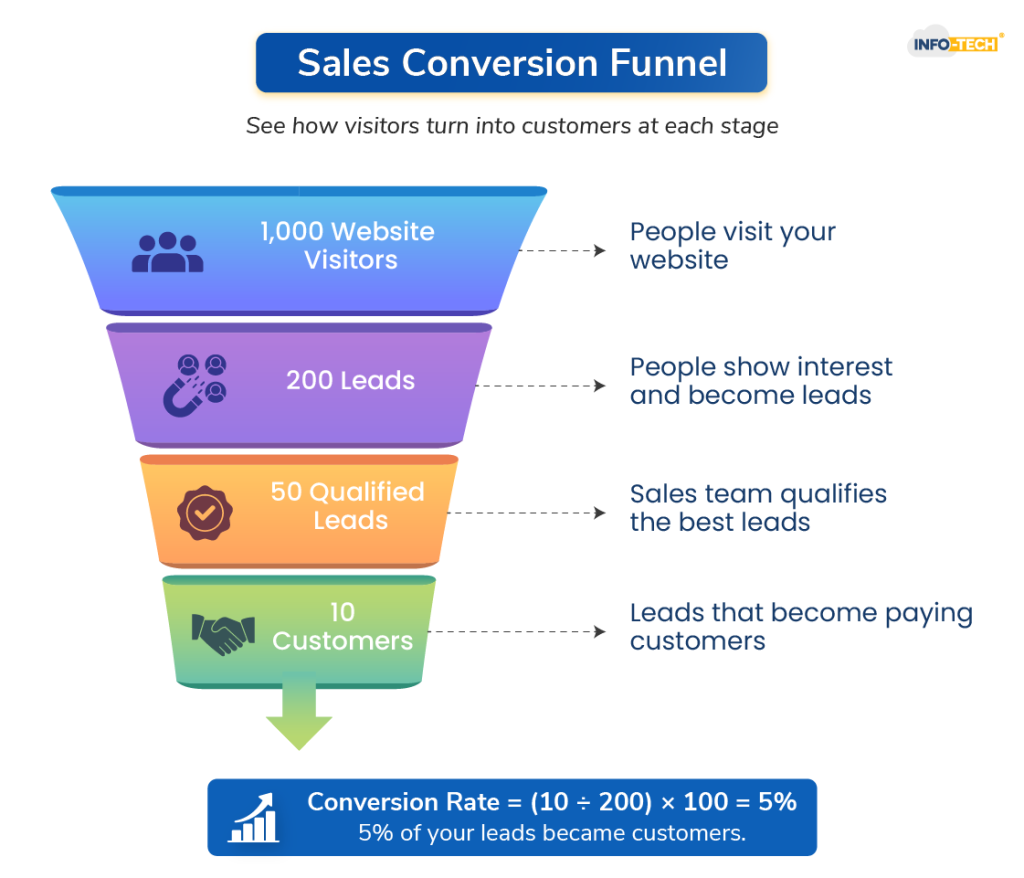
(Number of Customers ÷ Total Leads) × 100
Take the number of customers, divide it by the total number of leads, then multiply by 100. This gives you the conversion percentage.
Example: A company gets 200 leads during the month. Out of those 200 leads, 30 people become customers.
The calculation would be: (30 ÷ 200) × 100 = 15%
So the business has a sales conversion rate of 15%.
For some industries, that’s solid. For others, it may need improvement. Context matters a lot here.
What Affects Sales Conversion Rate?
There’s usually never one single reason behind low conversions. It’s normally a mix of smaller issues.
Lead Quality
Some leads were never going to buy in the first place. A lot of businesses chase volume because bigger numbers look impressive. But if the leads aren’t relevant, conversion rates naturally suffer. Ten good leads are often better than a hundred random ones.
Sales Process
People lose patience quickly when buying feels difficult. Slow responses, too many steps, unclear pricing, or poor communication can push potential customers away faster than most businesses realize. Sometimes improving the process matters more than generating new leads.
Personalization
Most people can instantly tell when a sales message was copied and pasted. Messages feel different when they sound human and actually relate to the customer’s situation. Even small personal touches make conversations feel less robotic.
Timing
Timing plays a huge role in sales. If someone shows interest today and hears back five days later, there’s a good chance they already moved on. Fast follow-ups almost always perform better.
How Can You Improve Your Sales Conversion Rate?
Businesses usually don’t need dramatic changes to improve conversions. Small fixes done consistently often make the biggest difference.
Focus on Better Leads
A smaller list of qualified leads is far easier to convert than a huge list of people who were never serious. Good targeting saves everyone time.
Follow Up Properly
A lot of sales happen after multiple conversations. But many businesses stop too early because they assume silence means rejection. Often, people are just busy or undecided.
Make Conversations Feel Real
Nobody enjoys talking to someone who sounds scripted. People respond better when conversations feel natural instead of overly polished and sales-heavy.
Check Where Leads Drop Off
Sometimes there’s a clear weak point in the funnel. Maybe prospects disappear after seeing pricing. Or the demos are too long. Maybe follow-ups slow down after the first call. Looking closely at where people lose interest usually reveals what needs fixing.
What Is Considered a Good Sales Conversion Rate?
There’s no universal number for a good sales conversion rate. A business selling expensive software will usually have different conversion rates compared to an ecommerce store selling low-cost products.
That’s why chasing random industry averages doesn’t help much. What matters more is whether your conversion rate is improving over time.
Why is Sales Conversion Rate Important for Growth?
At some point, every growing business realizes the same thing:
More leads alone won’t fix sales problems. What matters is how many of those leads actually become customers.
That’s why sales conversion rate is such an important metric. It gives businesses a clearer picture of what’s working, what isn’t, and where money is being wasted.
And when CRM software is used properly, it becomes much easier to manage leads, stay organized, and avoid losing opportunities that should have turned into sales.
Read also: CRM Meaning Explained: What Is CRM & Why It Matters
Sales Conversion Rate FAQs
What is a sales conversion rate?
A sales conversion rate is the percentage of leads or prospects that turn into paying customers.
How to calculate conversion rate of sales?
To calculate sales conversion rate, divide the number of customers by the total number of leads, then multiply by 100.
Formula: Sales Conversion Rate = (Number of Customers ÷ Total Leads) × 100
What is a KPI for conversion rate?
A conversion rate KPI is a performance metric that measures how many leads, visitors, or prospects complete a desired action, such as making a purchase, signing up, or becoming a customer.
How to get good sales conversion rate?
A good sales conversion rate comes from targeting the right leads and following up with them consistently. Businesses that respond quickly, personalize communication, and use CRM software to manage leads usually see better conversion rates.
