

In this article
- 1. What Is IRC3113 in Hong Kong?
- 2. When Should a Business File IRC3113?
- 3. IRC3113 Filing Checklist for SMEs and Startups
- 4. Who Must Sign IRC3113?
- 5. Can IRC3113 Be Filed Before Closing the Business?
- 6. How Can You Submit IRC3113?
- 7. Does Filing IRC3113 Cancel All Company Obligations?
- 8. What Happens to Business Registration Fees?
- 9. What If the Business Is in Liquidation?
- 10. Common IRC3113 Mistakes to Avoid
- 11. A Practical Pre-Filing Checklist
- 12. RC3113 Frequently Asked Questions
What Is IRC3113 in Hong Kong?
IRC3113 is the Inland Revenue Department form used to notify the Business Registration Office that a business or branch has ceased operating in Hong Kong. In plain terms, it is the form you use when you want the government to know that a registered business is no longer active and its business registration should be cancelled.
For many SMEs and startups, this form appears at a difficult stage. The business may be closing, restructuring, pausing operations, or shutting a branch. Because of that, IRC3113 is often treated as “just another form”. That is a mistake. If the closure is not properly reported, the business may continue receiving business registration demand notes, and the owner may still be treated as responsible for compliance matters.
Also Read: Business Registration Requirements in Hong Kong
When Should a Business File IRC3113?
A business should file IRC3113 after it has actually ceased business. The IRD does not accept advance notice before the cessation date. Once the business or branch has closed, the operator must notify the Commissioner of Inland Revenue in writing within one month.
This applies to sole proprietorships, partnerships, branch businesses, other unincorporated bodies, companies in liquidation, and non-Hong Kong corporations that have stopped having a place of business in Hong Kong.
For a startup founder, the key point is simple: do not wait until the next renewal notice arrives. Once the business has stopped trading, issuing invoices, serving customers, or operating from its registered branch, the closure should be documented properly.
IRC3113 Filing Checklist for SMEs and Startups
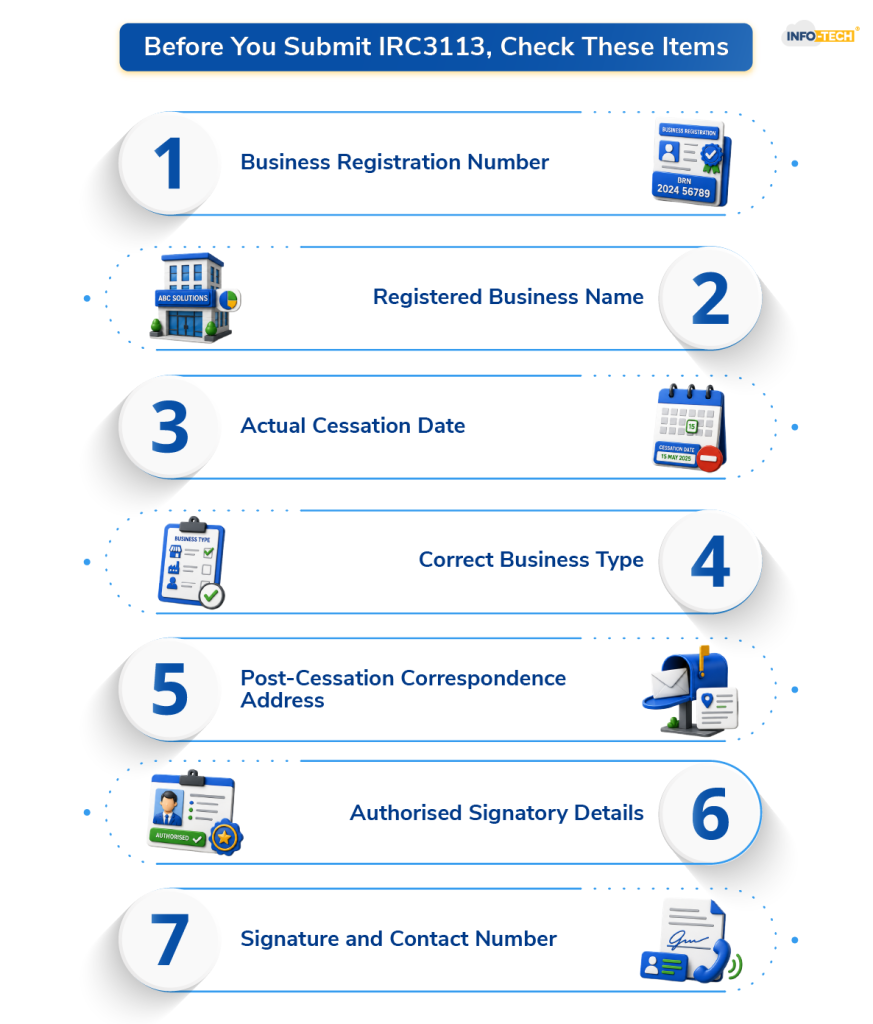
Before submitting the form, prepare the correct business details. The Business Registration Office needs enough information to identify the business clearly and update its records without confusion.
You should have the following ready:
| Item | What You Need |
| Business or branch registration number | Use the number shown on the Business Registration Certificate. For the main business, “000” is used for the branch code. |
| Business, corporation, or branch name | Use the registered name exactly as shown on official records. |
| Date of cessation | Enter the actual closing date in DD/MM/YYYY format. |
| Type of closure | Tick whether it is a sole proprietorship, partnership, branch, liquidation case, or non-Hong Kong corporation closure. |
| Postal address after cessation | Provide a valid correspondence address after the business closes. |
| Signer details | Include the signer’s name, designation, ID/passport/BR number where required, signature, date, and telephone number. |
This may look straightforward, but small inconsistencies can slow things down. A different spelling of the business name, a wrong branch number, or an unclear cessation date can create unnecessary back-and-forth.
Who Must Sign IRC3113?
The form must be signed by the business operator or an authorised person depending on the business structure.
For a sole proprietorship, the sole proprietor signs, for a partnership, a partner signs. for a body corporate, a director, manager, secretary, or liquidator may sign depending on the situation and for other unincorporated bodies, the principal officer signs.
This matters because the IRD may reject or question a form that is not properly signed. For SMEs using a corporate secretarial firm, the signer details should be handled carefully, especially where the form asks for the business registration number of the corporate director or secretarial firm.
Can IRC3113 Be Filed Before Closing the Business?
No. Advance notice is not accepted. The cessation date must already have occurred before the notice is filed.
This is a common mistake among founders who want to “settle paperwork early”. You can prepare the information in advance, but the notice itself should only be submitted after the business has ceased.
How Can You Submit IRC3113?
IRC3113 can be submitted by post or in person. The signed original form or written notice may be posted to the Commissioner of Inland Revenue or it may also be delivered in person to the Business Registration Office.
The IRD also allows cessation notification through GovHK’s online service for change of business registration particulars. However, if you are filing the physical IRC3113 form, do not send it by fax or email.
Does Filing IRC3113 Cancel All Company Obligations?
Not always. This is where many startups get confused.
Cancelling business registration is not the same as deregistering a limited company. A Hong Kong incorporated company is generally treated as carrying on business for business registration purposes until it is dissolved or deregistered. So, if your company is simply inactive but still legally exists, it may still need to maintain business registration and handle Companies Registry obligations.
If a company is applying for deregistration through the Companies Registry, the Companies Registry will notify the IRD of the deregistration result. In that situation, the applicant is not required to separately submit IRC3113 or a written notification to the IRD for that deregistration result.
For sole proprietors and partnerships, the IRC3113 process is usually more direct because the business registration is tied more closely to the business operation itself. For limited companies, closure usually requires broader planning, including tax clearance, accounting records, company deregistration, and possibly professional advice.
What Happens to Business Registration Fees?
A business must pay the business registration fee and levy up to and including the year in which the business ceased. In other words, filing IRC3113 does not automatically erase amounts that were already due for the cessation year.
This is important for founders managing cash flow during closure. Before assuming the business has no more government costs, check whether there are outstanding demand notes, renewal amounts, or penalties.
What If the Business Is in Liquidation?
If a limited company is in liquidation, IRC3113 may be used with supporting documents. The IRD states that a copy of the special resolution for liquidation should be forwarded. After reviewing the documents, the Commissioner may consider suppressing future business registration demand notes for years after the winding-up began. However, the company still has to pay the fee and levy up to and including the year in which winding-up commenced.
This is not the same as a simple business closure. If liquidation is involved, the company should usually work with a professional adviser, liquidator, or corporate service provider.
Common IRC3113 Mistakes to Avoid
The most common mistake is treating IRC3113 as a casual admin form. It is not complicated, but it still affects public business registration records and tax administration.
Avoid using an estimated future closure date. Do not leave the post-cessation correspondence address blank, do not forget to sign the form and do not email or fax the physical form to the Business Registration Office. And if the business is a limited company pursuing deregistration, do not confuse IRC3113 with the Companies Registry deregistration process.
For startups, another mistake is closing the business operationally but leaving bank accounts, subscriptions, payroll matters, invoices, or tax filings unresolved. The form tells the IRD the business has ceased, but it does not clean up every operational obligation by itself.
A Practical Pre-Filing Checklist
Before filing IRC3113, SMEs should review whether the business has stopped issuing invoices, completed final customer collections, settled supplier balances, processed employee final payments, updated accounting records, checked tax obligations, and saved copies of key documents.
This is also where good internal systems help. Accounting software, payroll software, and CRM software can make closure less messy because invoices, employee records, customer follow-ups, and payment histories are easier to trace. When records are scattered across spreadsheets and email threads, even a simple closure form can become stressful.
Final Thoughts
IRC3113 is not difficult to complete, but it should be handled with care. For SMEs and startups, the real issue is not the form itself; it is whether the business closure has been properly documented, timed, and separated from other legal obligations.
If you are closing a sole proprietorship, partnership, or branch, IRC3113 may be the key step in cancelling business registration. If you are closing a limited company, treat IRC3113 as only one part of a wider compliance picture involving tax, company records, possible deregistration, and final accounts.
A clean exit matters. It protects founders from unnecessary notices, penalties, and future confusion.
RC3113 Frequently Asked Questions
What is IRC3113 used for in Hong Kong?
IRC3113 is used to notify the Inland Revenue Department that a business or branch has ceased operating and that its business registration should be cancelled.
When should IRC3113 be filed?
It should be filed after the business has ceased. The notice must be submitted within one month of the cessation date.
Can I file IRC3113 before my business closes?
No. Advance notice is not accepted. The business must already have ceased before the form is submitted.
Is IRC3113 the same as company deregistration?
No. IRC3113 relates to business registration cancellation. Company deregistration is handled through the Companies Registry and involves a separate legal process.
