
Imagine you’re looking at your payslip and wondering if there’s a smarter way to structure your income. The rental reimbursement scheme is one of those options that’s worth paying attention to, especially in a high-cost city like Hong Kong.
At first glance, it might seem like just another benefit that corporate offices provide. But in reality, it’s a clever tax arrangement that can significantly reduce your tax burden without reducing your actual take-home value. Let’s break it down in a way that actually makes sense easily.
What Is Rental Reimbursement Scheme?
In simple terms, the rental reimbursement scheme allows your employer to cover part (or all) of your housing rent while restructuring your salary. Instead of receiving your entire income as cash salary, a portion is designated as a housing benefit.
The key point is: Even though your total monthly income remains the same, the way it is structured changes and that’s where the major tax advantage comes in.
This setup benefits both employees as well as employers. Employees enjoy lower taxable income, while employers may reduce their MPF contribution obligations since those are calculated based on cash salary paid to the employees.
Why It’s More Than Just “Rent Paid by Employer”?
At first glance, you might think: “If my salary is just being split differently, how does that help?”
That’s a fair question.
The real advantage lies on how the housing benefit is taxed. Unlike your regular salary, rental reimbursement is not fully counted as taxable income. It is assessed at a capped rental value that is significantly lower than the actual rent paid. This difference is what creates substantial tax savings.
What are the Benefits for Employees?
1. Direct Financial Relief on Housing
This is obvious: your rent is either partially or fully covered by your employer. In a city where rent can easily take up a large chunk of your income, this alone would be a meaningful financial benefit. But the real advantage goes deeper than that.
2. Lower Taxable Income
The standout benefit is how this scheme reduces your tax liability. Instead of taxing the full rental amount, Hong Kong tax rules apply a cap. The rental value is calculated as 10% of your taxable income or the actual rent paid, whichever is lower. Because of this, a large portion of your income effectively escapes full taxation.
The result? You end up paying less tax while still earning the same overall income.
What are the Benefits for Employers?
This scheme isn’t just employee-friendly but also strategically useful for companies.
1. Strong Talent Attraction
Offering rental reimbursement makes compensation packages more attractive for the employees, especially for skilled professionals and overseas hires. In competitive hiring markets, this can be a deciding factor for better talents to get hired too.
2. Reduced MPF Contributions
Since MPF contributions are calculated based on cash salary (not the housing benefit) of the employees, restructuring salaries can reduce the employer’s contribution obligations too. Over time, this can lead to meaningful cost savings for the business as a whole.
Who Is Eligible for Rental Reimbursement Scheme?
Unlike other statutory benefits, eligibility for rental reimbursement isn’t fixed by law; it depends wholly on the company policy. That being said, there’s also one consistent requirement across most organizations: you must show records and prove that you are renting a primary residence for stay.
This can be done by submitting proofs such as:
- A valid tenancy agreement
- Rental receipts or proof of payment
As long as these conditions are met and your employer offers the reimbursement scheme, you’re typically eligible for it.
How Rental Reimbursement Scheme Works?
The process is relatively straightforward, but it does primarily involve proper documentation.
- Verification of Residency
Your employer reviews your tenancy agreement and rental proof. - Salary Restructuring
Your employment contract is updated (or an addendum is added) to include the housing benefit. - Payment Arrangement
The employer may:
Reimburse you directly, or
Pay the landlord on your behalf - Tax Reporting
- The benefit is reported in the employer’s IR56B form
- You must also declare it in your individual tax return
What Employers Should Keep in Mind?
If you’re implementing this scheme as an employer, there are a few things you absolutely cannot overlook:
- Eligibility & consistency
Clearly define who qualifies and apply the rules uniformly. - Documentation is critical
Always collect tenancy agreements and proof of rent payments. - Strong administration matters
Poor handling may result in the benefit being treated as a taxable cash allowance—which defeats the purpose. - Accurate reporting
Ensure the housing benefit is properly reflected in the IR56B form. - Clear communication
Provide employees with a simple guide explaining how the scheme works and what they need to declare.
Payroll teams need to correctly classify rental reimbursements and calculate the relevant rental value when preparing employee tax filings. Many organizations rely on payroll software or HRMS software to streamline this process. These systems help track reimbursements, store documentation, manage payroll calculations, and ensure compliance with local tax regulations. By using structured processes and digital tools, employers can manage rental reimbursement schemes efficiently while minimizing administrative errors.
What is an Example for Tax Computation?
Let’s walk through a real-world scenario to understand the impact.
Scenario:
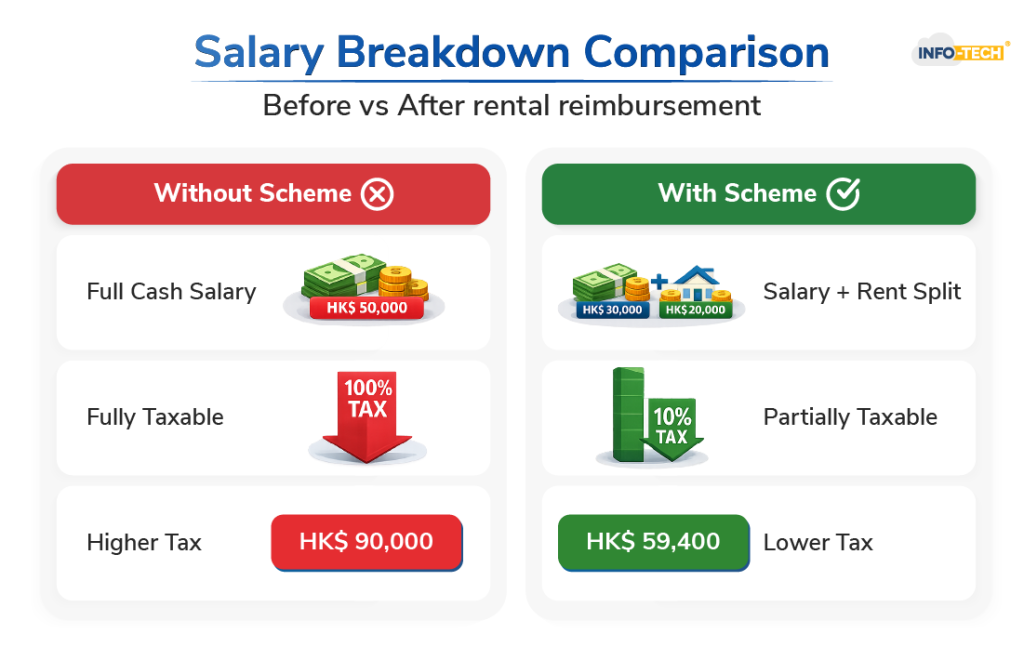
Let monthly income be HK$50,000, monthly house rent be HK$20,000, and tax rate be 15%.
We now compare two employees; Abby and Beth. One of them has no rental reimbursement and the other one has it.
Abby (No Rental Reimbursement)
- Annual income: HK$50,000 × 12 = HK$600,000
- Tax payable: HK$600,000 × 15% = HK$90,000
Beth (With Rental Reimbursement)
- Cash salary: HK$30,000
- Rental reimbursement: HK$20,000
- Total income remains: HK$50,000
Now the calculation changes, as annual cash salary will only count as HK$30,000 × 12 = HK$360,000.
Rental value (taxable portion of housing benefit) is 10% of HK$360,000 = HK$36,000
So, the total taxable income becomes
HK$360,000 + HK$36,000 = HK$396,000
Tax payable will be HK$396,000 × 15% = HK$59,400
So,
- Abby pays: HK$90,000
- Beth pays: HK$59,400
Total savings with Rental Reimbursement Scheme is HK$30,600.
That’s a significant reduction that can be achieved simply by restructuring income, not increasing it.
Final Thoughts
The rental reimbursement scheme is one of those rare financial arrangements where both employees and employers come out and ahead.
For employees, it offers a practical way to reduce tax without sacrificing income. For employers, it strengthens compensation packages while optimizing costs. If your company offers this benefit or is open to it, it’s definitely worth exploring. A small adjustment in how your salary is structured could translate into substantial yearly savings for both parties.
In a city like Hong Kong, where every dollar counts, that’s not something to overlook. With clear policies, proper record-keeping, and efficient payroll or HR systems, companies can manage rental reimbursement schemes smoothly while ensuring employees receive the intended financial and tax advantages. Contact us to stay compliant with the use of Info-Tech’s highly rated software.
Rental Reimbursement FAQs
What is a rental Reimbursement scheme?
A rental reimbursement scheme is a salary structuring arrangement where your employer pays for (or reimburses) your house rent instead of giving you the full amount as cash salary.
How much tax relief do you get on rent?
In Hong Kong, there isn’t a fixed “rent deduction” like in some other countries. Instead, tax relief on rent comes through the rental reimbursement scheme, which reduces how much of your income is taxed.
What is the full rent exemption scheme?
The term “full rent exemption scheme” isn’t an official legal term in Hong Kong tax rules, but people commonly use it to describe a situation under the rental reimbursement scheme where your entire rent is reimbursed by your employer and most of it is effectively not taxed.
How much rent can I take tax free?
In Hong Kong, you can’t take your rent completely tax-free, but under the rental reimbursement scheme, a large portion of it is effectively not taxed.
