
If you’ve worked with payroll in Hong Kong, you’ve probably seen the term MCP thrown around quite a bit. It stands for Monthly Contribution Payment, but honestly, that name makes it sound more complicated than it really is.
Think of MCP as the total MPF money that needs to be paid every month for an employee. This includes both parts—the employer’s contribution and the employee’s contribution. Every month, based on how much an employee earns, this amount is calculated and then sent to the MPF provider.
The important thing to understand here is that MCP isn’t something you can skip or delay. It’s a mandatory requirement, and even small mistakes can cause issues later on. That’s why most businesses take it pretty seriously once they understand how it works.
How MPF Contributions Works?
Now, MCP comes from MPF contributions, so let’s break that down in a simple way.
In most cases, both the employer and the employee contribute 5% of the employee’s income. Sounds easy so far, right? But there’s a catch—there are limits.
- If someone earns very little, they don’t have to contribute—but the employer still does
- If someone earns a lot, the contribution doesn’t keep increasing forever—it gets capped
Here’s a simple way to look at it:
| Monthly Salary | What Happens |
| Below HKD 7,100 | Employee pays nothing, employer still contributes |
| Between HKD 7,100 and 30,000 | Both contribute 5% |
| Above HKD 30,000 | Both contributions are capped at HKD 1,500 |
So, MCP changes depending on how much the employee earns. It’s not the same for everyone.
What “Income” Means Here?
One thing that trips people up is what counts as income when calculating MCP.
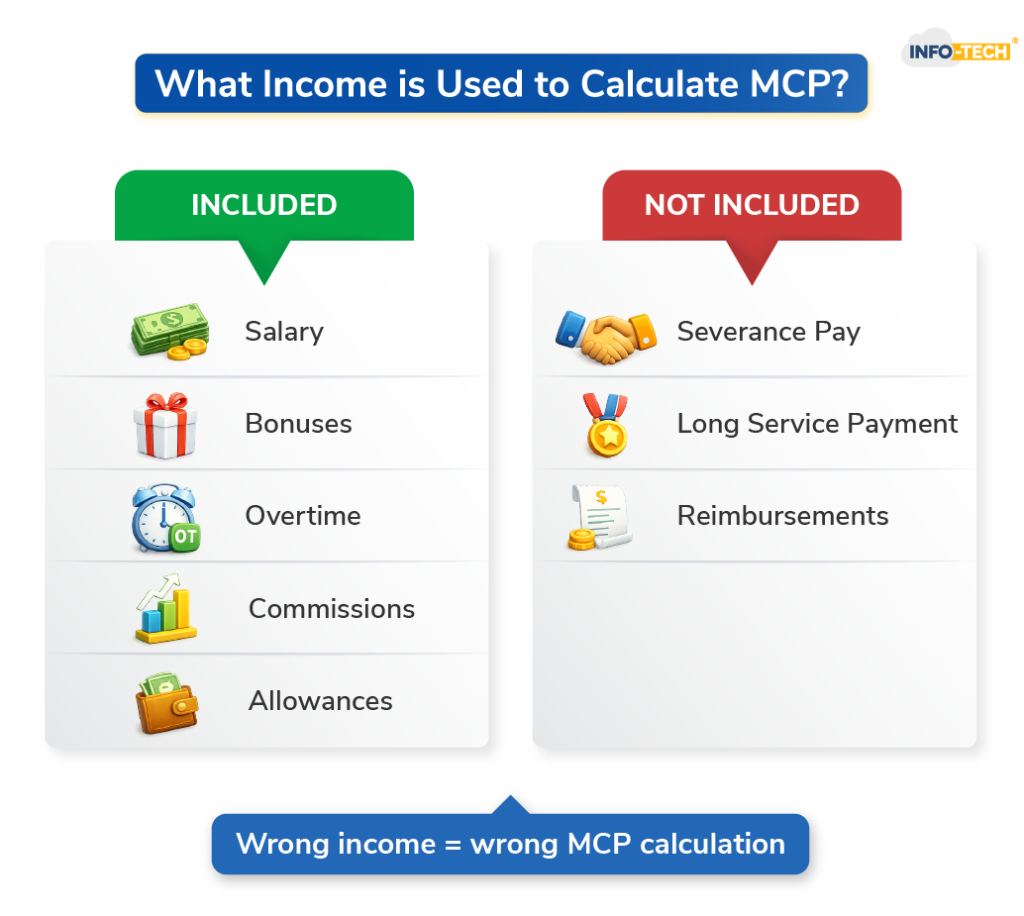
It’s not just basic salary. It usually includes things like bonuses, commissions, overtime pay, and allowances. Basically, if the employee earned it as part of their job, it probably counts.
But not everything is included. Payments like severance or long service pay are usually excluded.
This might sound like a small detail, but it’s actually where many mistakes happen. Miss out something like a bonus, and suddenly your MCP calculation is wrong.
How MCP is Calculated?
Let’s keep this simple.
- Take the employee’s total income for the month
- Calculate 5% for the employer and 5% for the employee
- Check if it needs to be adjusted (minimum or maximum limits)
- Add both together → that’s your MCP
That’s it. No complicated formulas.
Here are a few real-life examples so it clicks better:
| Salary | Employer | Employee | Total MCP |
| 6,500 | 325 | 0 | 325 |
| 20,000 | 1,000 | 1,000 | 2,000 |
| 40,000 | 1,500 | 1,500 | 3,000 |
Once you see it like this, MCP becomes much easier to understand.
What are the Deadlines For MCP?
Here’s the part many businesses struggle with—not the calculation, but the timing.
MCP must be paid on or before the 10th of the next month.
Miss that deadline, and you could face extra charges or penalties. It’s not something you want to deal with, especially if it keeps happening.
That’s why companies try to make this process as smooth and consistent as possible.
What are Some Common Mistakes?
Most MCP mistakes aren’t because people don’t understand it. They happen because of small things that get overlooked.
For example, someone might:
- Forget to include bonuses in the calculation
- Apply 5% correctly but forget the cap
- Miscalculate when an employee joins or leaves mid-month
These aren’t big mistakes individually, but over time, they can create compliance problems.
Why Many Companies Don’t Do This Manually Anymore?
When you only have a few employees, MCP is manageable. But as your team grows, things get messy quickly.
Different salaries, bonuses, changes every month—it all adds up. And the more manual work involved, the higher the chance of errors.
That’s why many companies now use payroll systems to handle MCP automatically. It saves time, reduces mistakes, and makes sure everything is done on time.
Final Thoughts
At the end of the day, MCP isn’t as complicated as it sounds. It’s just about calculating and paying MPF contributions correctly every month.
But even though the concept is simple, the execution needs to be consistent and accurate.
That’s where tools like Info-Tech’s payroll and HRMS software come in. They take care of MCP calculations, apply the right rules automatically, and make sure everything is submitted on time—so you don’t have to keep double-checking everything manually.
MCP Frequently Asked Questions
What is MCP in simple terms?
MCP is the total MPF contribution paid every month for an employee, including both employer and employee portions.
How do you calculate MCP?
You take the employee’s income, apply 5% for both employer and employee, adjust for limits, and add them together.
Do all employees need to contribute?
Not always. If the income is below HKD 7,100, the employee doesn’t contribute—but the employer still does.
What’s the maximum MCP amount?
The maximum is HKD 3,000 per month (HKD 1,500 from employer + HKD 1,500 from employee).
