
As per the Employment Ordinance Cap.57, sick leave is the period at which an employee is absent from work due to personal injury or illness. For eligible employees, this law will provide with statutory protection by means of sickness allowance; which is widely known as paid sick leave.
Sick Leave is a legal entitlement for all eligible employees, governed by set rules. Employees on paid sick leave cannot be dismissed from service and may result in financial penalties for the employer if the employee is entitled to paid sick leave.
What is the Eligibility for Paid Sick Leave In Hong Kong
Who Are All Entitled For Paid Sick Leave?
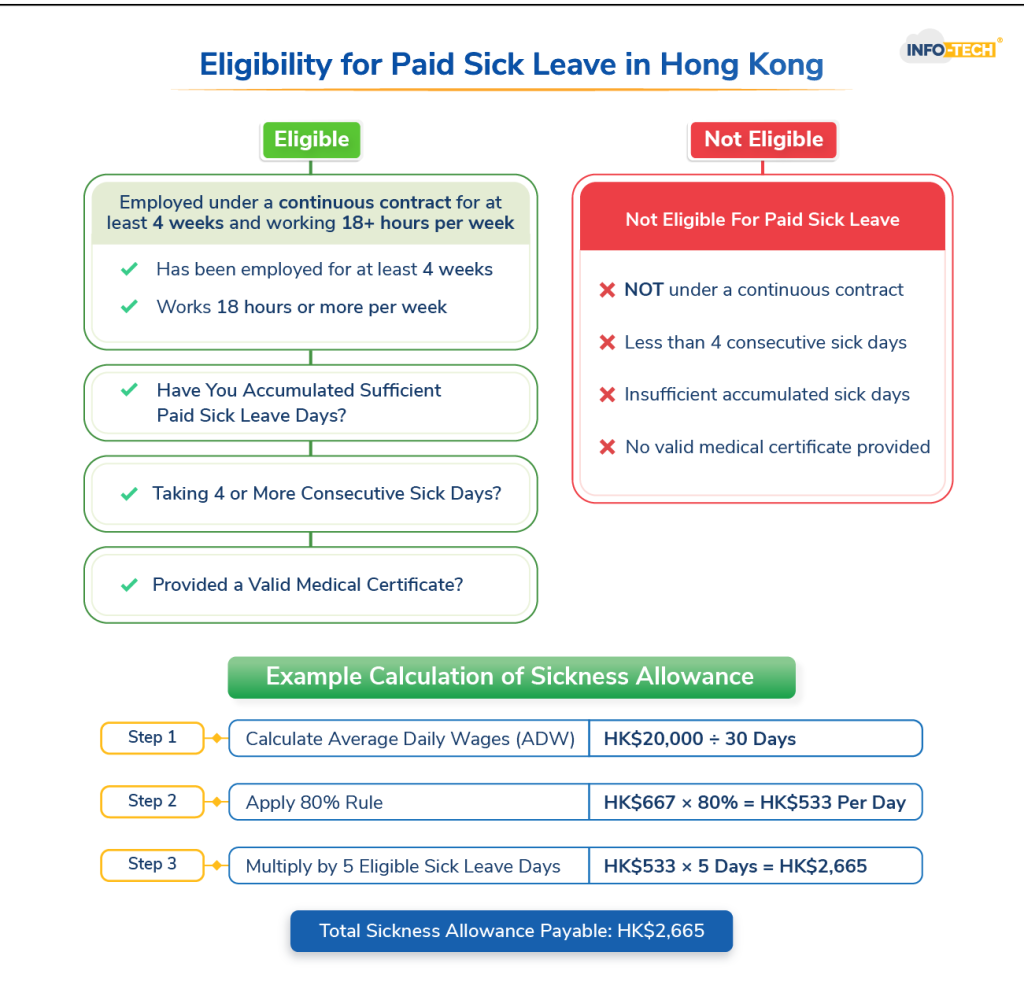
Employees who meet the following criteria are eligible to avail sickness allowance in Hong Kong
- Are employed under a continuous contract (for at least 4 weeks and working 18 hours or more per week)
- Have accumulated sufficient paid sick leave days
- Take sick leave for four or more consecutive day
- Provide a valid medical certificate issued by a registered medical practitioner, clearly stating the number of sick leave days granted and the date.
Important Note
- The employer must pay you 80% of your average daily wages as sickness allowance, if these criteria are met.
- If an employee takes 1, 2, or 3 days of sick leave, statutory payment does not apply.
- If these conditions are not being met by an employee, they won’t be eligible to avail paid sick leave, unless such benefits are being offered by your company.
How is the Accumulation of Sick Leaves?
Paid Sick Leaves can get accumulated in a progressive manner.
- First 12 months of employment: 2 paid sick leaves per month
- After 12 months: 4 paid sick leaves per month
- Maximum accumulation: 120 days
These accumulated days are being divided into two categories –
- Category 1: First 36 days
- Category 2: Remaining 84 days
💡Pro tip: Maintain proper records of the accumulated sick leaves individually, to avoid confusions.
What are the Types of Sick Leaves in Hong Kong?
Depending on each company’s policies, type(s) of sick leave provided to the employees may vary. Broadly, they could be categorized as
- Paid sick leave (statutory entitlement)
- Unpaid sick leave
- Category 1 and Category 2 sick leave days
- Company-provided sick leave
- Work-Related Injury or Occupational Disease Leave
How are the Types Of Sick Leave In Hong Kong?
| Type | Description | Conditions | Payment | Legal Basis |
|---|---|---|---|---|
| Statutory Paid Sick Leave (Sickness Allowance) | Legally protected sick leave under the Employment Ordinance. Employees accumulate paid sick days over time. | Must be under a continuous contract, availing minimum 4 consecutive days of sick leave, provide a valid medical certificate, and have sufficient accumulated sick days. | 80% of Average Daily Wages (ADW) Maximum accumulation: 120 days | Employment Ordinance (Cap. 57) |
| Unpaid Sick Leave | Applies when statutory requirements for paid sick leave are not met. | Fewer than 4 consecutive days of leave, having insufficient accumulated sick days and not under continuous contract. Also, no valid medical certificate is produced. | Not legally required to be paid (unless company policy provides otherwise) | Company policy / Employment contract |
| Category 1 Sick Leave | First portion of accumulated statutory sick leave. | The first 36 accumulated days. Commonly used for outpatient or short-term illness. | Paid at 80% of ADW (if eligibility conditions are met) | Employment Ordinance |
| Category 2 Sick Leave | Remaining portion of accumulated statutory sick leave. | Remaining days up to a total of 120 days. Usually for long-term illness or hospitalization. | Paid at 80% of ADW (if eligibility conditions are met) | Employment Ordinance |
| Company-Enhanced Sick Leave | Sick leave benefits exceeding statutory minimum requirements. | It depends on the company policy. May remove 4-day rule and offer additional days. | May offer 100% wages or improved benefits | Employment contract / Company policy |
| Work-Related Injury / Occupational Disease Leave | Applies when illness or injury arises due to employment. | Subject to work-related incidents. Different reporting procedures apply. | Compensation handled separately (may include wage compensation & medical expenses) | Employees’ Compensation Ordinance |
How is Sick Leave Pay Calculated?
Quick Answer: 80% of your Average Daily Wages (ADW) x Number of Days
Example Calculation
Monthly salary: HK$24,000
Assume 30 days in a month: HK$24,000 ÷ 30 = HK$800 per day.
Your Average Daily Wage (ADW) = HK$800.
80% of your daily wage: HK$800 × 80% = HK$640 per day.
For 5 consecutive sick days: HK$640 × 5 = HK$3,200;
✅ Total sickness allowance payable: HK$3,200.
Closing Thoughts
Understanding sick leave in Hong Kong is necessary for both employers and employees. That being said, having the apt count of sick leaves accumulated is also equally important to avoid confusion. Doing this manually can be time-consuming and is prone to human errors. This is where an easily accessible Leave Management Software can be of great help.
To talk to our experts for a personalized discussion, click here!
Read this article on Paid Time Off Types and its Benefits: You Need to Know
Sick Leave FAQs
Do I get paid if I am off sick for 2 days?
No, as per Hong Kong’s Employment Ordinance, you are not entitled to statutory sickness allowance; paid sick leave can be availed only if the sick leave lasts at least 4 consecutive days.
Can an employee who is on sick leave be terminated?
No, Hong Kong law strongly protects employees from being terminated during paid sick leave.
Do I get full pay if I’m off sick?
No, as per the Employment Ordinance of Hong Kong, employees in paid sick leave are entitled for 80% of your Average Daily Wages (ADW); not 100%.
When to inform sick leave?
There is no exact time stated for notifying sick leave. However, employees are expected to inform their employer as soon as possible when they are unable to attend work due to illness.
