
Operating Cash Flow (OCF) stands out as a key financial indicator for businesses. Even when profits look good on paper, it reveals if your business generates enough cash to keep daily operations running. In simple terms, profit shows if your business is earning; shows if your business can survive and grow.
This guide explains what operating cash flow is, why it matters, and how to calculate it step by step using methods that modern accounting standards accept.
What Is Operating Cash Flow?
Operating Cash Flow (OCF) represents the money a company generates from its main business activities during a set time frame. It shows the cash coming in and going out related to selling products or services, paying vendors, and covering employee salaries.
Unlike profit, it looks at real money movement, not bookkeeping entries or future expected payments. This makes OCF a much better gauge of everyday financial well-being.
Operating cash flow is the money a company makes from its regular business operations, not including financing and investing activities.
Why Operating Cash Flow Matters More Than Profit?
Many companies go under despite showing profits on their books. This often happens because profits don’t always mean cash in hand.
Accountants use accrual accounting to calculate profit. This method records income when it’s earned and expenses when they occur regardless of when money changes hands. It removes this skew and reveals the true cash position of a company.
It helps answer key questions like:
- Can the company pay its employees, vendors, and landlord on time?
- Can it grow without taking on debt?
- Will the company stay afloat during tough times?
Steady positive OCF points to a strong operation and lasting success.
Automated Accounting Software That Makes Operating Cash Flow Effortless!
What is the Difference Between Operating Cash Flow vs Net Income?
It often move in opposite directions, which can puzzle business owners.
Net income includes non-cash items like depreciation and amortisation. These items cut profits on paper but don’t involve any cash leaving the business. OCF adjusts for these items and also takes into account changes in working capital.
Key differences explained in simple terms:
- Net income shows accounting profit
- It shows actual cash generated
- Net income can be positive while OCF is negative
- OCF is tougher to manipulate and more reliable
This explains why investors lenders, and auditors keep a close eye on operating cash flow.
What Has an Impact on Operating Cash Flow?
It influences both operational performance and working capital management.
The main factors that drive cash flow include:
- How customers pay (accounts receivable)
- How much inventory is on hand and how fast it moves
- When suppliers get paid (accounts payable)
- Day-to-day costs like salaries, rent, and utilities
- Expenses that don’t involve cash such as depreciation
Companies that make money can still struggle with cash if clients are slow to pay or too much stock builds up.
Know More: Accounting Standards Of Hong Kong Businesses For Effective Operations.
How to Work Out Operating Cash Flow?
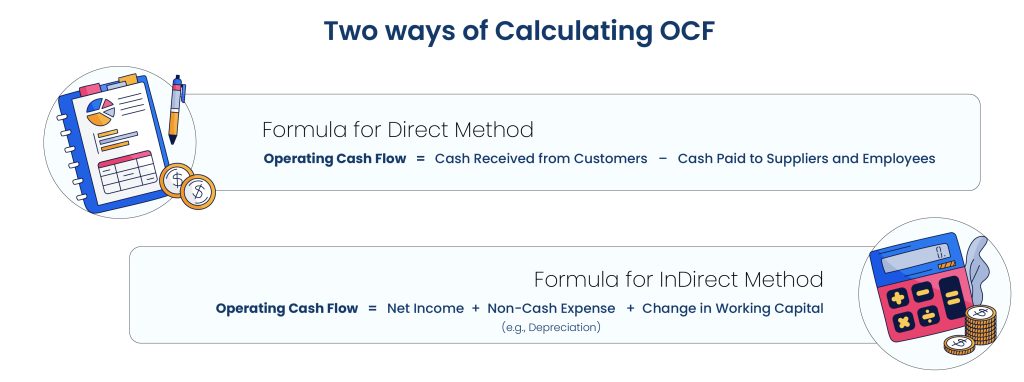
You can figure out in two main ways. Both approaches give you the same answer but take different routes to get there.
Method 1: The Direct Way to Calculate Operating Cash Flow
The direct method has an influence on OCF calculation by listing actual cash received and cash paid during the period. It gives a clear transaction-level picture of cash movements.
Operating Cash Flow = Cash received from customers – Cash paid for operating expenses
Typical cash inflows include:
- Cash collected from customers
Typical cash outflows include:
- Payments to suppliers
- Employee wages
- Rent, utilities, and operating expenses
Example (Direct Method)
A small bakery reports:
- Cash received from customers: HK$10,000
- Payments to suppliers: HK$3,000
- Employee wages: HK$2,000
- Rent and utilities: HK$1,000
Operating Cash Flow = HK$10,000 – HK$6,000 = HK$4,000
The bakery produced HK$4,000 in operating cash over the period.
Read More: Accounting Software And Its Step-By-Step Process For Operational Efficiency In Cash Flow.
Method 2: Indirect Method of Operating Cash Flow
The indirect method is the approach companies use most often in financial statements. It begins with net income and makes adjustments for non-cash items and changes in working capital.
Step-by-Step Indirect Method
Step 1: Begin with net income Step 2: Add non-cash expenses back in
- Depreciation
- Amortisation
Step 3: Make adjustments for changes in working capital
- Money owed to the company
- Goods available to sell
- Money the company owes
- Expenses paid in advance or due later
Formula
Cash from Operations = Net income + Non-cash costs ± Working capital shifts
Example (Indirect Way)
- Net income: HK$5,000
- Add wear and tear: +HK$1,000
Working capital changes:
- Money owed to us went up by HK$500 → take away
- Goods to sell went down by HK$300 → add
- Money we owe went up by HK$200 → add
Cash from Operations = HK$5,000 + HK$1,000 – HK$500 + HK$300 + HK$200 = HK$6,000
This indicates the business made HK$6,000 from its operating activities.
Which OCF Method Should Businesses Use?
Both methods are acceptable under accounting standards. However:
- The direct method provides clarity and openness
- The indirect method is simpler to prepare and used
Most businesses opt for the indirect method because it aligns well with income statements and balance sheets.
Refer More: How Payroll Integration Can Be Influenced In Accounting And HR Software For Seamless Operations.
Operating cash flow reveals how much actual cash a business makes from daily operations. Unlike profit, it shows liquidity, stability, and the ability to grow. Business owners who understand and track OCF can make better financial decisions and avoid running out of cash.
It reveals how much actual cash a business makes from daily operations. Unlike profit, it shows liquidity, stability, and the ability to grow. Business owners who understand and track OCF can make better financial decisions and avoid running out of cash.
Want to upgrade to advanced accounting software? Get in touch with our experts and clear up any questions with solid strategies. Talk us to now.
Operating Cash Flow FAQs
What is a good operating cash flow?
A good operating cash flow stays positive and steady over time. This shows the business makes enough money to pay its bills and grow without borrowing.
Can a business have profit but negative operating cash flow?
Yes. This happens when a company sells on credit, stocks up on inventory, or pays bills before getting money from customers.
Why do investors focus on operating cash flow?
Investors trust operating cash flow because it shows real money coming in. Accounting tweaks don’t change it as much as they do profit.
