

In this article
- 1. When Does A Business Officially Start In Hong Kong?
- 2. What Is The Difference Between Registration And Incorporation?
- 3. Why is a Business Registration Certificate Important?
- 4. What Are The Post-Registration Requirements?
- 5. Can You Operate Immediately After Registration?
- 6. Do All Businesses Need Additional Licences?
- 7. What Are The Common Compliance Mistakes?
- 8. Final Thought
- 9. Business Registration FAQs
People love to say Hong Kong is one of the easiest places in the world to start a business—and on paper, that’s absolutely true. You can get registered quickly, the process is streamlined, and there’s very little bureaucracy compared to other markets.
But here’s the part that doesn’t get enough attention: the system is simple, not casual.
It’s built to be efficient, not forgiving. And if you treat business registration like a quick checkbox instead of the start of a legal and financial responsibility, you’ll feel that difference sooner than you expect.
When Does A Business Officially Start In Hong Kong?
This sounds like a basic question, but it’s where a lot of people quietly get it wrong.
In Hong Kong, you’re required to register your business within one month of commencing operations. The issue is that “commencing operations” isn’t always as clear-cut as opening a shop or signing your first client.
It can be the moment you:
- start promoting your services seriously,
- accept your first payment,
- or begin offering goods, even informally.
A lot of founders assume registration happens once things feel “official.” Legally, that moment may have already passed. And while enforcement isn’t theatrical, it’s systematic, delays can lead to penalties without much warning.
What Is The Difference Between Registration And Incorporation?
Another thing that gets blurred too often is the difference between business registration and company incorporation.
If you’re setting up a limited company, incorporation happens through the Companies Registry. Business registration, however, is done with the Inland Revenue Department (IRD). In most cases, you’ll complete both at the same time through a one-stop process.
But if you’re not incorporating—say you’re freelancing, running a small online store, or testing a business idea as a sole proprietor—then business registration is your primary legal obligation. There’s no “lighter version” of compliance just because the business is small or early-stage.
That’s an important mindset shift. Scale doesn’t determine whether you’re accountable, activity does.
Why is a Business Registration Certificate Important?
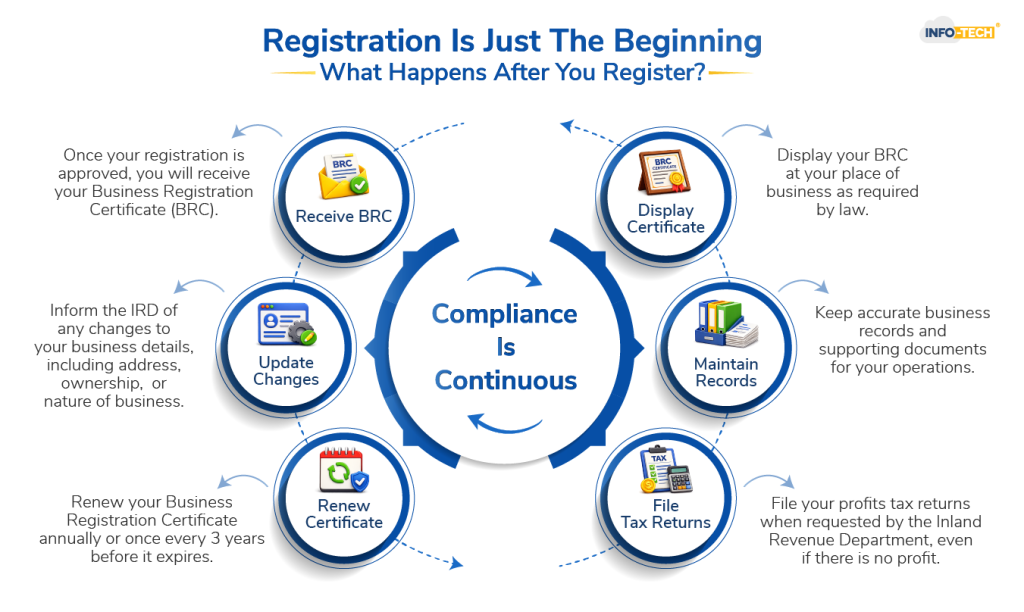
Once your application is approved, you’ll receive your Business Registration Certificate (BRC). It’s easy to treat this as administrative clutter—something to file away and forget.
That would be a mistake.
Your BRC is effectively your business’s identity within the system. It’s tied to your tax filings, your correspondence with the IRD, and often required for practical things like opening a bank account or working with partners.
You’re also expected to display it at your place of business. That might sound old-fashioned, but the principle still holds: your business should be visibly legitimate.
More importantly, the certificate signals that you’re now operating within a structured framework. From that point on, the expectation is consistency—accurate records, timely responses, and awareness of your obligations.
What Are The Post-Registration Requirements?
What catches many business owners off guard isn’t the registration process—it’s what follows.
Once you’re registered, you don’t just exist in the system—you’re expected to keep up with it.
Your BRC needs to be renewed, typically every year (or every three years, if you’ve opted for that). That sounds routine, but missing the deadline leads to penalties, and those penalties don’t take long to escalate.
At the same time, the Inland Revenue Department may issue tax returns, even if your business isn’t generating profit yet. Ignoring them doesn’t make them go away—it simply creates a backlog of problems that tend to surface at the worst possible time.
And if anything about your business changes—address, ownership, nature of activity—you’re expected to update the IRD. It’s not a one-time declaration; it’s an ongoing relationship.
Can You Operate Immediately After Registration?
This is another subtle but important point.
Business registration gives you a legal presence—but it doesn’t automatically give you permission to operate in every context.
Certain industries in Hong Kong are tightly regulated. If you’re in food and beverage, finance, education, trading, or anything that affects public safety or financial systems, additional licences and approvals are part of the equation.
A restaurant, for example, doesn’t just need a business registration certificate. It needs food licences, hygiene compliance, inspections, and ongoing regulatory checks. The same layered requirements apply across many sectors.
So while registration gets you through the front door, it doesn’t mean you’re ready to open for business just yet.
Do All Businesses Need Additional Licences?
Hong Kong’s system isn’t complicated. That’s not the problem.
The problem is assumption.
People assume:
- Small businesses fly under the radar,
- Early-stage ventures have more flexibility,
- Or that compliance can wait until revenue stabilises.
In reality, the system is designed to track activity, not size. Once you’re in, you’re visible. And because processes are digitised and interconnected, it’s much harder for things to be overlooked.
What tends to create friction isn’t the rules themselves—it’s discovering them too late.
What Are The Common Compliance Mistakes?
If you approach business registration with the mindset that it’s just a formality, you’ll constantly feel like you’re catching up.
A better way to look at it is this: registration is the foundation of how your business will operate within Hong Kong’s ecosystem.
That doesn’t mean overcomplicating things or getting buried in compliance from day one. It just means being deliberate.
Know when your obligations start.
Keep your records clean from the beginning.
Pay attention to timelines—especially renewals and tax filings.
None of this is difficult in isolation. It just requires consistency, which is something many businesses underestimate in the early stages.
Final Thought
Hong Kong makes it easy to start a business—but it expects you to run it properly.
That balance is what defines the system. It gives you speed and access, but in return, it expects discipline. And once you understand that, business registration stops being a hurdle and starts becoming what it actually is—the first step in building something that can operate, grow, and last within one of the world’s most structured business environments.
Business Registration FAQs
Do I need to register my business if I’m just freelancing or running a small side hustle?
Yes, you do. In Hong Kong, any individual carrying on a trade, profession, or business is required to register with the Inland Revenue Department within one month of starting. It doesn’t matter if you’re operating from home or earning irregular income—once there’s business activity, registration becomes a legal requirement.
What happens if I don’t register my business on time?
Failing to register within the required timeframe can lead to fines and potential legal consequences. While enforcement may not feel immediate, the system tracks inconsistencies over time. Delays can also create complications when dealing with taxes, banking, or official documentation later on
Is business registration the same as setting up a company in Hong Kong?
No, they’re not the same. Company incorporation is handled by the Companies Registry and applies to limited companies. Business registration, on the other hand, is managed by the Inland Revenue Department and applies to all business types—including sole proprietors and partnerships. Most limited companies complete both at the same time, but they are legally distinct processes.
Do I still need to file taxes if my business isn’t making money yet?
Yes. Once your business is registered, the Inland Revenue Department may issue tax returns regardless of profitability. Even if your business is not generating income, you’re still expected to respond and file accordingly. Ignoring these notices can lead to penalties and unnecessary complications.
