

In this article
- 1. Why are traditional performance reviews no longer working?
- 2. Why are Hong Kong companies moving toward data-driven reviews so quickly?
- 3. What actually changes inside a company when reviews become data-driven?
- 4. Are real-time feedback systems replacing traditional review cycles?
- 5. Are we at risk of turning employees into just numbers?
- 6. What does this shift mean for the future of talent management in Hong Kong?
- 7. Frequently Asked Questions
Something interesting is happening across Hong Kong workplaces right now. Performance reviews—once those awkward, once-a-year conversations everyone tolerated—are quietly being rebuilt from the ground up. And it’s not just a tech upgrade. It’s a mindset shift.
For years, talent management here leaned heavily on intuition. Managers relied on memory, personal impressions, or the most recent performance spikes. But in a city where competition is tight, margins are scrutinised, and talent mobility is high, guesswork no longer cuts it. Companies are starting to ask a tougher question: What if we actually had evidence behind every decision we make about people?
That’s where data-driven reviews step in—and they’re changing more than just appraisal forms.
Why are Traditional Performance Reviews No Longer Working?
Traditional reviews in Hong Kong have always had a timing problem. You sit down in December, try to recall January, and somehow compress a year of effort into a 30-minute conversation. It’s flawed by design.
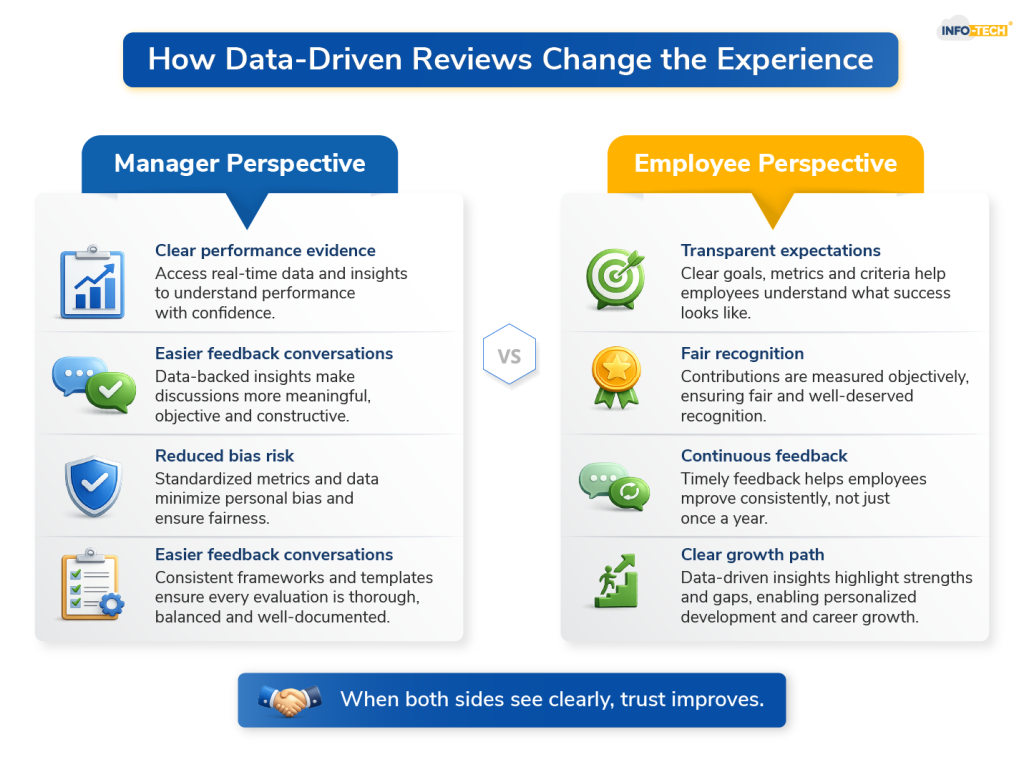
Data-driven systems flip this completely. Instead of relying on memory, they capture performance continuously—sales metrics, project milestones, client feedback, response times, collaboration signals. Suddenly, performance isn’t something you remember, it’s something you can see.
And when managers walk into review discussions now, the tone shifts. It’s less about opinions and more about patterns.
That alone reduces friction. Employees feel it too. When feedback is backed by actual data, it’s harder to dismiss—and easier to accept.
Why are Hong Kong companies moving toward data-driven reviews?
Hong Kong’s work culture has always been performance-oriented, but what’s accelerating this shift is pressure from multiple sides.
- Talent retention is getting harder. Skilled professionals expect fairness and transparency.
- Cross-border teams are more common, making visibility a challenge.
- Compliance and documentation matter more than ever.
Data-driven reviews solve all three at once. They create a clear trail. Every promotion, bonus, or corrective action can be backed by evidence.
And in a market where reputation matters, that kind of consistency builds trust internally.
What changes inside a company when reviews become data-driven?
The biggest misconception is that data-driven reviews are just about dashboards. They’re not. They fundamentally reshape how organisations think about talent.
Take promotions. Earlier, they often depended on visibility—who speaks more, who’s closer to leadership, who’s remembered. Now, quieter high performers have a better chance of being recognised because their contributions are recorded and visible.
Or consider underperformance. Instead of vague feedback like “you need to improve communication,” managers can point to specific patterns or gaps. That clarity makes improvement possible.
Even goal setting becomes sharper. Targets are no longer arbitrary—they’re grounded in actual past performance.
This is where Performance Review Software plays a critical role. It brings all these scattered data points into one place, turning them into something structured, usable, and fair.
Are real-time feedback systems replacing traditional review cycles?
Another shift that’s hard to ignore: the decline of the formal review cycle.
Data-driven environments encourage continuous feedback. Managers don’t wait six months to address issues or recognise achievements. The system nudges them, highlights patterns, and keeps performance visible throughout the year.
This reduces surprises during formal reviews—because nothing is really “new” anymore.
It also changes employee behaviour. When people know their work is being consistently tracked and acknowledged, engagement tends to rise. Not because they’re being watched—but because they’re being seen.
Are we at risk of turning employees into just numbers?
Of course, not everyone is immediately comfortable with this shift.
There’s a valid concern: Are we over-measuring people?
The answer depends on how companies implement it.
Data should inform decisions—not replace human judgement. The best organisations in Hong Kong use data as a foundation, while still leaving room for context and conversation.
Because performance isn’t just output. It’s effort, collaboration, adaptability—things that data can support, but not fully define.
The goal isn’t to eliminate the human element. It’s to remove bias from it.
What does this shift mean for the future of talent management in Hong Kong?
If you step back and look at the bigger picture, this shift is less about technology and more about accountability.
- Managers are becoming more responsible for evidence-based decisions
- Employees gain clarity on what actually matters
- Organisations build systems that are consistent, scalable, and fair
And in a place like Hong Kong—where speed, precision, and professionalism define success—this alignment is powerful.
The companies that embrace data-driven reviews early are already seeing the difference. Not just in performance outcomes, but in culture. Conversations are clearer. Expectations are sharper. Trust is stronger.
What’s the real takeaway here?
Talent management used to rely heavily on instinct. Now, it’s being rebuilt on insight.
That doesn’t make it less human—it makes it more honest.
And as more Hong Kong organisations invest in systems like Performance Appraisal Software, one thing is becoming clear: the future of performance management isn’t about judging people better.
It’s about understanding them better—and helping them grow with purpose.
Performance Review FAQs
What are data-driven performance reviews?
Data-driven performance reviews use real-time metrics, employee activity data, and measurable outcomes to evaluate performance instead of relying only on manager opinions. This approach makes feedback more accurate, transparent, and consistent across teams, especially in fast-paced markets like Hong Kong.
How does Performance Review Software improve talent management?
Performance Review Software centralises employee data, tracks progress continuously, and provides structured insights for managers. This helps organisations make fairer promotion decisions, identify skill gaps early, and create more meaningful development plans for employees.
Why are Hong Kong companies adopting data-driven reviews?
Hong Kong businesses are facing increasing pressure to retain talent, ensure compliance, and manage hybrid teams effectively. Data-driven reviews provide clear documentation, reduce bias, and help organisations stay competitive by making smarter, evidence-based HR decisions.
Do data-driven reviews replace human judgement?
Not at all. They support it. Data provides a clear foundation, but managers still interpret context, behaviour, and soft skills. The goal is to reduce bias and improve clarity—not remove the human element from performance management.
