
The Minimum Wage in Hong Kong, also known as Statutory Minimum Wage (SMW) is the legally mandated lowest hourly wage that must be paid by the employers as per the Minimum Wage Ordinance Cap 608. In this article, we will learn the latest minimum wage as per the statutory laws of Hong Kong, who all are covered under the law and step-by-step guide to calculate it.
Current Statutory Minimum Wage Rate (2026 Update)
The Statutory Minimum Wage law came into force from 1 May 2011. As of now, the Labour Department of Hong Kong officially announces that the minimum pay is at the rate of HK$42.1 per hour, in effect from 1 May 2025. Although the Chief Executive in Council has recommended raising the SMW rate to HK$43.1 per hour, it is subject to approval from the legislative council to come into force from 1 May 2026.
The purpose of implementing this law is to protect employees from getting paid extremely low wages and ensure fair compensation as per Hong Kong’s economic competitiveness.
Who Is Covered Under the Minimum Wage Law
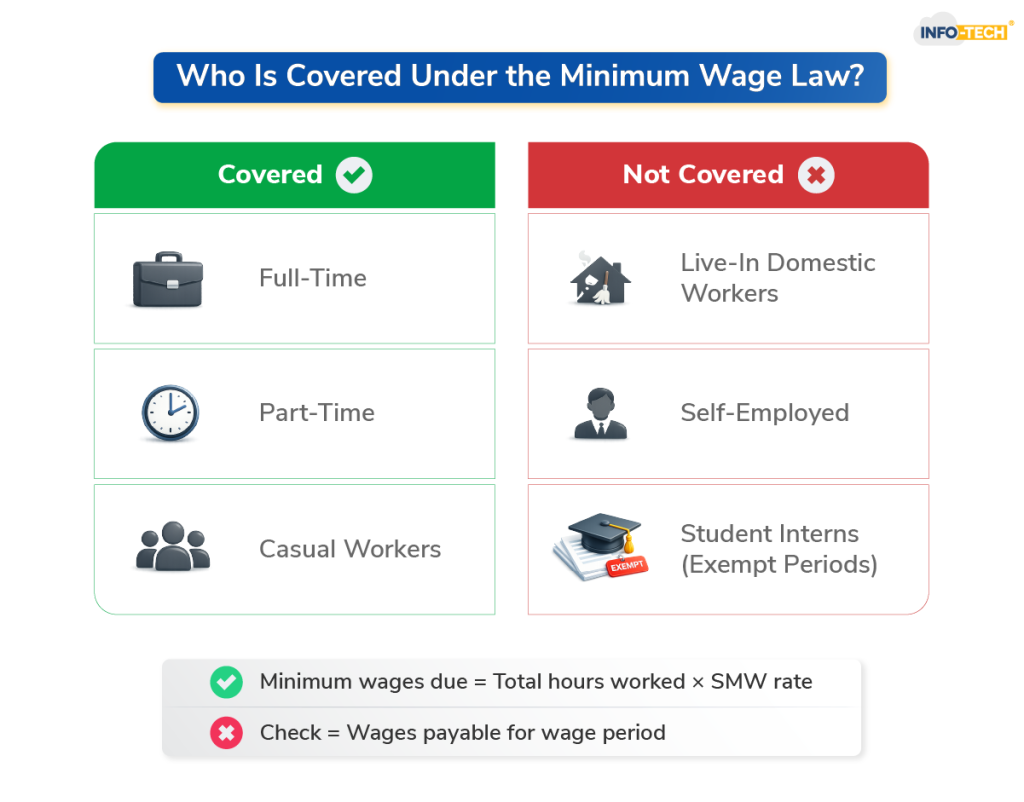
The law applies to all employees (unless stated otherwise), whether they
- Work full-time
- Work part-time
- Are in permanent contract
- Are paid monthly, weekly, hourly or piece based.
Special case: For employees with disabilities, the same law applies. But they may request a productivity assessment by approves assessors to check if wages are aligned to their productivity level. The employee with disability is still applicable for minimum hourly pay even if they do not take the assessment.
Some employees like live-in foreign domestic helpers, interns, work experience students and certain seafarers and apprentices are not covered under the law, since they are either covered by some other minimum allowable wage system, or are not considered as an employee.
How to Calculate Minimum Wage
For calculation, the average hourly wage must be determined.
Formula: Wage compliance =
Total wages in wage period / Total hours worked ≥ HK$42.1
Steps to identify
1: Identify the wage period – monthly, weekly, or daily.
2: Determine the total hours worked – hours worked in that period
3: Calculate the total wages – add basic salary and allowance
4: Work out the average hourly wage – divide total wages by total hours worked.
5: Compare with the minimum wage rate – result should at least be HK$42.1.
Example calculation:
If the total wages of an employee in a month are HK$12,000 and they have worked for 260 hours in total,
12,000÷260=46.15
Since HK$46.15 ≥ HK$42.1, the employer is compliant.
Key Employer Obligations Under Minimum Wage Law
If an employer fails to pay the minimum pay to the employees, it is a serious violation of the employment law and can lead to fines, reputational damage, or even imprisonment for up to 3 years. Applicable interest must also be paid for late wage payments. Maintenance of accurate payroll records is essential for compliance. When manual maintenance is vulnerable to errors, having a reliable payroll software will help organizations maintain accurate records for further use too.
Minimum Wage Hong Kong FAQs
What is the minimum wage in Hong Kong 2026?
As of 2026, the Statutory Minimum Wage (SMW) in Hong Kong is HKD 42.1 per hour (effective from May 1, 2025). The government has also announced an increase to HKD 43.1 per hour from May 1, 2026 (subject to final approval and implementation).
What is the minimum wage for a domestic helper in Hong Kong?
Domestic helpers in Hong Kong are governed by a separate wage protection framework called the Minimum Allowable Wage (MAW), not the general minimum wage law. According to that, the minimum pay for domestic helpers in Hong Kong is HKD 4,870 per month (effective from September 30, 2023).
Which country has the highest minimum wage in 2026?
As of 2026, Luxembourg has the highest minimum wage in the world, with €2,570 per month (≈ USD 2,700+) for unskilled workers and about €3,000+ per month for skilled workers.
What is the salary in Singapore vs Hong Kong?
While Singapore pays higher salaries comparatively, Hong Kong demands lower taxes and has stronger financial sector.
