
Most employers in Hong Kong are familiar with the IR56 series of tax forms used for reporting employee income. Forms like IR56B for employee remuneration or IR56F and IR56G for employee termination or departure from Hong Kong are commonly handled during the employer’s return process each year.
However, one form that many businesses overlook is IR56M.
Unlike other IR56 forms that deal with employees, IR56M is used to report payments made to individuals who are not employees but provide services to the company. This could include consultants, freelancers, agents, entertainers, trainers, contractors, or other professionals hired on a project or service basis.
In recent years, many Hong Kong companies — especially SMEs, startups, and growing businesses — have increasingly relied on freelancers and external service providers. While this flexible working model offers many advantages, it also brings additional tax reporting responsibilities.
If payments made to these non-employees are not reported correctly, businesses may face tax compliance issues, IRD enquiries, or potential penalties.
For this reason, understanding what IR56M is, when it is required, and who needs to be reported is important for companies that want to stay fully compliant with Hong Kong’s tax reporting rules.
What Is IR56M?
IR56M is a tax reporting form used by employers in Hong Kong to declare payments made to individuals who are not employees but provide services to the business.
Unlike payroll reporting forms that record salaries or wages paid to staff, IR56M focuses on service fees or professional payments made to external individuals.
The Inland Revenue Department (IRD) uses this information to ensure that individuals who earn income from providing services also report that income correctly for tax purposes.
In other words, the form helps the IRD track income that falls outside traditional employment relationships.
Why IR56M Exists
| Purpose | What It Means |
| Income transparency | Ensures service providers declare the income they receive |
| Tax monitoring | Allows IRD to track payments made to non-employees |
| Reporting accuracy | Businesses report professional service payments properly |
| Cross-checking | IRD can compare reported payments with individual tax returns |
Because of this process, IR56M plays an important role in maintaining transparency in Hong Kong’s tax system.
Why Many Businesses Miss IR56M
One of the main reasons IR56M is overlooked is simple: many companies assume that tax reporting only applies to employees.
In reality, businesses today often work with many external professionals. For example, companies frequently engage:
- Freelance designers
- Marketing consultants
- IT developers or system specialists
- Sales agents working on commission
- Corporate trainers or guest speakers
- Financial or legal consultants
- Entertainers or performers for events
- Project-based technical specialists
In most cases, payments to these individuals are treated as service expenses in accounting records. Because they are not on the payroll, businesses may not realise that some of these payments still need to be reported through IR56M.
Common Reasons Companies Overlook IR56M
- Businesses assume freelancer invoices do not require reporting
- Finance teams focus only on payroll-related reporting
- Payments are processed through accounts payable rather than HR or payroll systems
- Companies rely heavily on contractors instead of full-time employees
- There is no clear internal process for tracking service payments
As the gig economy and flexible workforce continue to grow, this reporting requirement is becoming increasingly relevant for Hong Kong businesses.
Who Needs to File IR56M?
Any business or organisation in Hong Kong that pays individuals for services — where those individuals are not employees — may need to submit Form IR56M.
This requirement applies to many different types of organisations, including:
- Private companies
- Partnerships
- Non-profit organisations
- Government-related institutions
- Startups and SMEs
The key point is whether the payment is made for services provided by a person who is not employed under a normal employment contract.
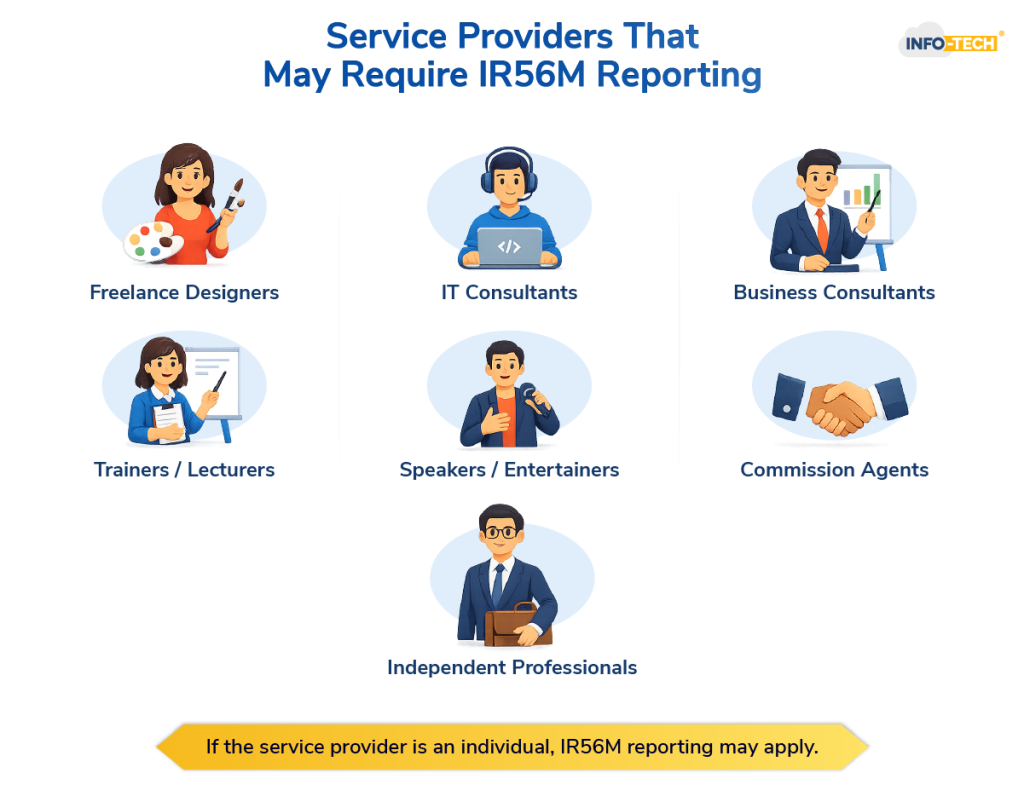
If the service provider is operating as an individual rather than a registered company, IR56M reporting may apply.
Individuals That May Need to Be Reported
Certain types of service providers are commonly reported under IR56M.
| Category | Examples |
| Consultants | Business consultants, strategy advisors |
| Freelancers | Designers, writers, developers |
| Agents | Commission-based sales agents |
| Professionals | Trainers, lecturers, advisors |
| Performers | Artists, entertainers, speakers |
| Contract specialists | IT technicians or project-based experts |
If the service provider operates as an individual rather than through a limited company, businesses should review whether IR56M reporting is required.
When Should IR56M Be Submitted?
IR56M reporting usually takes place during the employer’s return filing period each year.
Typical timeline
| Event | Timing |
| Employer’s Return issued by IRD | Usually April |
| Deadline for submission | Within one month |
| Reporting period | Previous tax year |
Businesses must include all relevant payments made during the reporting year.
Submitting the form late may result in IRD enquiries or compliance issues, so companies should prepare the necessary information in advance.
Information Required for IR56M
To complete IR56M, employers need to provide information about both the service provider and the payments made.
Typical information required
| Information | Examples |
| Personal details | Name, HKID number, address |
| Type of services provided | Consulting, training, performance |
| Total payment amount | Fees paid during the reporting period |
| Payment period | Dates services were performed |
| Employer details | Business registration information |
Keeping clear records of contractor payments throughout the year makes the reporting process much easier when the employer’s return period arrives.
IR56M Compared With Other IR56 Forms
Many employers confuse IR56M with other forms in the IR56 series. However, each form serves a different purpose.
You can explore the full framework in our guide:
IR56 Forms for Employers in Hong Kong : A Brief Study
Key differences between IR56 forms
| Form | Purpose | Covers |
| IR56B | Annual income reporting | Employees |
| IR56E | Notification of new employees | Newly hired staff |
| IR56F | Employee termination | Employees leaving a company |
| IR56G | Employees leaving Hong Kong | Departing staff |
| IR56M | Payments for services | Non-employees |
Understanding these differences helps businesses avoid reporting mistakes and maintain compliance with IRD requirements.
What Happens If IR56M Is Not Filed?
Failing to report payments under IR56M can create problems for businesses, particularly during tax reviews or audits.
Possible consequences include:
- Enquiries from the Inland Revenue Department
- Financial penalties for incorrect reporting
- Additional scrutiny during tax audits
- Administrative complications when filing employer returns
In many situations, these issues arise simply because companies did not have a system for tracking payments made to non-employees.
How Businesses Can Stay Compliant
Managing IR56M obligations becomes easier when companies establish clear internal processes for tracking service payments.
Practical steps businesses can take
- Keep proper records of contractors
Maintain a list of external service providers and document the services they perform.
- Separate payroll and service payments
Employee salaries and contractor payments should be recorded in different categories.
- Track payments throughout the year
Monitoring cumulative payments helps ensure nothing is missed when reporting season arrives.
- Collect necessary documentation
Gather identification details and contact information from service providers early.
- Review reporting obligations annually
Before filing the employer’s return, review whether any payments fall under IR56M.
These simple steps can significantly reduce the risk of missing important reporting obligations.
How HR and Payroll Systems Help With IR56 Reporting
As businesses grow, managing tax reporting manually can become complicated. Companies need to keep track of employee salaries, contractor payments, reporting deadlines, and compliance requirements.
Modern HRMS and payroll systems help simplify this process.
These systems allow businesses to:
- Maintain centralized workforce records
- Track both employee and contractor payments
- Generate compliance reports more easily
- Reduce administrative workload for HR and finance teams
- Improve accuracy during tax reporting
Using digital tools can help companies stay organised and better prepared during the annual employer return process.
How Info-Tech HR and Payroll Software Supports Compliance
For many Hong Kong companies, manually managing IR56 reporting can take significant time and effort. This is why many organisations are adopting integrated HRMS and payroll software.
It is designed to help businesses manage workforce administration while keeping statutory obligations in check.
The platform helps organisations:
- Automate payroll processing according to Hong Kong regulations
- Maintain centralized employee records
- Manage HR documentation digitally
- Integrate payroll, HR, and workforce management functions
- Monitor reporting obligations more effectively
By bringing multiple HR functions together in one system, Info-Tech solutions help businesses maintain better visibility over workforce payments and reporting requirements.
Final Thoughts
As the way businesses operate continues to evolve, many companies now rely on freelancers, consultants, and external specialists alongside their full-time employees. While this flexible workforce model offers many advantages, it also introduces additional reporting responsibilities.
IR56M is one such requirement that businesses often overlook.
Understanding when the form applies and keeping accurate records of service payments can help companies avoid compliance problems and unnecessary administrative complications.
With clear internal processes — and the support of modern HR and payroll systems — Hong Kong businesses can manage both employee and non-employee reporting obligations more efficiently and with greater confidence.
IR56M Frequently Asked Questions
What is IR56M in Hong Kong?
IR56M is a tax reporting form used by Hong Kong employers to declare payments made to individuals who provide services but are not employees. These may include freelancers, consultants, agents, entertainers, or trainers. The form helps the Inland Revenue Department track income earned outside standard employment and ensure proper tax reporting.
Who needs to be reported under IR56M?
Businesses must report payments made to individuals who provide services but are not employed by the company. Common examples include consultants, freelancers, commission agents, trainers, speakers, and entertainers. If the service provider operates as an individual rather than through a limited company, the payment may need to be reported under IR56M.
When should IR56M be submitted?
IR56M is usually submitted together with the employer’s annual return issued by the Inland Revenue Department. Employers typically receive the return in April and must submit the required forms, including IR56M if applicable, within one month.
What information is required to complete IR56M?
To complete IR56M, employers need to provide details about the service provider and the payments made. This includes the individual’s name, HKID number, address, the type of services provided, payment period, and the total amount paid during the reporting year.
