
Hong Kong companies boost worker productivity with digital scheduling tools. These systems assign shifts, match staff numbers to workload, cut down on extra hours, ensure labor law compliance, and help mixed on-site and remote teams. Up-to-date scheduling programs link to pay and time-tracking setups giving businesses a clear picture of their workforce in real time. This lets companies get the most out of their staff while staying in charge of day-to-day operations.
Introduction: The Workforce Productivity Challenge in Hong Kong
Hong Kong businesses compete in one of Asia’s toughest and most price-sensitive markets. Labour costs remain the biggest expense for many sectors like retail, logistics, healthcare, hospitality, and professional services. At the same time, hybrid work arrangements, remote teams, flexible contracts, and evolving compliance requirements have significantly increased workforce complexity.
In the past, people saw scheduling as a basic administrative job – creating work rosters, assigning shifts, and making sure there were enough workers. But now how a company plans its workforce has a direct impact on its profits, employee morale, compliance exposure, and maintaining customers satisfaction.
Getting the most from your workforce in 2026 isn’t just about filling empty shifts anymore. It is about ensuring optimal manpower utilisation while maintaining legal compliance, preventing burnout, and adapting to real-time business demand. This is precisely where e-scheduling software plays a transformative role.
What Does E-Scheduling Mean in Today’s Workforce Management?
Digital employee shift planning, monitoring, and optimization is what we call e-scheduling. Smart software systems do this job. E-scheduling is different from traditional spreadsheets or paper-based schedules. These new platforms have built-in rules automatic processes live updates, and connections to other systems.
Today’s e-scheduling software usually connects with:
- HRMS systems
- Attendance tracking tools
- Payroll processing platforms
- Leave management modules
- Mobile workforce applications
- AI-powered demand forecasting tools
Switching from manual schedules to digital ones isn’t just about new technology. It changes how companies handle their workforce from the ground up.
| To gain basic understanding, check out: Understanding The Basics Of E-scheduling Software |
How Hong Kong Companies Boost Workforce Productivity With E-Scheduling
1. Aligning Staff Numbers to Current Business Needs
A frequent problem across Hong Kong industries is poor staff allocation. Too many staff increase unnecessary labour costs, while too few staff causes service delays, employee stress, and reduced income.
E-scheduling boosts productivity by using data to predict demand accurately. Companies can examine:
- Historical transaction volume
- Seasonal business trends
- Peak-hour traffic patterns
- Customer booking information
- Project targets and due dates
Instead of making educated guesses about staffing needs, managers can assign employees where and when they’re needed.
Industry Application Examples
| Industry | Efficiency Outcome |
| Retail | Match staff numbers with promotional campaigns and mall traffic |
| F&B | Optimise shifts around lunch, dinner, and delivery peaks |
| Logistics | Adjust manpower based on shipment volume and distribution schedules |
| Healthcare | Ensure compliance with rest hour requirements while maintaining coverage |
| Professional Services | Allocate consultants according to billable project stages |
2. Cutting Overtime Expenses and Legal Exposure
In Hong Kong, compliance with Employment Ordinance, rest day rules, and holiday laws is key. Scheduling manually often causes unplanned overtime, unbalanced shifts, or violations from rest days.
E-scheduling tools boost compliance by:
- Keeping tabs on weekly and monthly work hours
- Alerting when overtime limits are near
- Making sure rest days happen
- Stopping double-booked shifts
- Keeping track of holiday work
This tech not only reduces compliance risks but also makes sure payroll is accurate. When work hours are logged overtime, calculations become spot-on, cutting down on disputes and payroll errors.
The end result? Better control over costs and regulatory alignment.
3. Helping Hybrid and Work-from-Home Team Setups
Remote and hybrid work setups are now a key part of Hong Kong’s job landscape. Handling scattered teams by hand leads to mistakes and poor communication.
E-scheduling boosts hybrid workforce output by offering:
- One digital schedule for all
- Phone alerts for shifts
- Live updates when things change
- GPS check-ins for remote workers
- Clear view of everyone’s schedule
This digital transparency makes sure that flexibility doesn’t mean less responsibility. Team leaders can monitor productivity, adjust manpower, and stay on top of things — even with teams spread out all over geographically.
4. Boosting Output Through Clear Schedules
Schedules have a direct effect on productivity. When staff don’t know their working hours, tasks, or shift duties, it causes confusions and inefficiency.
Digital scheduling tools clear up confusion by offering:
- Clear shift job descriptions
- Auto-assigned tasks
- Alerts before shifts start
- Easy-to-follow reporting lines
- Quick approval for shift swaps in real-time
When employees know what to expect before their shift begins, they can zero in on doing their job well instead of dealing with administrative confusions. This cuts down on delays, speeds up response times, and boosts overall work output.
5. Automating Workforce Allocation for Strategic Efficiency
In many small and mid-sized companies, managers spend hours each week making work schedules. This paperwork eats into time they could use to plan ahead, help their team grow, or expand the business.
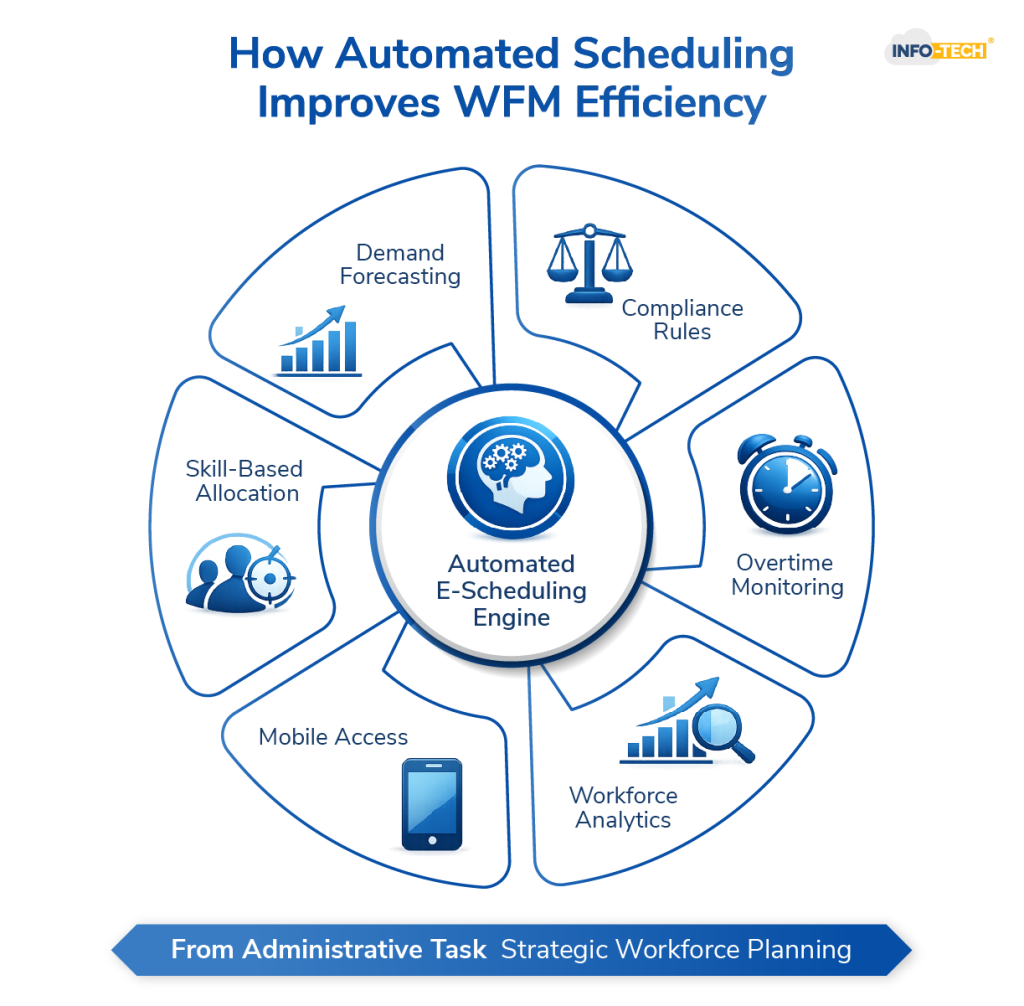
Smart scheduling tech makes workforce more productive by:
- Using rule-based shift templates
- Assigning staff automatically based on availability and skills
- Spreading workload evenly
- Stopping scheduling conflicts
- Changing manpower based on demand forecasts
Manual vs Automated Scheduling Comparison
| Efficiency Factor | Manual Scheduling | E-Scheduling |
| Time Required | High administrative effort | Automated within minutes |
| Human Error | Frequent | Minimal |
| Compliance Monitoring | Manual review | System-enforced |
| Overtime Control | Reactive | Proactive alerts |
| Workforce Visibility | Limited | Real-time dashboard |
Automation changes scheduling from reactive planning to predictive workforce management.
6. Boosting Employee Engagement and Retention
Workforce efficiency links to employee morale. Bad scheduling often causes burnout, unfair shift distribution, and high turnover rates.
E-scheduling boosts worker happiness by:
- Giving out shifts equitably
- Allowing employees to submit availability preferences
- Making it easy to switch shifts
- Creating steady schedules
- Cutting down on sudden changes
In Hong Kong’s tough job market keeping good workers depends on steady schedules. A clear and fair way to plan shifts builds trust among staff.
To learn about benefits for small businesses, check out: Top Benefits of Using E-Scheduling Software Apps for Small Business
E-Scheduling Helps Teams Work Better in These Key Ways
| Workforce Objective | How E-Scheduling Supports It |
| Cost Reduction | Prevents overstaffing and overtime |
| Compliance | Enforces rest day and labour law rules |
| Productivity | Improves shift clarity and accountability |
| Operational Stability | Aligns manpower with demand |
| Scalability | Handles workforce expansion easily |
| Decision-Making | Provides workforce analytics and reports |
Strategic Impact of E-Scheduling on Workforce Management (WFM)
E-scheduling helps to make workforce management more effective by combining manpower planning with business insights. Companies now have active workforce dashboards instead of fixed rosters. These dashboards show:
- Labor cost patterns
- Attendance dependability
- Overtime distribution
- Department productivity
- Staffing shortage risks
This information allows management to shift from reacting to staffing changes to predicting and improving workforce performance.
Workforce management becomes easy to measure, organize, and align with business goals.
Conclusion: E-Scheduling as a Workforce Strategy
In Hong Kong’s 2026 business environment, companies can’t rely on manual oversight alone to manage their workforce well. They need to handle hybrid teams, keep labor costs in check, follow regulations, and keep productivity high all at once.
An E-scheduling Software changes workforce planning into a job that is data-driven, automated, and aligns with company plans. It reduces on inefficiencies, helps follow rules better, works well for remote teams, and gets employees more involved.
For Hong Kong companies that want to grow digital scheduling isn’t just an option anymore, it’s a key part of how modern companies manage their workforce.
Frequently Asked Questions
How does automated scheduling contribute to WFM efficiency?
Automated scheduling improves workforce management efficiency by using predefined rules and demand forecasting to assign shifts accurately. It reduces manual errors, prevents overtime breaches, enforces compliance, balances workloads, and integrates with payroll and attendance systems. This results in improved labour cost control, stronger accountability, and more predictable operational performance.
How does scheduling impact productivity?
Scheduling impacts productivity by determining how effectively manpower is distributed across business operations. When shifts are aligned with demand and clearly communicated, employees perform with greater focus and efficiency. Proper scheduling reduces absenteeism, prevents burnout, improves team coordination, and ensures adequate staffing during peak periods, ultimately enhancing overall output and service quality.
What are the benefits of scheduling?
The benefits of scheduling include reduced labour costs, better compliance with employment regulations, improved workforce transparency, enhanced employee satisfaction, and stronger operational planning. Digital scheduling systems also support hybrid work models, reduce administrative workload, and provide real-time analytics for strategic decision-making.
