Customer Relationship Management (CRM) software is no longer just a sales database or a tool used by large enterprises. In today’s digital-first business environment, CRM systems play a central role in how modern businesses attract leads, manage customer interactions, improve retention, and drive long-term growth. This guide explains what CRM really is, how it works, why businesses use it, and how CRM tools are applied across industries.
What Exactly Is CRM?
CRM, or Customer Relationship Management, refers to a combination of strategies, processes, and technologies that businesses use to manage and analyse interactions with current and potential customers. At its core, CRM helps organisations store customer data in one place, track communication history, manage sales pipelines, and improve customer experiences across every touchpoint.
A CRM system typically records information such as customer contact details, interaction history, purchase behaviour, support tickets, and follow-up activities. Instead of scattered spreadsheets or disconnected tools, CRM creates a single source of truth for customer relationships.
| CRM is a system that helps businesses manage customer data, track interactions, automate sales and marketing activities, and improve customer relationships throughout the entire customer lifecycle. |
Why CRM Is Important for Modern Businesses
Customer expectations have changed significantly. Today’s customers expect faster responses, personalised communication, and consistent experiences across email, phone, social media, and messaging platforms. CRM tools help businesses meet these expectations by providing visibility, structure, and automation.
Modern businesses use CRM to:
- Centralise customer and lead information
- Improve sales follow-ups and conversion rates
- Personalise marketing campaigns
- Enhance customer service and support
- Analyse customer behaviour and trends
- Strengthen long-term customer loyalty
Without a CRM system, teams often work in silos, leading to missed opportunities, inconsistent messaging, and poor customer experiences.
How CRM Software Works
A CRM system collects and organises customer data from multiple channels such as websites, emails, calls, social media, and offline interactions. This data is then structured into customer profiles that teams can access in real time.
CRM platforms typically support:
- Lead management: Capturing, scoring, and assigning leads
- Sales pipeline tracking: Monitoring deals from first contact to closure
- Customer communication tracking: Logging calls, emails, meetings, and notes
- Marketing automation: Sending targeted campaigns based on customer behaviour
- Customer support management: Tracking issues, resolutions, and satisfaction
- Reporting and analytics: Measuring performance and forecasting growth
Automation features reduce manual work, while analytics help managers make data-driven decisions.
What Are the 4 Types of CRM Software?
Based on their primary function, CRM systems are commonly categorised into four main types,
| CRM Type | Description | Primary Use Case |
| Operational CRM | Focuses on automating sales, marketing, and service processes | Lead tracking, sales automation, customer support |
| Analytical CRM | Analyses customer data to identify trends and insights | Customer behaviour analysis, forecasting |
| Collaborative CRM | Improves communication across teams and channels | Shared customer data, omnichannel communication |
| Strategic CRM | Focuses on long-term customer relationships and retention | Customer loyalty, lifecycle management |
Most modern CRM platforms combine elements of all four types rather than fitting into just one category.
How Modern Businesses Use CRM Software to Improve Performance
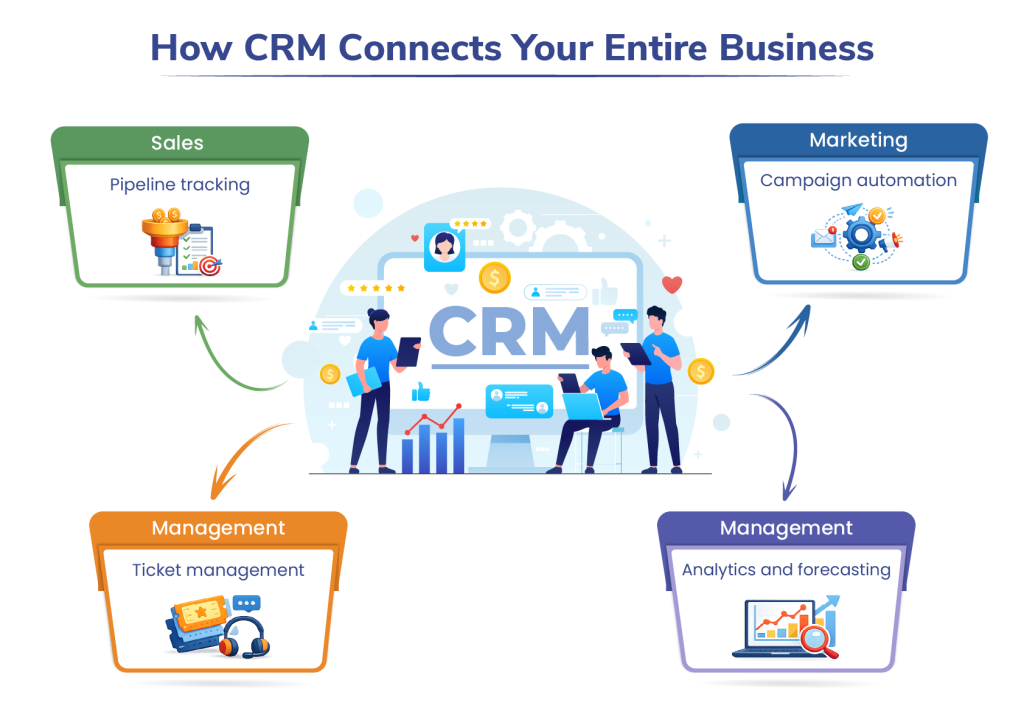
CRM software are tools used across departments, not just sales. Businesses adopt CRM systems to create consistent workflows and better customer experiences.
· Sales Teams
Sales teams use CRM to manage leads, track opportunities, schedule follow-ups, and monitor deal progress. By having visibility into every interaction, sales representatives can engage prospects at the right time with relevant information.
· Marketing Teams
Marketing teams rely on CRM data to segment audiences, personalise campaigns, and measure campaign effectiveness. CRM helps align marketing activities with actual customer behaviour rather than assumptions.
· Customer Support Teams
Support teams use CRM to access customer history, resolve issues faster, and maintain service quality. A complete view of previous interactions improves response accuracy and customer satisfaction.
· Management and Leadership
Managers use CRM dashboards and reports to evaluate performance, identify bottlenecks, and forecast revenue. This visibility helps businesses plan growth strategies more effectively.
What Is an Example of a CRM?
A common example of a CRM system is a platform that allows businesses to capture website leads, assign them to sales representatives, track communication, send follow-up emails, and generate reports on conversion rates.
For example, a CRM might track a customer from the moment they submit an enquiry form, record every email and call, update deal status automatically, and notify teams when action is required.
Is Salesforce a CRM?
Yes, Salesforce is a CRM platform. It is one of the most widely used CRM systems globally and is known for its extensive features covering sales, marketing, customer service, and analytics. Though CRM platforms are available for businesses of all sizes, Salesforce is often used by medium to large enterprises.
Benefits of Using CRM Software
Businesses that implement CRM systems effectively often experience:
- Higher lead conversion rates
- Improved customer retention
- Better team collaboration
- More accurate sales forecasting
- Reduced manual data entry
- Enhanced customer satisfaction
CRM tools also support scalability, allowing businesses to manage growing customer bases without losing visibility or control.
Common CRM Features Explained
| Feature | What It Does | Business Impact |
| Contact Management | Stores customer and lead data | Centralised information |
| Sales Automation | Automates follow-ups and tasks | Faster deal closure |
| Pipeline Management | Visualises sales stages | Better forecasting |
| Marketing Automation | Runs targeted campaigns | Higher engagement |
| Reporting & Analytics | Tracks performance metrics | Data-driven decisions |
Final Thoughts
CRM has evolved from a simple contact database into a strategic business tool. Modern businesses use CRM systems to improve customer experiences, streamline internal processes, and make informed decisions based on real data. Understanding how a CRM Software works and how it is applied helps organisations choose the right approach to building stronger, long-term customer relationships.
Schedule a Demo With Info-Tech Today!
Frequently Asked Questions
What exactly is CRM?
CRM is a system that helps businesses manage customer information, track interactions, automate sales and marketing activities, and improve customer relationships throughout the customer lifecycle.
What are the 4 types of CRM?
The four types of CRM are Operational CRM, Analytical CRM, Collaborative CRM, and Strategic CRM. Most modern CRM platforms combine features from all four categories.
What is an example of a CRM?
An example of a CRM is a system that captures leads, tracks sales conversations, automates follow-ups, and provides reports on customer engagement and sales performance.
Is Salesforce a CRM?
Yes, Salesforce is a CRM platform used by businesses to manage sales, marketing, customer service, and customer data in one system.
