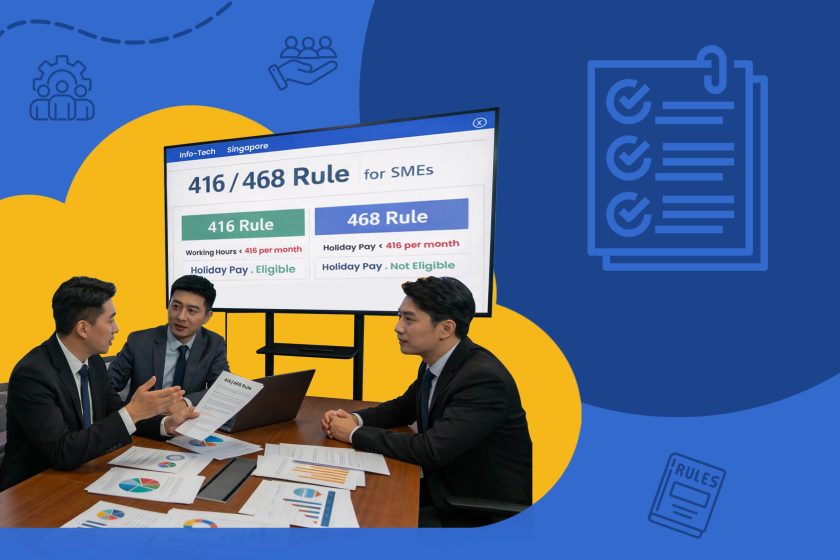
Hong Kong’s shift from the old 4-18 rule to the new 4-68 rule stands out as a key change to the Employment Ordinance that affects SMEs in recent times. This update boosts employee protection by widening who can get statutory benefits — and it changes how companies track work hours, maintain attendance records, and handle payroll.
Businesses that depend on part-time, casual, retail, F&B, logistics, cleaning, or shift-based workers, compliance under the new 468 rule requires tighter monitoring of hours across a 4-week period. SMEs without proper tracking systems might mess up when calculating what employee entitlements such as paid annual leave, statuatory holidays, sickness allowance, and severance payments.
This article explains the meaning of the 416/468 rule, the compliance requirements for SMEs, and how Info-Tech can help industries to manage the transition in a productive and safe manner.
What Is the 468 Rule in Hong Kong?
The 468 rule takes the place of the previous 418 continuous contract requirement under the Employment Ordinance.
The old 418 rule stated: An employee had a “continuous contract” if they worked 18 hours or more per week for 4 weeks in a row.
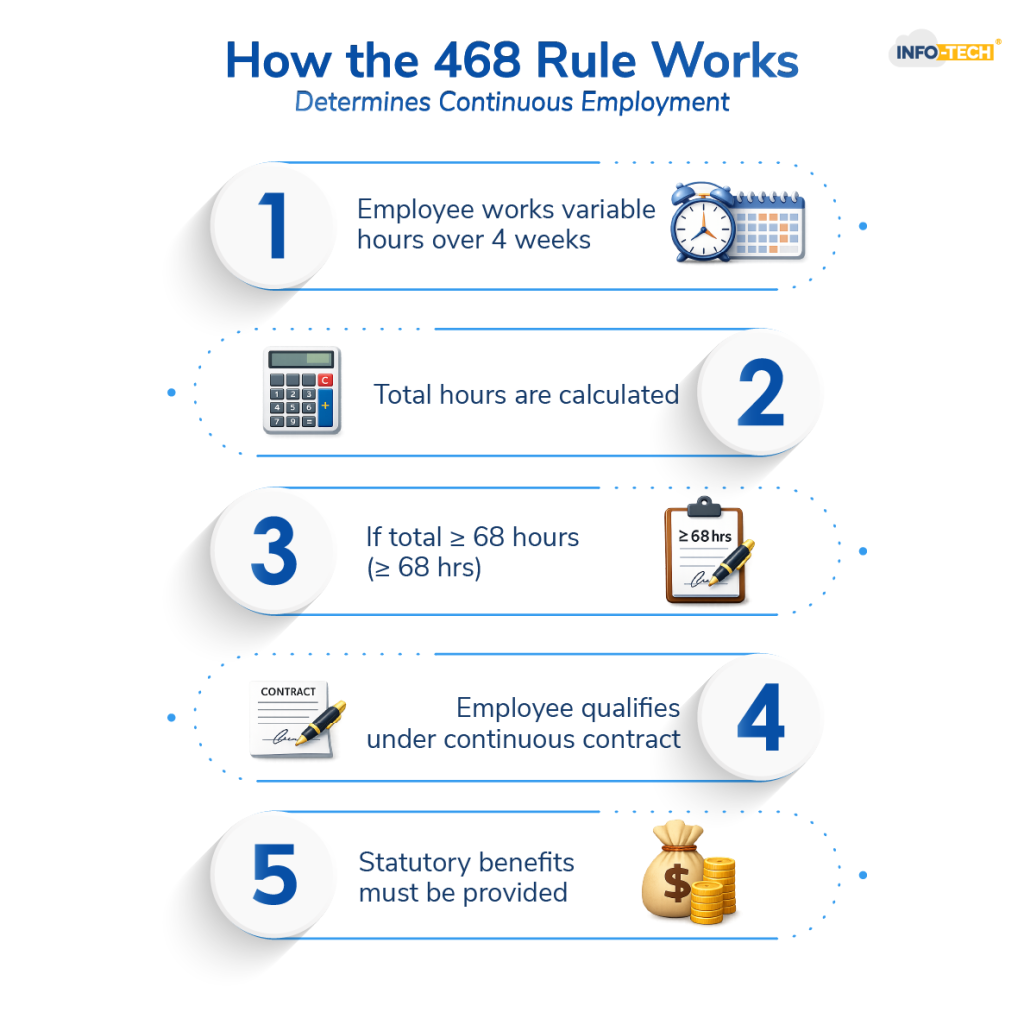
The new 468 rule states: An employee qualifies if they work 68 hours or more in total over 4 weeks in a row.
Why This Change Is Important
The previous weekly limit let companies plan work schedules under 18 hours weekly to skip giving continuous contract benefits.
The new 4-week total method makes it harder to avoid eligibility because:
- Hours add up over 4 weeks
- Weekly distribution isn’t the only thing that counts anymore
- More part-time and irregular workers might now get benefits
- Small businesses need to keep exact records of total hours
418 Rule vs 468 Rule -Compliance Comparison
| Criteria | Old 418 Rule | New 468 Rule |
| Measurement | 18 hours per week | 68 hours over 4 weeks |
| Calculation Style | Weekly threshold | Rolling 4-week total |
| Flexibility | Less flexible | More flexible but broader coverage |
| Employee Coverage | Narrower | Wider |
| Risk of Avoidance | Easier | Harder |
| Record-Keeping Burden | Moderate | Higher |
The main shift in compliance involves the shift to rolling hour calculations. This change means companies need to track attendance instead of estimating manually.
What Benefits Does the 468 Rule Trigger?
When an employee meets the 468 rule requirements, they gain the right to statutory benefits under a continuous contract such as:
- Holidays with pay required by law
- Paid annual leave
- Paid sick leave
- Benefits for new mothers and fathers
- Severance payment
- Long service payment
- Notice period protections
This increases financial obligations for employers, particularly SMEs that operate with flexible manpower arrangements.
What Do Small and Medium-Sized Businesses in Hong Kong Need to Do?
Small and medium-sized businesses must now:
- Keep exact records of how long employees work every 4 weeks
- Know when employees go over 68 hours
- Change eligible employee to ongoing contract status right away
- Apply statutory benefits correctly
- Maintain proper employment and payroll records
- Ensure payroll calculations reflect entitlement changes
If they don’t follow these rules, they might get in trouble:
- Labor Department investigations
- Backdated benefit claims
- Financial penalties
- Damage to reputation
What Share of Hong Kong Businesses Are SMEs?
SMEs make up the core of Hong Kong’s economy.
- Over 98% of Hong Kong businesses are SMEs
- They give jobs to about 45% of the private sector workforce
This shows the 468 rule affects SMEs instead of big companies in fields with flexible or part-time work setups.
How Info-Tech Can Help Industries & SMEs With the 468 Rule
The main issue with the 468 rule relates to operations — not ideas. The law is easy to understand, but hard to manage manually.
This is where Info-Tech’s HRMS and Payroll system plays a key role.
1. Automated Rolling 4-Week Hour Calculation
Instead of HR teams checking timesheets manually, Info-Tech’s system:
- Keeps track of clock-in and clock-out data in real-time
- Adds up hours on its own across rolling 4-week cycles
- Points out employees getting close to the 68-hour limit
- Identifies employees who meet the 468 rule requirements
This cuts down on mistakes and the risk of compliance.
2. Smart Continuous Contract Conversion Logic
When an employee reaches the eligibility threshold:
- The system changes their employment status
- It applies required benefits automatically
- Payroll calculations adjust to match
This helps SMEs avoid missing benefit triggers.
3. Payroll Integration with Statutory Entitlements
The 468 rule makes payroll more complex. Eligible employees now get:
- Pay for statutory holidays
- Annual leave accrual
- Sick leave entitlement
- Severance/ long service computation
Info-Tech integrates:
- Attendance data
- Leave module
- Payroll module
This makes sure that once employees qualify, their benefits are calculated with consistence and compliance.
4. Audit Trail & Labour Inspection Readiness
The Labour Department might require proofs to see how hours are calculated.
Info-Tech gives:
- Full reports on attendance
- Summaries of hours over 4 weeks
- Breakdowns of pay entitlements
- Past records
This helps SMEs be ready for inspections.
5. Industry-Specific Support
Industries that feel the biggest impact include:
- Retail
- F&B
- Logistics
- Construction
- Cleaning services
- Property management
- Security services
These sectors often use shift-based scheduling and part-time employees. Info-Tech’s system helps with:
- Shift planning
- Overtime configuration
- Flexible work patterns
- Multiple employment types
Operational Risk Without System Support
| Risk Area | Without HR System | With Info-Tech |
| Hour Calculation | Manual & error-prone | Automated rolling tracking |
| Benefit Trigger | Easy to miss | System alert & auto-adjust |
| Payroll Compliance | Complex manual setup | Integrated entitlement engine |
| Labour Inspection | Difficult documentation | Exportable reports |
| Financial Risk | Backdated claims | Preventive compliance |
Conclusion:
The change from the 418 rule to the 468 rule goes beyond a simple legal update — it transforms how Hong Kong manages part-time and flexible work.
Small and medium-sized enterprises (SMEs) face a real challenge: they need to put this law into practice, not just understand it.
Tracking manually raises the risk of breaking rules. Using spreadsheets for payroll leads to more mistakes in calculations. Noticing problems late increases financial risks.
Info-Tech helps businesses and SMEs by automating rolling hour calculations by integrating time attendance software and payroll software.
As Hong Kong works to protect employees better, SMEs need to make their own systems stronger with systems as these.
Frequently Asked Questions
What is the 468 rule in Hong Kong?
The 468 rule defines continuous contract employment as working 68 hours or more across 4 weeks in a row. This rule takes the place of the old requirement of 18 hours each week and gives more employees access to legal benefits under the Employment Ordinance.
What is the requirement for SME in Hong Kong?
SMEs need to keep track of employee hours. They must know when workers hit the 68-hour mark. They have to give statutory benefits to workers who qualify. They should keep payroll records. They must follow Employment Ordinance rules. Proper record-keeping and payroll systems are key.
What percentage of Hong Kong is SME?
SMEs make up over 98% of Hong Kong businesses. They employ about 45% of private sector workers. This means changes to labor laws, like the 468 rule, have a big effect on SMEs.
